Monday, 21 May 2018

Firm boundaries and delegation

Interesting new NBER working paper on the relationship between the boundaries of the firm and delegation within the firm.

Come Together: Firm Boundaries and Delegation
Laura Alfaro, Nicholas Bloom, Paola Conconi, Harald Fadinger, Patrick Legros, Andrew Newman, Raffaella Sadun, John Van Reenen
NBER Working Paper No. 24603
Little is known theoretically, and even less empirically, about the relationship between firm boundaries and the allocation of decision rights within firms. We develop a model in which firms choose which suppliers to integrate and whether to delegate decisions to integrated suppliers. We test the predictions of the model using a novel dataset that combines measures of vertical integration and delegation for a large set of firms from many countries and industries. In line with the model's predictions, we obtain three main results: (i) integration and delegation co-vary positively; (ii) producers are more likely to integrate suppliers in input sectors with greater productivity variation (as the option value of integration is greater); and (iii) producers are more likely to integrate suppliers of more important inputs and to delegate decisions to them.

The world really has gone mad!!

Where is Richard Dawkins when you need him?!!
"Darwin's Plagiarisms: The Greatest Fraud in History: Introduction to the Inheritance Model of Creation and the New Evolution Theory"

DEIRDRE ROSE, The Ministry of Second Timothy, Inc.

This is a comparative study which evaluates two theories: The theory of evolution and the theory of creation. The purpose of the study is to facilitate the development of a new branch of science. The status of these two theories are as such: evolution is treated as fact, and creation is not considered science. This paper turns everything on its head. Evolution and creation are handled in a completely new and different way. The human life cycle is redefined, and the order of life processes rearranged. Evolution is now defined as the end of the biological process, not the beginning; and there is a place for creation in this new model using a conceptual metaphor taken from a software engineering paradigm known as object-oriented design. In the process of comparing these two theories, the author unveils the greatest fraud in history -- great because it has gone undetected for two centuries and is still being perpetuated today.
I wonder what biology journal will publish this?

Saturday, 12 May 2018

George Schultz interview

From the Jamie Weinstein Show comes this interview with economist and former Secretary of State George P. Schultz.
Episode 58: George P. Schultz

In the latest episode of The Jamie Weinstein Show, from the Hoover Institution at Stanford University, the 97-year-old former Secretary of State George Schultz opens up on the prospects for peace on the Korean Peninsula, what made President Ronald Reagan a great leader, his career, and much more.

46 copies sold last year.

Today I received a note from my publisher telling me that The Theory of the Firm: An overview of the economic mainstream sold a total of 33 hardback copies and 13 e-book copies in 2017.

Not yet a millionaire, but we are getting there.

Many thanks to the 46 of you out there.

As for the rest of you ...... shame! Shame!!

Friday, 11 May 2018

"A Brief Prehistory of the Theory of the Firm" has been published .......

I think!

I say "I think" because its not like my publisher bothered to tell me the book has been published or anything, but because I just noticed that on their website they are giving May 8, 2018, as the publication date.


So I want you all to start buying!

I've said it before, and I'll say it again,  its a great book, well worth buying for wives, husbands, girlfriends, boyfriends, mistresses, mothers-in-law, toy-boys, family, friends, pets, total strangers you meet in the street or any combinations of the above. Its great for Christmas, holiday reading, birthdays, Mother's day, Father's day, any day.

Honestly, I don't really care why you buy it, what's important is that you do buy it, preferably multiple copies, often!

You can buy here, here, here, here and here.

Tuesday, 8 May 2018

"The Value of Rationally Reconstructing Buchanan's Work" with Richard Wagner

On this episode of the Hayek Program Podcast, Jayme Lemke interviews Richard Wagner on James Buchanan's life and legacy, his experience studying with James Buchanan, and future directions in Virginia political economy.

Saturday, 5 May 2018

Cover design for "A brief prehistory of the theory of the firm"


With a bit of luck it will be out in June, the Routledge webpage is now saying 15 May, but it can be pre-ordered from the publisher right now. Also available for pre-order here and here.

Thomas Sowell on his new book "Discrimination and Disparities"

Peter Robinson at Uncommon Knowledge of the Hoover Institution interviews Thomas Sowell about his new book Discrimination and Disparities.
Rich or poor, most people agree that wealth disparities exist. Thomas Sowell discusses the origins and impacts of those wealth disparities in his new book, Discrimination and Disparities in this episode of Uncommon Knowledge.

Sowell explains his issues with the relatively new legal standard of “disparate impact” and how it disregards the American legal principle of “burden of proof.” Sowell and Robinson discuss how economic outcomes vary greatly across individuals and groups and that concepts like “disparate impact” fail to take into account these variations.

They chat about the impact of nuclear families on the IQs of individuals, as studies have not only shown that children raised by two parents tend to have higher levels of intelligence but also that first-born and single children have even higher intelligence levels than those of younger siblings, indicating that the time and attention given by parents to their children greatly impacts the child’s future more than factors like race, environment, or genetics. Sowell talks about his book in which he wrote extensively about National Merit Scholarship finalists who more often than not were the first-born or only child in a family.

Sowell and Robinson go on to discuss historical instances of discrimination and how those instances affected economic and social issues within families, including discrimination created by housing laws in the Bay Area. They discuss unemployment rates, violence, the welfare state in regards to African American communities, and more.

Friday, 4 May 2018

Adam Smith's discovery of trade gravity

From the latest (Vol. 32 No. 2 Spring 2018) issue of the Journal of Economic Perspectives.

Retrospectives: Adam Smith's Discovery of Trade Gravity
Bruce Elmslie
The gravity equation is a current workhorse of empirical trade theory. It is generally acknowledged that this theory, which relates the extent of trade between countries to their respective sizes, distances, and relative trade barriers, was first developed by Jan Tinbergen in 1962. Acceptance of the gravity model as part of the discipline's core was limited by its scant theoretical foundation for the first 40 years of its existence. This paper finds that a theory of trade gravity was first developed by Adam Smith in The Wealth of Nations. Moreover, it is shown that Smith's statement of a proportional relation between economic size and distance came about as an application of his general theory of differential capital productivity in different economic sectors, and his elaboration of a theory of the gains from trade originated by David Hume. It is further shown that Smith had an explanation of the size of border affects in trade volumes, and a gravity theory of trade restrictions.
Something else for which Smith was ahead of his time.

Sunday, 29 April 2018

Does fractional reserve banking endanger the economy? A debate

On April 16, 2018, two free market economists debated a topic that has long divided libertarians. Fractional reserve banking refers to banks' standard practice of keeping only a portion of their depositors' money on hand and loaning out the rest.

In The Mystery of Banking (1983), the anarcho-capitalist economist Murray Rothbard called fractional reserve banking "a shell game, a Ponzi scheme, a fraud in which fake warehouse receipts are issued and circulate as equivalent to the cash supposedly represented by the receipts." Other libertarian economists, such as Larry White and Steve Horwitz, have argued that the practice is perfectly defensible.

At The Soho Forum, a debate series in New York City that is sponsored by the Reason Foundation, Robert Murphy debated George Selgin over the following resolution: "Fractional Reserve banking poses a threat to the stability of market economies."

Murphy, a research assistant professor with the Free Market Institute at Texas Tech University, argued for the affirmative. He has a Ph.D. in economics from NYU has addiliations with the Institute for Energy Research, the Mises Institute, the Fraser Institute, and the Independent Institute. He has authored hundreds of articles and several books explaining economics to the layperson, including Choice: Cooperation, Enterprise, and Human Action.

Selgin, who opposed the resolution, is a senior fellow and director of the Center for Monetary and Financial Alternatives at the Cato Institute and professor emeritus of economics at the University of Georgia. His research covers a broad range of topics within the field of monetary economics, including monetary history, macroeconomic theory, and the history of monetary thought. He is the author of The Theory of Free Banking, Bank Deregulation and Monetary Order, Less Than Zero: The Case for a Falling Price Level in a Growing Economy, and most recently Good Money: Birmingham Button Makers, the Royal Mint, and the Beginnings of Modern Coinage.

The Soho Forum runs Oxford-style debates, in which the audience votes on the resolution at the beginning and end of the event. The side that gains more ground is victorious. ​In this case, Selgin won by convincing 14 percent of the audience to switch over to his side.

Wednesday, 25 April 2018

Lightships and public goods

From the Economics Detective comes this interview with Vincent Geloso in which he discusses his work with Rosolino Candela on lightships and their importance in economics.

The abstract of their paper reads:
What role does government play in the provision of public goods? Economists have used the lighthouse as an empirical example to illustrate the extent to which the private provision of public goods is possible. This inquiry, however, has neglected the private provision of lightships. We investigate the private operation of the world’s first modern lightship, established in 1731 on the banks of the Thames estuary going in and out of London. First, we show that the Nore lightship was able to operate profitably and without government enforcement in the collection of payment for lighting services. Second, we show how private efforts to build lightships were crowded out by Trinity House, the public authority responsible for the maintaining and establishing lighthouses in England and Wales. By including lightships into the broader lighthouse market, we argue that the provision of lighting services exemplifies not a market failure, but a government failure.

Economists who changed the world

In this audio from the BBC History Extra magazine Linda Yueh discusses her new book, The Great Economists, which explores the work and legacy of some of history’s greatest economic thinkers, and reveals some of the lessons they might offer for us today


An interesting podcast, even if I'm not sure I would entirely agree with some of Yueh's discussion and interpretation of the writers she considers. On the other hand Tyler Cowen is quoted as saying, about the book, "The best place to start to learn about the very greatest economists of all time".

Sunday, 22 April 2018

On C-span Chris Coyne discusses police militarisation and state surveillance

Chris Coyne discussed his book, Tyranny Comes Home: The Domestic Fate of U.S. Militarism on C-span.

Thomas Sowell and Samuel Bowles on Marx

From Thomas Sowell's book "On Classical Economics":


Not everybody judges Marx quite so harshly. In a recent article on "Marx and modern microeconomics", at VoxEU.org, Samuel Bowles argues that Marx has, in fact, contributed something significate to modern microeconomics,
Few economists doubt that Marx flunked economics, a judgement mostly based on his labour theory of value. But this column argues that Marx’s representation of the power relationship between capital and labour in the firm is an essential insight for understanding and improving modern capitalism. Indeed, this insight is incorporated into standard principal–agent models of labour and credit markets.
If the rejection of Marx is primarily about the labour theory of value then would we not also have to flunk Adam Smith? We don't so there must be more than this going on.

Bowles goes on to say,
But Marx chose to study a more challenging question: how could the domination of labour by capital take place in a private, perfectly competitive, economy governed by a liberal state? His answer was based on what seems a strikingly modern principal–agent representation of the employer–employee relationship, arising from a conflict of interest over the amount of labour effort performed that could be resolved in an enforceable contract.
In a sense, Bowles is wrong about the perfectly competitive model. Since this model is one of zero transaction costs there are no firms and the production environment is one without principal-agent problems. Firms and principal-agent issues only arise in a world of positive transaction costs.

Bowles continues by saying,
The final step in Marx’s explanation of domination in a liberal capitalist economy was the process of accumulation and technical change that supports a permanent “reserve army" (ibid) of the unemployed, and which provides the basis of the employer’s labour discipline strategy. The private ownership of the means of production conveys the right to exclude others from use of the firm’s assets, and therefore the owners of firms have a powerful threat to induce workers to supply the effort that could not be secured by contract: work hard, or join the "reserve army".
and
Marx did not explain why the labour contract was incomplete. He assumed this was an uncontroversial empirical observation and used it as the starting point for his economic theory.
Further on Bowles writes,
Just as Mendel underpinned Darwin, a more complete understanding of the incomplete labour contract developed in the twentieth century, but did not overturn Marx’s conclusions. Like Marx, Ronald Coase (1937) stressed the central role of authority in the firm’s contractual relations:

“[N]ote the character of the contract into which a factor enters that is employed within a firm ...[T]he factor ... for certain remuneration agrees to obey the directions of the entrepreneur.”

Indeed, Coase defined the firm by its political structure:

“If a workman moves from department Y to department X, he does not go because of a change in prices but because he is ordered to do so ... the distinguishing mark of the firm is the suppression of the price mechanism.” (ibid)

Herbert Simon provided the first Coasean model of the firm (Simon 1951). He represented the employment contract as an exchange in which the employees transfer control rights over their work tasks to the employer, in return for a wage. Simon stressed the advantage to the employer of this arrangement, because there was unavoidable uncertainty about the tasks that would be required over the course of the contract. Therefore there was a high cost of agreeing to a complete contractual specification of the activities to be performed. Simon did not know that he was modelling exactly the incomplete contract for labour that was the fulcrum of Marx’s economic theory.

Coase or Simon did not directly explain why control rights confer power. As an empirical matter, the firm appears to be a political institution in the sense that some members of the firm routinely give commands with the expectation that they will be obeyed, while others are constrained to follow these commands. If we say that the manager has the right to decide what the worker will do, this means only that the manager has the legitimate authority, not the power to secure compliance. Given that, in a liberal society, the manager is restricted in the kinds of punishment that can be inflicted, and given that the employee is free to leave, it is a puzzle that orders are typically obeyed.

Noticing this, Armen Alchian and Harold Demsetz challenged the Coasean idea that the firm is a mini “command economy”, suggesting that the employment contract is no different in this respect from other contracts:

“The firm ... has no power of fiat, no authority, no disciplinary action any different in the slightest degree from ordinary market contracting between any two people ... Wherein then is the relationship between a grocer and his employee different from that between a grocer and his customer?” (Alchian and Demsetz 1972)

Oliver Hart (1989) responded:

'[T]he reason that an employee is likely to be more responsive to what his employer wants than a grocer is that the employer ... can deprive the employee of the assets he works with and hire another employee to work with these assets, while the customer can only deprive the grocer of his customer and as long as the customer is small, it is presumably not very difficult for the grocer to find another customer."
In a footnote in his book "Firms, Contracts, and Financial Structure" Oliver Hart does note that,
Given its concern with power, the approach proposed in this book has something in common with Marxian theories of the capitalist-worker relationship [...]
But what is not clear is that the development of the incomplete contracts approach to the theory of the firm by Grossman-Hart-Moore owes anything directly to the Marxian theories. The connection between them seems to have been noted after the fact rather than being a driving force.

When discussing the why in the property rights theory firms rather than workers own the nonhuman assets used in production Bengt Holmstrom argues that one reason is that by putting the nonhumans assets under the control of the firm, those running the firm have the maximum power to decide how the firm is organised and run. He notes that Marx would have agreed with this, but Holmstrom disagrees with Marx about the purpose of the firm's concentration of power.


This brings me back to Sowell's point that a contribution depends not just on what is offered but also on what is accepted, and I'm not convinced that Marx's ideas were accepted in the sense that they actually drove the development of the property rights approach to the firm.

So I'm thinking that Sowell, rather than Bowles, is right in his assessment of Marx.

Saturday, 21 April 2018

Abby Hall on the boomerang effect and the militarisation of the US domestic police force

From the Economic Rockstar comes this interview with Abby Hall on the militarisation of the US domestic police force.
Abby Hall is an Assistant Professor in Economics at the University of Tampa in Tampa, Florida and a Research Fellow with the Independent Institute.

She earned her PhD in Economics from George Mason University in Fairfax, Virginia in 2015.

Her broader research interests include Austrian Economics, Political Economy and Public Choice, and Peace Economics, and Institutions and Economic Development.

Her work includes topics surrounding the U.S. military and national defense, including, domestic police militarization, arm sales, weapons as foreign aid, the cost of military mobilization, and the political economy of military technology.

She is currently researching how foreign intervention adversely impacts domestic political, social, and other institutions.

You can find Abby’s research, writings and other information on her website at www.abigailrhall.com.

Friday, 20 April 2018

Are there limits to free speech?

In this audio from the IEA Kate Andrews and Steve Davies discuss the limits to free speech.

Are there limits to free speech - and if so, where should they be set?

In this week’s podcast, Dr Steve Davies, Head of Education at the IEA and News Editor Kate Andrews examine this question.

They take a look at free speech on social media, and at universities, where issues like ‘safe spaces’ and ‘no platforming’ are increasingly controversial.

Yet, the situation is rather more complex than it might seem.

Though, Steve argues, speech should be as free as possible - private institutions and private individuals also have a right to determine what speech they permit on their own property. And public funding of institutions can also complicate matters.

Thursday, 19 April 2018

Dave Rubin interviews Thomas Sowell

Dr. Thomas Sowell (Economist and Author) joins Dave to discuss his new book “Discrimination & Disparities.” They dive into Dr. Sowell’s Marxist past, free speech on college campuses, the role of government, minimum wage laws, his experience as a black conservative, debunking systemic racism, and more.

Saturday, 14 April 2018

CEOs and the family firm

Do family CEOs work harder? The answer seems to be no.

A new paper out in The Review of Financial Studies (31(5) 2018: 1605–53) looks at:

Managing the Family Firm: Evidence from CEOs at Work
Oriana Bandiera, Renata Lemos, Andrea Prat and Raffaella Sadun
We build a comparable and bottom-up measure of CEO labor supply for 1,114 CEOs and investigate whether family and professional CEOs differ along this dimension. Family CEOs work 9% fewer hours relative to professional CEOs. CEO hours worked are positively correlated with firm performance and account for 18% of the performance gap between family and professional CEOs. We study the sources of the differences in labor supply across family and professional CEOs by exploiting firm and industry heterogeneity and variation in meteorological and sports events. Evidence suggests that family CEOs value or can pursue leisure activities more so than professional CEOs
Makes sense to me. One reason for founding and running a family firm would be the flexibility it gives to pursue things other than work. Even if this comes at a financial cost.

Friday, 13 April 2018

The determinants of productivity

From VoxEU.org comes this short video in which Professor John Van Reenen discusses the impact of management on productivity.
Competition can foster productivity by eliminating unproductive firms out of the market. John Van Reenen discusses the impact of management quality on productivity - and how this is influenced by market forces. This video was published by the CORE Project.

How much should we care about inequality?

In this podcast from the IEA, Dr Steve Davies, Head of Education at the IEA, and News Editor Kate Andrews examine this question.
How much should we worry about inequality?

With ongoing Corbyn-mania in UK politics, and the popularity of books like Thomas Piketty’s Capital in The 21st Century, it seems like we’ve never cared more about promoting equality of outcome. But is our concern justified? Is economic disparity a characteristic of modernity - or a persistent feature of human civilization?

As Steve explains, inequality - and public concern about it - has been a feature of societies around the world, for centuries.

They also challenge the commonly held view that inequality has been rising in recent years - and examine whether people care more about some kinds of inequity than others.

Thursday, 12 April 2018

Monopsony models and the minimum wage

In an interesting and provocative article at Bloomberg Noah Smith discusses recent empirical research that suggests that higher minimum wages do not have negative effects on employment. Smith argues that this work discredits the standard competitive model of labour markets He favours a model of monopsonistic markets where employers have market power. Smith writes,
Together with the evidence on minimum wage, this new evidence suggests that the competitive supply-and-demand model of labor markets is fundamentally broken. If employers have the power to set wages, then not just minimum wage, but other labor market policies -- for example, union-friendly laws -- can be expected to help workers a lot more than popular introductory economics textbooks now predict.

Textbook writers and instructors should respond by changing the baseline model of labor markets that gets taught in class. Students ought to start with a model of market power, in which a few companies set wages below levels found in a competitive market unless prevented from doing so. That model is about as easy to work with as the traditional supply-and-demand setup, but matches the data much better.
Perhaps not too surprisingly not all economists agree with him.

At the EconLog blog, Scott Sumner says he is not convinced by Smith's arguments. Sumner writes,
1. The replication crisis in the sciences, and the social sciences.

2. Conservative studies seem able to explain the very low levels of hours worked in Europe much better than progressive studies. And the studies that Smith cites are progressive studies. That doesn't mean progressives are wrong, but until progressives are able to explain Europe's labor market, I'll continue to have trouble taking them seriously.

3. Most importantly, Smith overlooks the fact that empirical research is just as unfriendly to the monopsony model of labor markets as it is to the competitive model of labor markets. AFAIK, almost all the empirical studies of the minimum wage suggest that higher minimum wages do not come out of profits, but rather are passed on in terms of higher prices. That result is 100% consistent with the competitive model of labor markets, and inconsistent with the monopsony model (which suggests that if employment doesn't fall then product prices do not rise.)

Thus empirical studies show that when a minimum wage increase forces grocery stores to pay higher wages, they pass on the increased costs in the form of higher prices.

Now I suppose that progressives could argue that demand curves don't slope downwards, and that the higher prices will not reduce sales. In that case, a higher minimum wage need not reduce employment. But as soon as you abandon downward sloping demand curves, you are faced with other dilemmas. For instance, why should progressives oppose "regressive" consumption taxes? After all, if demand curves don't slope downwards, then higher prices would not reduce consumption. And since living standards depend on consumption, regressive taxes would not reduce the living standards of the poor.

Of course we know that demand curves do slope downwards, and we know that regressive taxes tend to adversely impact the poor. What we need to figure out is whether higher minimum wages raise prices and reduce sales. So far, the empirical evidence suggests that they do.

To summarize, the empirical evidence on the effect on minimum wages on employment is mixed. The empirical evidence on the effect of minimum wages on prices is pretty clear---it raises prices. That means that, on balance, the empirical evidence is more supportive of the competitive labor market model than the monopsony model.

This doesn't mean that firms have no monopsony power---they almost certainly have some. The question is how much, and whether the short and long run labor demand elasticities differ.
At the Cafe Hayek blog, Don Boudreaux says,
First, as Jim Buchanan, Donald Dewey, and other economists have pointed out, as long as demand curves for outputs are downward sloping, monopsony power is only a necessary and not a sufficient condition for minimum wages not to reduce the employment prospects of low-skilled workers. For minimum wages not to reduce these workers’ employment prospects, employers with monopsony power must also have monopoly power (and not just the sort of such ‘power’ as is identified in models of monopolistic competition). That is, these employers must have the ability to keep the prices of the outputs they sell above average total costs. If they do not have this ability, then there are no excess profits, or rents, out of which the higher labor costs can be paid.

Second, empirical studies typically fail to examine all the many ways that employers and employees can adjust to minimum wages. The list of such possible adjustments other than reduced hours of employment includes reductions in formal fringe benefits (such as paid leave), reductions in informal fringe benefits (such as workplace safety higher than what is minimally required by legislation), and changes in the nature of the jobs such that workers are worked harder in order to produce more output per hour. To the extent that adjustments such as these occur, minimum-wage-induced reductions in employment will be fewer or lower, but the standard textbook model really still holds.

Third, because in the U.S. the national minimum wage has been in place now for 80 years and is at no risk of being repealed, employers have long ago adjusted their business plans – their capital-labor ratios – to the existence of minimum wages. And employers expect occasional minimum wage increases. Therefore, even the finest and most carefully controlled empirical study of a minimum-wage hike today will not detect the employment-reducing effects of the long-standing expectation of minimum-wage hikes. Because employers have already adjusted to the reality of minimum wages – and to the reality of minimum wages being increased from time to time – any study that correctly finds little or no negative employment effect from this or that minimum-wage hike today nevertheless misses the negative employment effects of minimum wages overall.

Fourth, about monopsony power: it’s more difficult to detect than, ironically, standard textbook models suggest. Suppose that Acme, Inc., competes for workers by offering unusually attractive fringe benefits and work conditions. And suppose that Acme, Inc., has a differential advantage over other employers at supplying to its workers such non-wage amenities, or that for Acme, Inc., the marginal cost of attracting X number of workers by supplying non-wage amenities is lower than is its cost of attracting X number of workers by increasing the wages it pays. Under such conditions, Acme, Inc., gains the power to lower its workers wages by some amount without losing all, or perhaps even any, of its workers.

An empirical study of this firm would conclude that Acme, Inc., has monopsony power. But this conclusion would be incorrect, for the ‘power’ that Acme, Inc., is detected to have over its workers is ‘power’ that Acme, Inc., purchased from its workers – workers who voluntarily agreed to Acme’s employment terms.

Put differently, if (as is not unreasonable for many employers) Acme, Inc., values a steady workforce, it can purchase – with non-wage amenities – from its workers the ability to cut their wages without their quitting. The textbook-bound economist, seeing only the reduced wages and no mass exodus of workers from Acme, leaps confidently to the conclusion that Acme has monopsony power. Yet clearly, in this example, that conclusion would be mistaken.
On Twitter, David Neumark, an economist who has spent many years studying minimum wages, wrote,
Thus, while Smith's position is certainly interesting, and could apply in some particular labour markets, I think he needs to do more to convince many of his fellow economists that the markets with monopsony power should be the standard model for labour markets.

Tuesday, 10 April 2018

The 10-Year baby window that is the key to the women’s pay gap

An interesting new twist on the effects of children on the pay gap between men and women. It has long been argued that having kids is one reason for the gap in pay between men and women but now a new study suggests that women who have their first child before 25 or after 35 eventually close the salary divide with their husbands. It's the years in between that are most problematic.

Claire Cain Miller discusses the new research at the Upshot blog at the New York Times. Millar writes,
Today, married couples in the United States are likely to have similar educational and career backgrounds. So while the typical husband still earns more than his wife, spouses have increasingly similar incomes. But that changes once their first child arrives.

Immediately after the first birth, the pay gap between spouses doubles, according to a recent study — entirely driven by a drop in the mother’s pay. Men’s wages keep rising. The same pattern shows up in a variety of research.
The new twist in the research is to point out that,
When women have their first child between age 25 and 35, their pay never recovers, relative to that of their husbands. Yet women who have their first baby either before 25 or after 35 — before their careers get started or once they’re established — eventually close the pay gap with their husbands.
Why?
One explanation is that the modern economy requires time in the office and long, rigid hours across a variety of jobs — yet pay gaps are smallest when workers have some control over when and where work gets done. In high-earning jobs, hours have grown longer and people are expected to be available almost around the clock. In low-earning jobs, hours have become much less predictable, so it can be hard for working parents to arrange child care.

The issue, in general, comes down to time. Children require a lot of it, especially in the years before they start school, and mothers spend disproportionately more time than fathers on child care and related responsibilities. This seems to be particularly problematic for women building their careers, when they might have to work hardest and prove themselves most, and less so for women who have already established some seniority or who have not yet started careers.
So it may not just be having kids that matters for the pay gap, but when you have them matters as well.

Sunday, 8 April 2018

Early gender gaps among university graduates

In a recent article at VoxEU.org Marco Francesconi and Matthias Parey write on Early gender gaps among university graduates. A summary of their column reads
Women earning substantially less than men in all advanced economies, despite the considerable progress women have made in labour markets worldwide. This column explores the recent experience of university graduates in Germany soon after their graduation. Men and women enter college in roughly equal numbers, but more women complete their degrees. Women enter university with slightly better high school grades but leave with slightly lower marks. Immediately after university completion, male and female full-timers work very similar number of hours, but men earn more across the pay distribution. The single most important proximate factor that explains the gap is field of study at university (Emphasis added).
Francesconi and Parey go on to say,
Several channels may be at work behind our results. One could be related to human capital considerations. The importance of field of study indicates the relevance of pre-market choices. These also interact with subsequent market decisions (such as occupational choice) at the very beginning of professional careers (e.g. Liu 2016). In turn, such choices could be partly driven by gender differences in preferences (e.g. risk aversion and time discounting), self-confidence, competitiveness, earnings expectations, and valuation of non-wage benefits (e.g. Buser et al. 2014, Mas and Pallais 2017, Reuben et al. 2017). Another possible channel is related to statistical discrimination against women, based on employers’ difficulty in distinguishing more from less career-oriented women (e.g. Gayle and Golan 2012, Reuben et al. 2014). These mechanisms deserve more attention in future research.

Collecting data: Domesday Book edition

When commenting on the data collection methods used to compile the Domesday Book in 1086 McDonald (1998: 1) writes,
As with many modern surveys, the data were compiled from answers to questionnaires; but, unlike most contemporary censuses, answers were not given in confidence but were scrutinised publicly in local courts. In many ways the checks on the accuracy of the data were more stringent than those for currently complied official data.
Maybe the old technology is still the best technology. StatsNZ could learn a thing or two from the William the Conqueror and the Normans.

Ref.:
  • McDonald, John (1998). Production Efficiency in Domesday England, 1086, London: Routledge.

Wednesday, 4 April 2018

Noah Smith on immigration economics

From David Beckworth’s podcast series, Macro Musings comes this audio of an interview with Noah Smith on Immigration Economics.
Noah Smith is a Bloomberg View columnist and formerly a professor of finance at Stony Brook University. Today, he joins the show to talk about his journey into the economics blogosphere and some of his recent work on immigration into the United States. . David and Noah discuss some of the false narratives surrounding immigration as well as the impact of immigration on native workers’ wages, labor markets, and the broader economy.

Tuesday, 3 April 2018

Trade and minimum wages in general equilibrium

An new NBER working paper on the effects of minimum wages on trade.

Trade and Minimum Wages in General Equilibrium: Theory and Evidence
Xue Bai, Arpita Chatterjee, Kala Krishna, Hong Ma
NBER Working Paper No. 24456
Do minimum wages affect economic outcomes beyond low-skill employment? This paper develops a new model with heterogeneous firms under perfect competition in a Heckscher-Ohlin setting to show that a binding minimum wage raises product prices, encourages substitution away from labor, and creates unemployment. It reduces output and exports of the labor intensive good, despite higher prices and, less obviously, selection in the labor (capital) intensive sector becomes stricter (weaker). Exploiting rich regional variation in minimum wages across Chinese prefectures and using Chinese Customs data matched with firm level production data, we find robust evidence in support of causal effects of minimum wage consistent with our theoretical predictions.

Saturday, 31 March 2018

Worst. Tariffs. Ever. The Smoot-Hawley tariff

From NPR's Plant Money comes this audio involving Doug Irwin on the Worst. Tariffs. Ever.
About a month ago, President Trump walked up to a podium, and followed through on a big campaign promise. He said the U.S. was going to impose a 25-percent tariff on foreign steel, and a 10-percent tariff on foreign aluminum.

#833: Worst. Tariffs. Ever.
His announcement was met with a lot of face-palming from economists. Why? Because we've been down this road before.

Today on the show, we learn how the Smoot-Hawley tariff act of 1930 helped tank the world economy. And why it means that today, 90 years later, President Trump has the power to start what many people say is a trade war.

Wednesday, 28 March 2018

Sam Warburton on the economic effects of the America's Cup

Warburton was interviewed on Radio New Zealand's Morning Report.
The Auckland venue for New Zealand's Americas Cup defence was agreed this week and will go to Auckland Council for sign off tomorrow. Yesterday, when I spoke to the Economic Development Minister David Parker about the sign off for the America's Cup village he was talking up the economic dividend the required investment of over two hundred million dollars of public money will yield. New Zealand Initiative economist Sam Warburton heard our interview yesterday and is unconvinced. He's in our Wellington studio.

Thursday, 22 March 2018

Trade wars and the Smoot-Hawley tariff: what really happened?

From Trade Talks comes this interview with Douglas Irwin on the Smoot-Hawley tariff, its effects and its relevance for today:
Soumaya Keynes of The Economist and PIIE Senior Fellow Chad P. Bown speak with Douglas Irwin (PIIE and Dartmouth College) about popular misconceptions around the Smoot-Hawley Tariff Act of 1930, the Great Depression, and the global trade wars that ensued. They discuss how the gold standard, tariffs, quotas, exchange controls, imperial preferences, and bartering all fit into the dismantling of the international trading system in the 1930s. They then put President Trump's trade policy actions in perspective.

Thursday, 15 March 2018

The gender wage gap is really a child care penalty

A couple of graphs make this point.


and


These graphs come from a column at Vox. The column is A stunning chart shows the true cause of the gender wage gap by Sarah Kliff.

Kliff discusses research by Henrik Kleven, an economist at Princeton University. Kliff writes
His [Kleven] study is among a growing body of research that suggests what we often think of as a gender pay gap is more accurately discussed as a childbearing pay gap or motherhood penalty.

Childless women have earnings that are quite similar to men’s salaries, while mothers experience a significant wage gap.
Kliff continues,
A 2009 study led by University of Chicago’s Marianne Bertrand echoes that conclusion. It examined the earnings of thousands of business school graduates. It found that women earned an average salary of $115,000 right out of graduate school, while men earned $130,000. Men also worked, on average, a few more weekly hours and had a bit more prior experience as they entered the workforce.

But nine years into their careers, women saw their salaries rise to an average of $250,000 — while men’s salaries averaged out at $400,000. Men were earning 60 percent more than women.

“The one thing which is not changing is the effect of children,” Kleven says of the gender wage gap. “This is very persistent and constant. All the other sources are declining, but the child effect sticks, and that ends up taking over as the key driver.”

Historical drivers of the gender wage gap — a lack of education among women, for example — are disappearing. But the professional penalty women face for having children is stubborn, and it isn’t going anywhere.
Such findings are consistent with the findings of yet other researchers such as Claudia Goldin. Goldin (Professor of Economics at Harvard University) has written,
These findings provide more nuance in explaining why the gap widens with age and why it is greater for women with children. Whatever changes have already taken place in American society, the duty of caring for children — and for other family members — still weighs more heavily on women. And if you thought that moving to a more family-friendly nation would eliminate the gap, think again. In several nations, including Sweden and Denmark, a “motherhood penalty” in earnings exists, even though these nations have generous family policies, including paid family leave and subsidized child care.

Such considerations bring us to a very sensitive area: domestic arrangements at home, especially among couples with children. These are personal questions. In theory, gender earnings equality is possible when both parents take off the same amount of time and enjoy the same flexibility at work.
So the answer to the pay gap may be in the choices made within the home. And that makes it difficult for public policy to deal with.

Wednesday, 14 March 2018

The senselessness of trade wars

The senselessness of trade wars is well expressed in an adage attributed to the British economist Joan Robinson:
Even if your trading partner dumps rocks into his harbour to obstruct arriving cargo ships, you do not make yourself better off by dumping rocks into your own harbour.
Alas in a trade war as soon as one country dumps rocks in its harbours everybody starts dumping rock in theirs, and everybody losses. So no matter what some twitting presidents seem to think, trade wars are not easy and nobody wins them. They really are a lose/lose proposition.

Economist's views on tariffs

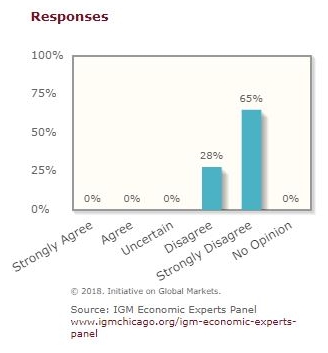
The IGM Economic Experts Panel at the University of Chicago's Booth School of Business were asked their views on the statement
Imposing new US tariffs on steel and aluminum will improve Americans’ welfare.

And yes 100% of those who answered either disagreed or strongly disagreed with the statement (Three people did not answer, if you want to know why the numbers only add up to 93%.)

Yes 100%.

In short, economists do sometimes agree, and one thing they agree on is that tariffs are bad.

Politicians take note.

Wednesday, 7 March 2018

Steve Hanke on Trump's protectionist policies

From RNZ's Morning Report comes this discussion with Professor Steve Hanke of Trump's recent protectionist policies.
China has responded to Donald Trump's threat of a trade war with a warning that it won't sit idly by if its economy is hurt by new protectionist policies by the United States. The US President openly talked of starting a trade war late last week when he announced stiff new tariffs on imported steel and aluminium. He tweeted: "Trade wars are good, and easy to win. Example, when we are down $100 billion with a certain country and they get cute, don't trade anymore-we win big. It's easy!" Mr Trump also threatened to impose a tax on EU-made cars. His comments have drawn strong criticism from the International Monetary Fund, the World Trade Organisation and trading partners including Canada and China. Professor of Applied Economics at Baltimore's Johns Hopkins University and a former senior economic advisor to President Ronald Reagan, Steve Hanke, has described Mr Trump's proposed new tariffs as a "horror".

Monday, 5 March 2018

Milton Friedman on the protection of the US steel industry

Protection is, unfortunately, in the news again. The US may be starting a trade war by imposing steep tariffs on imported steel and aluminum. Milton Freedman explains why protection is a bad idea.

Saturday, 3 March 2018

Brink Lindsey and Steven Teles on rent-seeking and the twin melees afflicting the U.S. economy

From David Beckworth’s podcast series, Macro Musings comes this audio of an interview with Brink Lindsey and Steven Teles on Rent-Seeking and the Twin Melees Afflicting the U.S. Economy
Lindsey and Teles join Beckworth to discuss their new book, "The Captured Economy: How the Powerful Enrich Themselves, Slow Down Growth, and Increase Inequality." For Lindsey and Teles, slow growth and inequality are “twin melees” that are harming the economy. They discuss some of the issues at the root of these problems, including excessive occupational licensing laws and zoning regulations, as well as some ways to fix them.

Friday, 2 March 2018

Competition and search in internet markets for used books

A couple of years back in an email about my book The Theory of the Firm: An overview of the economic mainstream I wrote:
The other thing I don't get is the price dispersion. $180 at the book depository but $355 at the NZ based Mighty Ape website. Isn't this internet thingy supposed to do away with price dispersion by making information more available?
Well it appears, for one market at least, I'm wrong about the effects of the internet on price dispersion. The advent of the online market for used books has increased price dispersion in online relative to offline sales. It has also raised prices but improved welfare for both sellers and buyers, especially where unusual titles are concerned.

The following is by Morgan Foy and comes from the March 2018 issue of the NBER Digest.

Online shopping has become ubiquitous. Has this raised profits or raised consumer welfare? Both, at least in one market. In Match Quality, Search, and the Internet Market for Used Books (NBER Working Paper No. 24197), Glenn Ellison and Sara Fisher Ellison find that digitization of the used book market increased prices and price dispersion in online relative to offline sales. Profits on used books were 80 percent higher online, but the higher prices facing buyers were more than compensated for by the expanded access to hard-to-find volumes that the internet provided.

By visiting physical bookstores in 2009, the researchers created a sample of 335 books. They then collected online prices for the same titles in 2009 and in 2012. Contrary to what many might have expected, they found that the used books were typically more expensive online than in brick-and-mortar stores: the average online price was about $20, while the equivalent offline price was roughly $11. There was also a lot of dispersion in the online prices. The accompanying figure provides one illustration: online prices for what the researchers call "standard" titles — fairly obscure, typically out-of-print books — were much higher and much more dispersed than offline prices.

Normally, price dispersion is interpreted as a sign that markets are not working well, and higher prices are interpreted as evidence that buyers are worse off. But the researchers note that neither is necessarily true. They point out two avenues through which the rise of internet markets and the associated availability of online search technologies could affect prices. Better search technologies could lead to buyers being better informed, inducing sellers to reduce prices in an attempt to win business. This is the "competition effect." Online markets could also make it easier to find products with unique value to a specific buyer — an increase in match quality. For example, a buyer searching for a specific 15-year-old used book may have a hard time tracking it down at a brick-and-mortar store. The internet facilitates search, thereby increasing demand for unusual titles. The latter effect benefits buyers, but will also tend to increase prices. Knowing only that average prices are higher online does not permit any conclusion about whether this is because the "competition effect" was small or the "match effect" was strong enough to offset increased competitive pressure.

To explore the hypothesis that both effects are important in the used book market, the researchers examine how price levels and price dispersion vary across different types of used books and over time, looking for patterns that would be expected if match quality effects were important. They find several different pieces of evidence consistent with the view that price increases reflect match-quality improvements and that search technologies have made consumers more informed. For example, they looked separately at what they termed "local interest" books — books about the history or geography of a specific area or otherwise associated with that area. They noted that brick-and-mortar bookstores in those areas had high prices for these books relative to online sellers, consistent with the notion that brick-and-mortar stores were already providing about the best match quality one could imagine for such books.

Whether buyers' welfare is higher or lower in the online market depends on the strength of the match quality effect. To address this issue, the researchers develop a model of competing sellers of unusual items, and infer important quantities like the rates at which potential consumers are arriving and the magnitudes of potential gains from selling to well-matched consumers. They use the price data they collected as well as sales data they inferred from disappearances of specific online listings in sequential data gatherings. The researchers estimate that per-bookseller revenues were 80 percent higher online than offline in 2009, due to both higher prices and a higher likelihood of sale. And, more strikingly, they estimate that the consumer welfare gains are not only positive, but roughly equally as large. In the case of the used book market, they therefore conclude that moving online has been a win-win process for sellers and buyers. More generally, the paper suggests that match quality may be an important and underappreciated source of welfare gains from online sales.

Wednesday, 28 February 2018

Venezuela's inflation rate

An interesting graph from Steve Hanke showing Venezuela's rate of inflation. Not a pretty sight.


Friday, 23 February 2018

Trump the worst president?

A question asked by Jason Brennan at the Bleeding Heart Libertarians blog.
Trump is the worst president ever?

So say an important subset of political scientists:
That was the finding of the 2018 Presidents & Executive Politics Presidential Greatness Survey, released Monday by professors Brandon Rottinghaus of the University of Houston and Justin S. Vaughn of Boise State University. The survey results, ranking American presidents from best to worst, were based on responses from 170 current and recent members of the Presidents and Executive Politics section of the American Political Science Association.
Brennan hoped that the political scientists involved could put aside their current partisan resentment and answer this question somewhat objectively, but it appears not. Brennan writes,
Sure, I despise Trump too. But the worst president ever?

Worse than McKinley and Teddy Roosevelt, who oversaw the straightforwardly evil US-Phillipine war, which left 200,000 civilians dead? Worse than Hoover, who greatly exacerbated the Great Depression with stupid interventions? Worse than Wilson, who put Americans needlessly into the unjustifiable Great War and then so screwed up post-war negotiations that World War II became close to inevitable? Worse than the long string of presidents who oversaw the extermination, forced relocation, and genocide of Native Americans? Worse than FDR, who put Japanese Americans in concentration camps? Worse than Nixon, who had to resign because of his corruption? Worse than Bill Clinton, whose sanctions of Iraq may have killed around 500,000 Iraqi children? (Note, that this number is controversial. HT: Dan Bier) Worse than Ulysses Grant, whose administration had a cartoonish degree of corruption? Worse than Polk, who unjustly seized massive amounts of land from Mexico?
Thus we do have to ask if a more objective ranking would put Trump at the bottom. Or at least they should be a lot clearer as to the criteria used to determine "worst".

On the link between US pay and productivity

From VoxEU.org comes a column by Anna Stansbury and Lawrence Summers on the relationship between pay and productivity in the US.
Since 1973, there has been divergence between labour productivity and the typical worker’s pay in the US as productivity has continued to grow strongly and growth in average compensation has slowed substantially. This column explores the causes and implications of this trend. Productivity growth appears to have continued to push workers’ wages up, with other factors to blame for the divergence. The evidence casts doubt on the idea that rapid technological progress is the primary driver here, suggesting rather that institutional and structural factors are to blame.
Stansbury and Summers writes,
Our contribution to these debates is, we believe, to demonstrate that productivity growth still matters substantially for middle income Americans. If productivity accelerates for reasons relating to technology or to policy, the likely impact will be increased pay growth for the typical worker.

We can use our estimates to calculate a rough counterfactual. If the ratio of the mean to median worker's hourly compensation in 2016 had been the same as it was in 1973, and mean compensation remained at its 2016 level, the median worker's pay would have been around 33% higher. If the ratio of labour productivity to mean compensation in 2016 had been the same as it was in 1973 (i.e. the labour share had not fallen), the average and median worker would both have had 4-8% more hourly compensation all else constant. Assuming our estimated relationship between compensation and productivity holds, if productivity growth had been as fast over 1973-2016 as it was over 1949-1973, median and mean compensation would have been around 41% higher in 2016, holding other factors constant.

This suggests that the potential effect of raising productivity growth on the average American’s pay may be as great as the effect of policies to reverse trends in income inequality – and that a continued productivity slowdown should be a major concern for those hoping for increases in real compensation for middle income workers.

This does not mean that policy should ignore questions of redistribution or labour market intervention – the evidence of the past four decades demonstrates that productivity growth alone is not necessarily enough to raise real incomes substantially, particularly in the face of strong downward pressures on pay. However it does mean that policy should not focus on these issues to the exclusion of productivity growth – strategies that focus both on productivity growth and on policies to promote inclusion are likely to have the greatest impact on the living standards of middle-income Americans.
So productivity still matters for pay with increases in productivity increases resulting in pay increases.

Tuesday, 13 February 2018

Economic costs of hosting the Olympics and World Cup

In this audio economist Andrew Zimbalist, a professor of economics at Smith College and the author of Circus Maximus: The Economic Gamble Behind Hosting the Olympics and the World Cup (Brookings Institution Press, 2015), reveals the real economic costs and benefits of hosting mega-sporting events and discusses the prospects of FIFA following the corruption scandal.

Wednesday, 7 February 2018

You know your economy is in trouble when ......

you get paid in eggs!

A Wall Street Journal report on the situation in Venezuela tells us
One U.S. dollar now fetches around 236,000 bolivars on the street, around 80 times what it bought at the start of last year. Five years ago, that could buy a small apartment; now it barely covers an appetizer at lunch.

“The authorities have lost control, they can’t stop creating bolivars even if they wanted to,” said Omar Zambrano, a former economist for the Inter-American Development Bank. “This ends in two ways: Either we adopt the dollar or we go back to bartering.”

That’s what Marina Fernandez, a professor of architecture at a Caracas university, has done, finding out that some people will take, yes, the humble egg. When she didn’t have enough cash to pay for parking, she handed over two eggs. Her university department, short of cash, paid a computer programmer with a carton of eggs.

Ms. Fernandez said onions or bananas, for some reason, just won’t do. “If you’re going to receive food as payment, the people want it to at least be a protein,” she said. “The egg is perfect.”
Barter is really, really inefficient but sometimes its the best you can do. Hyperinflation means money is worthless so people go back to barter. Or they start to use a new medium of exchange. But eggs seem a bit too breakable to be a totally satisfactory replacement for money.

Such is the crazy, sad world of Venezuela today.

Saturday, 3 February 2018

Islam and economic performance: historical and contemporary links

An interesting looking article by Timur Kuran forthcoming in the Journal of  Economic Literature goes sunder the above title.

The abstract reads,
This essay critically evaluates the analytic literature concerned with causal connections between Islam and economic performance. It focuses on works since 1997, when this literature was last surveyed. Among the findings are the following: Ramadan fasting by pregnant women harms prenatal development; Islamic charities mainly benefit the middle class; Islam affects educational outcomes less through Islamic schooling than through structural factors that handicap learning as a whole; Islamic finance hardly affects Muslim financial behavior; and low generalized trust depresses Muslim trade. The last feature reflects the Muslim world’s delay in transitioning from personal to impersonal exchange. The delay resulted from the persistent simplicity of the private enterprises formed under Islamic law. Weak property rights reinforced the private sector’s stagnation by driving capital out of commerce and into rigid waqfs. Waqfs limited economic development through their inflexibility and democratization by restraining the development of civil society. Parts of the Muslim world conquered by Arab armies are especially undemocratic, which suggests that early Islamic institutions, including slave-based armies, were particularly critical to the persistence of authoritarian patterns of governance. States have contributed themselves to the persistence of authoritarianism by treating Islam as an instrument of governance. As the world started to industrialize, non-Muslim subjects of Muslim-governed states pulled ahead of their Muslim neighbors by exercising the choice of law they enjoyed under Islamic law in favor of a Western legal system.
In short, institutions matter. They help explain why around 1000 years ago the Islamic world was the most advanced area of the world but slowly they lost that advantage as Western countries developed more growth friendly institutions.

The case for 'touting'

From the IEA comes this audio on scalping and the value of it.
The resale of tickets has been around for as long as humans have charged entry to events. Evidence of ticket 'touting' goes all the way back to Ancient Rome.

In the 21st century though, it's becoming an increasingly controversial practice.

Companies like Viagogo, Seatwave and Stubhub now offer tickets to otherwise hard-to-reach events - but, often, at a hefty price.

Today on our podcast, IEA News Editor Kate Andrews interviews Dr Steve Davies, the IEA's Head of Education and author of new report 'Digital Resellers: The case for Secondary Ticket Markets'.

Steve believes that ticket resale is simply one aspect of the 'Sharing Economy' which enables voluntary transactions to take place between willing buyers and sellers. Those who aim to resell tickets for a profit, Steve argues, are themselves taking on considerable risk.

We examine the economics, and the morality, of ticket resale, and take a look at the way artists like Ed Sheeran, Taylor Swift and Madonna use market mechanisms to sell their products.


The discussion by Steve Davies is based on a new paper he has written for the IEA entitled Digital Resellers: The Case for Secondary Ticket Markets. A summary of the report is:
  • The reselling of tickets for events has a long history, dating back at least to Roman times.
  • Such secondary markets in tickets are no different from other kinds of secondary market, and serve the same purpose: to correct flaws in the initial primary market.
  • In recent years, new technology has led to the appearance of many new players in this market. Most of these are facilitating platforms rather than being directly involved as buyers or sellers of tickets.
  • This market is fragmented with no firm having more than a very small part of the total secondary ticket market. That market itself is still small compared to the general market for tickets but is growing rapidly.
  • This has led to many calls for limitations on ticket resale and, in particular, for what are effectively price caps.
  • These arguments are wrongheaded and would disrupt an effective market. The more fundamental or underlying objections to secondary ticket markets are simply rejections of the principles of trade and a refusal to accept the reality of scarcity.
  • It is the primary market for tickets that is dysfunctional. The secondary market is correcting its defects, so that tickets get into the hands of those who value them most. We are probably moving towards a new kind of market in tickets.

Friday, 2 February 2018

Zingales on Hart

At the 2018 ASSA meeting Luigi Zingales delivered a lecture honouring Oliver Hart, co-winner of the 2016 Nobel Prize for economics.

In part Zingales said,
In the 1970s, this question [the make-or-buy decision] started to receive attention in the so-called transaction-cost literature. The key contributions during that period were Alchian and Demsetz (1972), Williamson (1971 and 1975) and Klein, Crawford, and Alchian (1978). Alchian and Demsetz identified the unique nature of the firm in the team production and the associated cost of metering individual contributions to the collective output. This is the line of research the other Nobelist we are celebrating today, Bengt Holmstrhom, pursued. By contrast, Williamson and Klein, Crawford, and Alchian focused on the role of the firm in mitigating the cost of opportunism. Imagine a printing press owned and operated by someone different from the publisher. If alternative users have much lower valuations for the services of the printing press than the current user, there exists an appropriable quasi rent. Klein, Crawford, and Alchian conclude that “if an asset has a substantial portion of quasi rent which is strongly dependent upon some other particular asset, both assets will tend to be owned by one party.” They are quick to add that “this advantage of joint specialized assets … must of course be weighed against the cost of administering a broader range of assets within the firm.”

In these few lines there are all the key insights of the pre-Hart literature, but also all its limitations, among them:
  1. If integration has to do with joint specialized physical assets, to what extent does an employee “belong” to a firm? What makes an employee different from an independent contractor? Are Alchian and Demsetz right in claiming that “I can fire my grocer by stopping purchases from him”? (Not just a theoretical discussion, think about Uber.)
  2. What aspect of integration produces all these benefits? Why can’t they be achieved through long-term contracting?
  3. Can you have too much integration? Are the limits of the firm determined only by “administrative or bureaucratic costs” or can integration also be detrimental? Does communism not work only because of bureaucracy?
It is these limitations that Hart along with Sandy Grossman and John Moore sort to deal with.
The main source of these limitations is the lack of a formal model, the lack of a language to express clearly the driving forces. The work by Grossman and Hart and Hart and Moore answers all these questions.
  1. First of all, the emphasis moves from the specialization of physical assets to that of human capital. In this way, they are able to explain how a firm has “power” over its employees. When my colleague “fires” United Airlines, he does not deprive United employees of any asset they have specialized to. When the CEO of United fires a pilot, he does deprive her of assets (physical and organizational) she specialized to. A pilot (especially an older pilot) is more valuable inside United than outside of it. Thus, a specialized pilot will continue being employed by United. Nevertheless, United’s ability to control the pilot’s quasi-rent is the source of the power an employer has over its employee.
One of the many merits of Oliver’s contribution is to have brought back the concept of power inside economics. This is a concept pervasive in political science and sociology, and pervasive in Marxian economics, but completely absent from neoclassical economics. In fact, Oliver’s view of the firm is very reminiscent of the Marxian view, but where Marx sees exploitation, Oliver sees an efficient allocation.
  1. Having identified the source of power, Grossman and Hart help us understand why this can only stem from integration.
To cut this Gordian knot, Oliver and Sandy introduce a new concept: the “residual right of control,” i.e. the right to dispose of an asset in all the situations that have not been explicitly contracted out. They identify this residual right of control with ownership.
With regard to ownership being identified with residual rights of control it is interesting to note a footnote in the Grossman and Hart paper,
Richard Posner, whose opinion on the legal definition of ownership we solicited, has referred us to the following statement by Oliver Wendell Holmes (1881/1946, p. 246): "But what are the rights of ownership? They are substantially the same as those incident to possession. Within the limits prescribed by policy, the owner is allowed to exercise his natural powers over the subject-matter uninterfered with, and is more or less protected in excluding other people from such interference. The owner is allowed to exclude all, and is accountable to no one but him."
Zingales continues,
Of course, this opens the question of why some contingencies cannot be written in a contract, a question Oliver has spent a great deal of time on and a question I will return to momentarily, if time allows.

But if we accept that contracts are incomplete, then it is easy to see how the residual right of control can be used opportunistically to reduce the share of the surplus of other parties in a relationship.

This insight applies in all walks of life. For example, I just launched an economic podcast. In preparation for this event, I have spent a lot of time and effort. Much of this effort is specific to this particular podcast. So how does ownership of this podcast, which currently is in the hands of the University of Chicago, affect my incentives? Not only I, but most of the economics profession would not have a framework to think about this important question without the work of Oliver.

This is an inconsequential example, but it illustrates how rich the Grossman-Hart-Moore framework is in addressing a fundamental problem of entrepreneurs: how to allocate cash flow and control rights to maximize the commitment of all the key players to a new venture. I regularly teach this in my entrepreneurship class and I would not know how to frame this problem if it wasn’t for Grossman-Hart-Moore.

Note that—unlike Williamson—their results do not rely on friction in the renegotiation process. Grossman-Hart-Moore assume costless renegotiation ex post. Still, ownership (and the residual right of control it confers) matters because of the way it affects the out-of-equilibrium outside option and, through it, the share of ex post surplus each party appropriates. This share impacts not only the distribution of the quasi-rents, but also the ex ante incentives to make firm-specific investments, and thus efficiency itself.
  1. Having identified how integration works, Grossman-Hart-Moore can also explain the costs of integration. Since control is zero-sum, control given to party A takes control away from party B, reducing B’s incentives to make firm-specific investments. Thus, integrating a supplier reduces the incentive of the supplier to invest in his human capital. As a result, who should own what, the famous question of the boundaries of the firm, finds a very simple answer: it depends upon the relative importance of the contribution to the various parties.
Hart's work has affected many areas of economics.
Before Oliver finance scholars had focused on the allocation of cash flow rights. Yet, it was difficult to explain why capital structure mattered purely on the basis of cash flow right allocation, since all the effects produced by financing decisions could be undone by contracts. It is thanks to Oliver’s model that researchers could start thinking in terms of control allocation: capital structure mattered because it provides a contingent way to allocate control. In other words, Grossman-Hart-Moore changed the way corporate finance theory was done and did so in an irreversible way.

Unlike poets who only allow people to express their feelings, economic theorists also provide a framework for empirical researchers to study new phenomena. The work of Kaplan and Stromberg (2003) on the allocation of control rights in venture capital contracts or the work of Michael Roberts and Amir Sufi on debt covenants would be inconceivable without Oliver’s work.

Similarly, it is very difficult to understand corporate governance without Oliver’s contribution. The famous survey by Shleifer and Vishny (1997) that incorporates Oliver’s work on control rights, changed the literature on corporate governance. Without Oliver’s seminal contribution that change would not have taken place.

While finance has been the main area of application of ICT, there is hardly a field in economics that has not been impacted. One of the first applications, pioneered by Oliver himself with Tirole, is to industrial organization. ICT provides a way to rationalize the famous market foreclosure argument. Another natural area of application is to the costs and benefits of public ownership. This also was pioneered by Oliver with Shleifer and Vishny in the famous prison paper. It is also not surprising that ICT has been applied to internal organization (Aghion) and to international trade (Antras). Finally, issues of power and contract incompleteness are essential to political economy, and in fact in recent years we have seen a proliferation of applications in this direction.

There are a lot of other areas where Oliver’s theory of incomplete contracts can be profitably applied, as family economics. There is hardly a contract that is more incomplete than marriage and one where relationship specific investments (like the children) are more important.

Oliver is a role model not only for his intellectual achievements, but also for the integrity with which he has achieved them. For more than a decade he argues back and forth with two other Nobelist Erik Maskin and Jean Tirole abut the foundations of his theory of incomplete contract. In spite of the enormous amount of reputation he had a stake, he had the courage to recognize that Maskin and Tirole’s critiques were valid and he went back to the drawing board and produced with John Moore a new foundation of incomplete contracts [this work is the 'reference point' approach to incomplete contracts].
The incomplete contracts theory has been one of the major theoretical advances in economics in the last 30 years and Hart's role in it fully justifies the award of the Nobel Prize.

Thursday, 1 February 2018

Latest Blogwatch column

My Blogwatch column from the latest issue (Issue 60, December 2017) of the NZAE magazine Asymmetric Information.

Are Google and Facebook monopolies?

On this episode of The Big Question, Chicago Booth’s Luigi Zingales and George Mason University’s Tyler Cowen discuss the market power wielded by digital platforms, and how to promote competition.


This is a very interesting discussion of an important issue. Well worth the half hour needed to watch it.

Venezuela officially enters the not-REAL-socialism stage

Writing at the IEA blog Kristian Niemietz says,
Now we’ve finally learned what went wrong in Venezuela: it wasn’t real socialism. At the World Economic Forum summit in Davos, Shadow Chancellor John McDonnell explained:

“It’s not that the issue is socialism vs capitalism. […]

All the objectives of Chavez […] would have been successful if they had mobilised the oil resources to actually invest in the long term […]

I think in Venezuela they took a wrong turn, a not particularly effective path, not a socialist path.”

McDonnell is in good company. Quite a few prominent figures on the left, such as Noam Chomsky and Slavoj Žižek, are now explicitly disputing Venezuela’s socialist credentials.
So Venezuela joins the very long list of countries that at some point are held up as role models of "socialism" by Western intellectuals but which, once they start failing, became an embarrassment to the socialist cause. When the problems become so obvious and undeniable socialism in these countries ceases to be ‘real’ socialism, which of course why it fails. Or so we are told. But every socialist country seems to suffer the same fate. Why is this I wonder.

"A Brief Prehistory of the Theory of the Firm". Update

The book is now in the hands of a production editor. The publication of the hardback version is due in June 2018.

You can, however, pre-order it here (Routledge) or here (Amazon) or here (Book Depository). Prices seem to vary a lot so check multiple sellers to see who gives the best deal.

Wednesday, 31 January 2018

Eric Crampton on "Recipe for Disaster"

On Radio New Zealand Nights, Dr Eric Crampton of the New Zealand Initiative talks through the findings of the Initiative's latest report, Recipe for Disaster, about the government's policy preparedness for the next big earthquake.

Thursday, 25 January 2018

The effects of rent controls

The example of Mumbai, India.

In this video, from Marginal Revolution University, Alex Tabarrok discusses the effects of rent controls on the supply of rental properties in Mumbai.

Tuesday, 23 January 2018

Distracting from poverty relief: the Oxfam report debunked

In this podcast, IEA Research Director Dr Jamie Whyte is interviewed by Kate Andrews and they discuss Oxfam's latest report on global inequality, arguing that the poverty-relief charity is attacking the economic system that has lead to the greatest fall in absolute poverty the world has ever seen.