In January 2007, the Dutch Ministry of Agriculture issued a report in which it took 29 pages to explain "quality standards for onions," complete with 43 photographs.Isn't government wonderful.
Friday, 11 July 2008
Dutch fact of the day
From The Bayesian Heresy we learn this Dutch Fact of the Day


The Mafia's economic role
Last month I commented on a column at VoxEU.org by Daron Acemoglu, Davide Ticchi and Andrea Vindigni which offers A theory of military dictatorships. In this piece Acemoglu, Ticchi and Vindigni explain
Our basic analytic framework is simple. Two groups, the elite rich and the citizens, are in conflict under democratic and nondemocratic regimes. Under democracy, redistributive policies benefit the citizens at the expense of the rich. Under oligarchy the rich keep their wealth but have to create (and pay) a repressive military to maintain them in power. A repressive military is a double-edged sword, however; once created, it has the option of attempting to establish a military dictatorship, seizing power from democratic or oligarchic governments. This is the political moral hazard problem at the core of our framework.Now I see that Richard Baldwin has posted at the Free Exchange blog on The Mafia's economic role. Baldwin says
I write about it here since the logic fits perfectly with the theory that Daron Acemoglu and co-authors recently wrote up in a Vox column. The model they put forward explains the three-way "dance" between the rich, the citizens and the military under democratic and non-democratic regimes.He continues
In fin-de-siècle Sicily, the landed aristocracy (0.1% of the population) owned 99% of the land. Very nice for them, of course, but the peasants were continually revolting. In the absence of a strong state, the aristocracy turned to the Mafia. The exhibit explained that the aristocracy would lease land to Mafia bosses who would lease it out to medium level Mafioso who would in turn set up share-cropping contracts with the peasants. The Mafia used force and terror to make sure the peasants worked hard and didn't cause trouble. Revolts were repressed violently, often with the help of the army and/or police. No wonder so many Sicilians left for America.
Supply or demand?
From The Wisdom of Whores blog.
 Elizabeth Pisani writes
 Elizabeth Pisani writes
My rudimentary understanding of economics suggests the scarcer commodity should sell for more.The difference in price could also be explained by there being differences in demand. Or most likely a bit of both.
Thursday, 10 July 2008
4th Annual Condliffe Memorial Lecture
Anyone in Christchurch on the night of July 15th should attend the 4th Annual Condliffe Memorial Lecture. The lecture will be held at 6:00-7:00pm in the Coppertop, Level 2, of the Commerce Building at the University of Canterbury. A pdf map of the University is here. The Commerce Building is at I4.
The lecture is hosted each year by Department of Economics here at Canterbury in honour of John Bell Condliffe, who became the first Professor of Economics at Canterbury University College in 1921. This year the lecture will be given by
Joel Slemrod's lecture makes the point that when it comes to tax policy, what looks good on paper often fails in the real world. Economists studying tax issues have devoted a lot of time to "optimal" tax policy but have spent comparatively little time squaring those policies with such real-world concerns as tax avoidance and policy implementability. No government can announce a tax system and then either rely on taxpayers' sense of duty to remit what is owed or expect that individual behavior will not change as consequence. For example, the nine percentage-point gap between the top New Zealand marginal income tax rate and the corporate tax rate might induce firms to retain earnings rather than distribute dividends and further induce individuals to incorporate to lower their tax liability. This talk discusses recent developments that link traditional economic reasoning with how policy can be implemented. The insights gained then are applied to current tax policy issues such as the proper design of consumption taxes, business taxes, and how to "draw lines" in tax law.
Please RSVP to virginia.mckenzie@canterbury.ac.nz.
(HT: Eric Crampton)
The lecture is hosted each year by Department of Economics here at Canterbury in honour of John Bell Condliffe, who became the first Professor of Economics at Canterbury University College in 1921. This year the lecture will be given by
Professor Joel Slemrod
on the topic of
Tax Policy in the Real World
Joel Slemrod's lecture makes the point that when it comes to tax policy, what looks good on paper often fails in the real world. Economists studying tax issues have devoted a lot of time to "optimal" tax policy but have spent comparatively little time squaring those policies with such real-world concerns as tax avoidance and policy implementability. No government can announce a tax system and then either rely on taxpayers' sense of duty to remit what is owed or expect that individual behavior will not change as consequence. For example, the nine percentage-point gap between the top New Zealand marginal income tax rate and the corporate tax rate might induce firms to retain earnings rather than distribute dividends and further induce individuals to incorporate to lower their tax liability. This talk discusses recent developments that link traditional economic reasoning with how policy can be implemented. The insights gained then are applied to current tax policy issues such as the proper design of consumption taxes, business taxes, and how to "draw lines" in tax law.
Please RSVP to virginia.mckenzie@canterbury.ac.nz.
(HT: Eric Crampton)
Are you serious Mr. Stiglitz?
Over at the Austrian Economists blog Peter Boettke asks Are you serious Mr. Stiglitz? Given what Stiglitz wrote I'm hoping, no.
Boettke quotes Lord Skidelsky on Stiglitz. Skidelsky wrote
Boettke quotes Lord Skidelsky on Stiglitz. Skidelsky wrote
he lacks the eloquence, urgency, and passion of the preacher, while he has too often abandoned the rigor of the scientist.Boettke writes
Stiglitz is also scandalously sloppy as a public intellectual.The main target of Boettke's attack is Stiglitz's recent op-ed piece that claims that Neo-Liberalism has reached its end. Boettke writes
In this op-ed he actually claims that neo-liberalism was never supported by economic theory nor economic history. Instead, neo-liberalism was a political doctrine supported by interest groups. So much for the Nobel winning ideas of Hayek, Friedman, Stigler, Buchanan, Coase, Becker, Lucas and V. Smith. So much for the empirical evidence on the governmental causes of the Great Depression, the historical record on economic performance and political tryanny under communism, the failed efforts at development planning in Africa and Latin America, etc.Boettke continues by pointing out
Not only does he dismiss in this latest op-ed an entire stream of intellectual history in economics from Adam Smith through J. B. Say and Bastiat to Mises and Hayek, and the other thinkers I named, but he is trying to dismiss without any data analysis the positive benefits of market reforms for much of the world over the past 30 years. Again, lets remember this is just an op-ed -- though of course one written by a thinker that is internationally recognized and respected as an economist. Thankfully, Andrei Shleifer's "The Age of Milton Friedman" will be published in the Journal of Economic Literature, and it contains data and argument that demonstrates the empirical record is contrary to what Stiglitz suggests so professional opinion has yet to be completely swayed over to Stiglitz's opinion on theory and evidence.While I would hope Stiglitz is not serious, I fear he really is and, sadly, people will listen to him because of who he is. The battle for classical liberalism goes on.
Norberg on Klein on Tiananmen Square
Naomi Klein's recent book, The Shock Doctrine, alleges that the Tiananmen Square crackdown was intended to crush opposition to pro-market reforms. Johan Norberg argues that in fact it caused liberalization to stall for years.
Wednesday, 9 July 2008
Most lucrative university majors
This from Fobes.com. A list of the most lucrative majors in university. Based on US data. But interesting nonetheless. Engineering is the big winner, but quantitative, analytical skills look in big demand.
1. Computer EngineeringThe Forbes article explains
2. Economics
3. Electrical Engineering
4. Computer Science
5. Mechanical Engineering
6. Finance
7. Mathematics
8. Civil Engineering
To gauge the most lucrative majors, we turned to PayScale.com, which collects real-time salary information from 10 million users. They looked at 20 popular majors where most of the graduates go into the private sector; thus, some popular majors, like education and social work, were excluded.
We looked at median salaries to wipe out outliers at the top and bottom ends of the scale. Salaries included bonuses and commissions, but excluded any stock compensation. All jobs were included in the data, not just those specific to the major. Anyone who acquired an advanced degree was excluded from the study.
UK government on biofuels
This news report from the BBC claims that the UK is to slow expansion of biofuels amid fears they raise food prices and harm the environment. The news item refers to a UK government commissioned report, the Gallagher Report, saying that
It predicts that current policies could see grain prices in the EU rise by 15%, sugar by 7% and oil seed by 50%.Yet Labour and the Greens want to push ahead with mandatory biofuel uptake here in New Zealand. The BBC item also says that
The review estimates that an extra 10.7 million people in India could find themselves in poverty, while countries such as Kenya, Malawi and Bangladesh could see hundreds of thousands affected. (Emphasis added)
Its report calls for biofuels to be introduced more slowly than planned until controls are in place to prevent higher food prices and land being switched from forests or agriculture.Controls??? How exactly are controls going to prevent higher food prices? We have seen the effects of biofuel subsidies and mandates, higher food prices, greater poverty and greater environmental damage. How would even more controls effect any of this? Do the writers of the Gallagher Report really think that even greater controls in the UK will affect the world price of food? It is government controls that have caused the mess in the first place, removing these controls - the subsidies and the mandates - is the answer, not adding even more controls on. That will, most likely, just make the problem worse.
Corporate fraud
In another short interview from VoxEU.org Luigi Zingales, Robert C. McCormack Professor of Entrepreneurship and Finance, University of Chicago, talks to Romesh Vaitilingam about corporate fraud in large US companies and the role of various actors in exposing fraud, including the Securities and Exchange Commission, auditors, employees, industry regulators and the media.
Tuesday, 8 July 2008
Do gun bans work?
Steven D. Levitt at the Freakonomics blog says No More D.C. Gun Ban? No Big Deal. Levitt makes the point that the primary reason for having bans is to lower crime but then he asks Do they actually work? He writes
There is remarkably little academic research that directly answers this question, but there is some indirect evidence.He starts by looking at the direct evidence, such as it is. Levitt writes
The fundamental difficulty is that you have one law change. So you can compare D.C. before and after. Or you can try to find a control group and compare D.C. before and after to that control group before and after (in what economists call a differences-in-differences analysis).But what about the indirect evidence? Here Levitt explains
The problem here is that crime rates are volatile and it really matters what control group you pick. I would argue that the most sensible control groups are other large, crime-ridden cities like Baltimore or St. Louis. When you use those cities as controls, the gun ban doesn’t seem to work.
What about indirect evidence? In Chicago we have a gun ban and 80 percent of homicides are done with guns. The best I could find about the share of homicides done with guns in D.C. is from a blog post which claims 80 percent in D.C. as well. Nationwide that number is 67.9 percent, according to the F.B.I.Here I think Levitt has a point, gun bans don't effect those who use guns in crime. People who want a gun for criminal purposes don't care if there is a gun band, since they are not likely to use the legal market for getting a gun. If you are a drug dealer, and want a gun, you get it illegally so a gun ban doesn't effect you.
Based on those numbers, it is hard for someone to argue with a straight face that the gun ban is doing its job. (And it is not that D.C. and Chicago have unusually low overall homicide rates either.)
It seems to me that these citywide gun bans are as ineffective as many other gun policies are for reducing gun crime. It is extremely difficult to legislate or regulate guns when there is an active black market and a huge stock of existing guns. When the people who value guns the most are the ones who use them in the drug trade, there is next to nothing you can do to keep the guns out of their hands.
Wilkinson v. Hanson
At Bloggingheads.tv Will Wilkinson talks with Robin Hanson about bias, disagreement, status-seeking, and the romance of cryonics.
This week on EconTalk
This week EconTalk host Russ Roberts talks with Michael Munger of Duke University about Munger's recent trip to Chile and the changes Chile has made to Santiago's bus system. What was once a private decentralized system with differing levels of quality and price has been transformed into a system of uniform quality designed from the top down. How has the new system fared? Not particularly well according to Munger. Commuting times are up and the President of Chile has apologized to the Chilean people for the failures of the new system. Munger talks about why such changes take place and why they persist even when they seem inferior to the original system that was replaced.
Culture and institutions
What's missing?
Below is China's new 10 yuan ($1.5; £0.75) note, but what is missing? The back has an ancient Greek statue of a discus thrower on it.


Benefits of globalisation
Here is a link to a short (12 minutes 31 seconds) interview, from VoxEU.org, with Anne Krueger of Johns Hopkins University, in which Krueger talks to Romesh Vaitilingam about trade liberalisation and its impact on economic growth and living standards, particularly in developing countries.
Monday, 7 July 2008
Petrol prices are high?
Many people seems to think that petrol prices are "high" right now. In his posting, And You Thought Today's Gas Prices Were High?, Mark Perry at the CARPE DIEM blog gives, for the US at least, a little perspective on today's "high prices".
Consider this graph from the Perry posting: The graph shows the cost of 1,000 gallons of petrol in the US as a percent of US per-capita disposable income, annually back to 1929.
Perry writes
Consider this graph from the Perry posting:
The graph shows the cost of 1,000 gallons of petrol in the US as a percent of US per-capita disposable income, annually back to 1929.Perry writes
The retail price of gas was only about 20 cents a gallon from 1929 to 1946, but annual per-capita disposable income in the 1930s was only about about $400-500 (about $6,000 in today's dollars), so that a 1,000 gallons of gas cost as much as almost 49% of per-capita disposable income in 1933, and averaged more than 38% from 1929-1939~!Is there any reason to think that the same basic patten wouldn't show up in the data for New Zealand?
To reach those levels today, gas would have to sell for between $14 and $17 per gallon!
Interesting blog bits
- Gray Becker comments on The Graying of College Faculties.
- Richard Posner comments on Aging Professors
- Mieke Reuser and Hendrik P. van Dalen discuss Aid and AIDS: A delicate cocktail.
Development assistance targeting health overwhelmingly concentrates on HIV/AIDS. This column argues that that focus neglects critical demographic issues and degrades health infrastructure, particularly in Sub-Saharan Africa. The prime rule for AIDS aid should be “First, do no harm”.
- Will Wilkinson comments on Two Views on Luck and Redistribution.
- Jonathan Guryan, Erik Hurst and Melissa S. Kearney discuss Time with the kids: Parental education and child care
Everyone knows that educated people earn more, smoke less, are less likely to be obese and live longer. This column discusses recent research that shows more educated parents also spend more time with their kids – a result ripe with implications for the inter-generational persistence of income and health inequalities.
- The Visible Hand in Economics asks What is inflation?
- The Times has an article on the fact that Scientists reopen debate over GM food.
So this is what marketing courses teach
This from Greg Mankiw's blog:
The Snarkiest url of All TimeOne comment at the West at Yale blog notes
I recently ran across this:
http://www.safetyschool.org/
In the good ol' days www.gradeinflation.org redirected to Harvard's site, too.
The centipede game and chess players
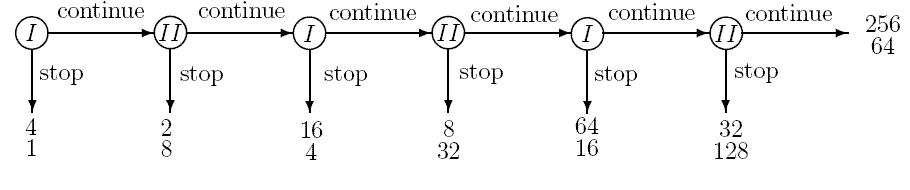 The game above is what game theorists call the centipede game:
One instance of the centipede game is as follows. A pile of $4 and a pile of $1 are lying on a table. Player I has two options, either to “stop” or to “continue.” If he stops, the game ends and he gets $4 while Player II gets the remaining dollar. If he continues, the two piles are doubled, to $8 and $2, and Player II is faced with a similar decision: either to take the larger pile ($8), thus ending the game and leaving the smaller pile ($2) for Player I, or to let the piles double again and let Player I decide. The game continues for at most six periods. If by then neither of the players have stopped, Player I gets $256 and Player II gets $64. Figure 1 depicts this situation. Although this game offers both players a very profitable opportunity, all standard game theoretic solution concepts predict that Player I will stop at the first opportunity, getting just $4.The Uncover Economist reports on research by Ignacio Palacios-Huerta and Oscar Volij where skilled chess players were asked to play the game. With reference to Player I stopping at the first opportunity Tim Harford writes
... nobody really thinks this is the way players would behave in reality. The optimal strategy seems sociopathic; isn’t it worth playing cooperatively in the hope that the other player will do the same thing.I not sure I get the "optimal strategy seems sociopathic" bit. The optimal strategy is the optimal strategy, counterintuitive it may be, but I don't see it as "sociopathic". Harford continues
They found that the chess players were far more likely to play optimally; grandmasters always played optimally and took the $4. Hyper-rationality can be a disadvantage. (Or did the experiment discover something else: that chess grandmasters are sociopaths?) Palacios-Huerta and Volij don’t speculate. My guess is that they have discovered something about the rationality rather than morality or empathy of chess players, but I may be wrong.I'm not sure I would go for the "Hyper-rationality can be a disadvantage" bit either. If Player I doesn't go for the $4, then he will get $2 and $4 is better than $2.
Sunday, 6 July 2008
More on Adam Smith's statue


The statue shows Smith in later life. Behind him is a ploughshare which reminds us of an economic doctrine from which Smith made great advances – the physiocrat doctrine that all wealth stemmed ultimately from agriculture. To his front is a beehive, a symbol of industry, topped by a globe on which Smith rests his hand - made invisible by his academic gown.


The two pictures below come from the blog posting A magnificent tribute by Madsen Pirie at the Adam Smith Institute blog. It was the Adam Smith Institute who organized the creation and funding of statue. The statue was funded by private donations.

 Press coverage of the statue by the BBC is here, by the Scotsman here, the International Herald Tribune here, The Financial Times here, The Herald here, Bloomberg News here, The Courier here, the Galloway Gazette here, The Press Association here, The Times here and the Financial Post here.
Subscribe to:
Posts (Atom)