Abby Hall is an Assistant Professor in Economics at the University of Tampa in Tampa, Florida and a Research Fellow with the Independent Institute.
She earned her PhD in Economics from George Mason University in Fairfax, Virginia in 2015.
Her broader research interests include Austrian Economics, Political Economy and Public Choice, and Peace Economics, and Institutions and Economic Development.
Her work includes topics surrounding the U.S. military and national defense, including, domestic police militarization, arm sales, weapons as foreign aid, the cost of military mobilization, and the political economy of military technology.
She is currently researching how foreign intervention adversely impacts domestic political, social, and other institutions.
You can find Abby’s research, writings and other information on her website at www.abigailrhall.com.
Saturday, 21 April 2018
Abby Hall on the boomerang effect and the militarisation of the US domestic police force
From the Economic Rockstar comes this interview with Abby Hall on the militarisation of the US domestic police force.


Friday, 20 April 2018
Are there limits to free speech?
In this audio from the IEA Kate Andrews and Steve Davies discuss the limits to free speech.
Are there limits to free speech - and if so, where should they be set?
In this week’s podcast, Dr Steve Davies, Head of Education at the IEA and News Editor Kate Andrews examine this question.
They take a look at free speech on social media, and at universities, where issues like ‘safe spaces’ and ‘no platforming’ are increasingly controversial.
Yet, the situation is rather more complex than it might seem.
Though, Steve argues, speech should be as free as possible - private institutions and private individuals also have a right to determine what speech they permit on their own property. And public funding of institutions can also complicate matters.
Thursday, 19 April 2018
Dave Rubin interviews Thomas Sowell
Dr. Thomas Sowell (Economist and Author) joins Dave to discuss his new book “Discrimination & Disparities.” They dive into Dr. Sowell’s Marxist past, free speech on college campuses, the role of government, minimum wage laws, his experience as a black conservative, debunking systemic racism, and more.
Saturday, 14 April 2018
CEOs and the family firm
Do family CEOs work harder? The answer seems to be no.
A new paper out in The Review of Financial Studies (31(5) 2018: 1605–53) looks at:
Managing the Family Firm: Evidence from CEOs at Work
Oriana Bandiera, Renata Lemos, Andrea Prat and Raffaella Sadun
A new paper out in The Review of Financial Studies (31(5) 2018: 1605–53) looks at:
Oriana Bandiera, Renata Lemos, Andrea Prat and Raffaella Sadun
We build a comparable and bottom-up measure of CEO labor supply for 1,114 CEOs and investigate whether family and professional CEOs differ along this dimension. Family CEOs work 9% fewer hours relative to professional CEOs. CEO hours worked are positively correlated with firm performance and account for 18% of the performance gap between family and professional CEOs. We study the sources of the differences in labor supply across family and professional CEOs by exploiting firm and industry heterogeneity and variation in meteorological and sports events. Evidence suggests that family CEOs value or can pursue leisure activities more so than professional CEOsMakes sense to me. One reason for founding and running a family firm would be the flexibility it gives to pursue things other than work. Even if this comes at a financial cost.
Friday, 13 April 2018
The determinants of productivity
From VoxEU.org comes this short video in which Professor John Van Reenen discusses the impact of management on productivity.
Competition can foster productivity by eliminating unproductive firms out of the market. John Van Reenen discusses the impact of management quality on productivity - and how this is influenced by market forces. This video was published by the CORE Project.
How much should we care about inequality?
In this podcast from the IEA, Dr Steve Davies, Head of Education at the IEA, and News Editor Kate Andrews examine this question.
How much should we worry about inequality?
With ongoing Corbyn-mania in UK politics, and the popularity of books like Thomas Piketty’s Capital in The 21st Century, it seems like we’ve never cared more about promoting equality of outcome. But is our concern justified? Is economic disparity a characteristic of modernity - or a persistent feature of human civilization?
As Steve explains, inequality - and public concern about it - has been a feature of societies around the world, for centuries.
They also challenge the commonly held view that inequality has been rising in recent years - and examine whether people care more about some kinds of inequity than others.
Thursday, 12 April 2018
Monopsony models and the minimum wage
In an interesting and provocative article at Bloomberg Noah Smith discusses recent empirical research that suggests that higher minimum wages do not have negative effects on employment. Smith argues that this work discredits the standard competitive model of labour markets He favours a model of monopsonistic markets where employers have market power. Smith writes,
At the EconLog blog, Scott Sumner says he is not convinced by Smith's arguments. Sumner writes,
Thus, while Smith's position is certainly interesting, and could apply in some particular labour markets, I think he needs to do more to convince many of his fellow economists that the markets with monopsony power should be the standard model for labour markets.
Together with the evidence on minimum wage, this new evidence suggests that the competitive supply-and-demand model of labor markets is fundamentally broken. If employers have the power to set wages, then not just minimum wage, but other labor market policies -- for example, union-friendly laws -- can be expected to help workers a lot more than popular introductory economics textbooks now predict.Perhaps not too surprisingly not all economists agree with him.
Textbook writers and instructors should respond by changing the baseline model of labor markets that gets taught in class. Students ought to start with a model of market power, in which a few companies set wages below levels found in a competitive market unless prevented from doing so. That model is about as easy to work with as the traditional supply-and-demand setup, but matches the data much better.
At the EconLog blog, Scott Sumner says he is not convinced by Smith's arguments. Sumner writes,
1. The replication crisis in the sciences, and the social sciences.At the Cafe Hayek blog, Don Boudreaux says,
2. Conservative studies seem able to explain the very low levels of hours worked in Europe much better than progressive studies. And the studies that Smith cites are progressive studies. That doesn't mean progressives are wrong, but until progressives are able to explain Europe's labor market, I'll continue to have trouble taking them seriously.
3. Most importantly, Smith overlooks the fact that empirical research is just as unfriendly to the monopsony model of labor markets as it is to the competitive model of labor markets. AFAIK, almost all the empirical studies of the minimum wage suggest that higher minimum wages do not come out of profits, but rather are passed on in terms of higher prices. That result is 100% consistent with the competitive model of labor markets, and inconsistent with the monopsony model (which suggests that if employment doesn't fall then product prices do not rise.)
Thus empirical studies show that when a minimum wage increase forces grocery stores to pay higher wages, they pass on the increased costs in the form of higher prices.
Now I suppose that progressives could argue that demand curves don't slope downwards, and that the higher prices will not reduce sales. In that case, a higher minimum wage need not reduce employment. But as soon as you abandon downward sloping demand curves, you are faced with other dilemmas. For instance, why should progressives oppose "regressive" consumption taxes? After all, if demand curves don't slope downwards, then higher prices would not reduce consumption. And since living standards depend on consumption, regressive taxes would not reduce the living standards of the poor.
Of course we know that demand curves do slope downwards, and we know that regressive taxes tend to adversely impact the poor. What we need to figure out is whether higher minimum wages raise prices and reduce sales. So far, the empirical evidence suggests that they do.
To summarize, the empirical evidence on the effect on minimum wages on employment is mixed. The empirical evidence on the effect of minimum wages on prices is pretty clear---it raises prices. That means that, on balance, the empirical evidence is more supportive of the competitive labor market model than the monopsony model.
This doesn't mean that firms have no monopsony power---they almost certainly have some. The question is how much, and whether the short and long run labor demand elasticities differ.
First, as Jim Buchanan, Donald Dewey, and other economists have pointed out, as long as demand curves for outputs are downward sloping, monopsony power is only a necessary and not a sufficient condition for minimum wages not to reduce the employment prospects of low-skilled workers. For minimum wages not to reduce these workers’ employment prospects, employers with monopsony power must also have monopoly power (and not just the sort of such ‘power’ as is identified in models of monopolistic competition). That is, these employers must have the ability to keep the prices of the outputs they sell above average total costs. If they do not have this ability, then there are no excess profits, or rents, out of which the higher labor costs can be paid.On Twitter, David Neumark, an economist who has spent many years studying minimum wages, wrote,
Second, empirical studies typically fail to examine all the many ways that employers and employees can adjust to minimum wages. The list of such possible adjustments other than reduced hours of employment includes reductions in formal fringe benefits (such as paid leave), reductions in informal fringe benefits (such as workplace safety higher than what is minimally required by legislation), and changes in the nature of the jobs such that workers are worked harder in order to produce more output per hour. To the extent that adjustments such as these occur, minimum-wage-induced reductions in employment will be fewer or lower, but the standard textbook model really still holds.
Third, because in the U.S. the national minimum wage has been in place now for 80 years and is at no risk of being repealed, employers have long ago adjusted their business plans – their capital-labor ratios – to the existence of minimum wages. And employers expect occasional minimum wage increases. Therefore, even the finest and most carefully controlled empirical study of a minimum-wage hike today will not detect the employment-reducing effects of the long-standing expectation of minimum-wage hikes. Because employers have already adjusted to the reality of minimum wages – and to the reality of minimum wages being increased from time to time – any study that correctly finds little or no negative employment effect from this or that minimum-wage hike today nevertheless misses the negative employment effects of minimum wages overall.
Fourth, about monopsony power: it’s more difficult to detect than, ironically, standard textbook models suggest. Suppose that Acme, Inc., competes for workers by offering unusually attractive fringe benefits and work conditions. And suppose that Acme, Inc., has a differential advantage over other employers at supplying to its workers such non-wage amenities, or that for Acme, Inc., the marginal cost of attracting X number of workers by supplying non-wage amenities is lower than is its cost of attracting X number of workers by increasing the wages it pays. Under such conditions, Acme, Inc., gains the power to lower its workers wages by some amount without losing all, or perhaps even any, of its workers.
An empirical study of this firm would conclude that Acme, Inc., has monopsony power. But this conclusion would be incorrect, for the ‘power’ that Acme, Inc., is detected to have over its workers is ‘power’ that Acme, Inc., purchased from its workers – workers who voluntarily agreed to Acme’s employment terms.
Put differently, if (as is not unreasonable for many employers) Acme, Inc., values a steady workforce, it can purchase – with non-wage amenities – from its workers the ability to cut their wages without their quitting. The textbook-bound economist, seeing only the reduced wages and no mass exodus of workers from Acme, leaps confidently to the conclusion that Acme has monopsony power. Yet clearly, in this example, that conclusion would be mistaken.
Strong mischaracterization of the evidence on the #minimumwage https://t.co/Xd5JUXp0ks— David Neumark (@NeumarkDN) April 5, 2018
Tuesday, 10 April 2018
The 10-Year baby window that is the key to the women’s pay gap
An interesting new twist on the effects of children on the pay gap between men and women. It has long been argued that having kids is one reason for the gap in pay between men and women but now a new study suggests that women who have their first child before 25 or after 35 eventually close the salary divide with their husbands. It's the years in between that are most problematic.
Claire Cain Miller discusses the new research at the Upshot blog at the New York Times. Millar writes,
Claire Cain Miller discusses the new research at the Upshot blog at the New York Times. Millar writes,
Today, married couples in the United States are likely to have similar educational and career backgrounds. So while the typical husband still earns more than his wife, spouses have increasingly similar incomes. But that changes once their first child arrives.The new twist in the research is to point out that,
Immediately after the first birth, the pay gap between spouses doubles, according to a recent study — entirely driven by a drop in the mother’s pay. Men’s wages keep rising. The same pattern shows up in a variety of research.
When women have their first child between age 25 and 35, their pay never recovers, relative to that of their husbands. Yet women who have their first baby either before 25 or after 35 — before their careers get started or once they’re established — eventually close the pay gap with their husbands.Why?
One explanation is that the modern economy requires time in the office and long, rigid hours across a variety of jobs — yet pay gaps are smallest when workers have some control over when and where work gets done. In high-earning jobs, hours have grown longer and people are expected to be available almost around the clock. In low-earning jobs, hours have become much less predictable, so it can be hard for working parents to arrange child care.So it may not just be having kids that matters for the pay gap, but when you have them matters as well.
The issue, in general, comes down to time. Children require a lot of it, especially in the years before they start school, and mothers spend disproportionately more time than fathers on child care and related responsibilities. This seems to be particularly problematic for women building their careers, when they might have to work hardest and prove themselves most, and less so for women who have already established some seniority or who have not yet started careers.
Sunday, 8 April 2018
Early gender gaps among university graduates
In a recent article at VoxEU.org Marco Francesconi and Matthias Parey write on Early gender gaps among university graduates. A summary of their column reads
Women earning substantially less than men in all advanced economies, despite the considerable progress women have made in labour markets worldwide. This column explores the recent experience of university graduates in Germany soon after their graduation. Men and women enter college in roughly equal numbers, but more women complete their degrees. Women enter university with slightly better high school grades but leave with slightly lower marks. Immediately after university completion, male and female full-timers work very similar number of hours, but men earn more across the pay distribution. The single most important proximate factor that explains the gap is field of study at university (Emphasis added).Francesconi and Parey go on to say,
Several channels may be at work behind our results. One could be related to human capital considerations. The importance of field of study indicates the relevance of pre-market choices. These also interact with subsequent market decisions (such as occupational choice) at the very beginning of professional careers (e.g. Liu 2016). In turn, such choices could be partly driven by gender differences in preferences (e.g. risk aversion and time discounting), self-confidence, competitiveness, earnings expectations, and valuation of non-wage benefits (e.g. Buser et al. 2014, Mas and Pallais 2017, Reuben et al. 2017). Another possible channel is related to statistical discrimination against women, based on employers’ difficulty in distinguishing more from less career-oriented women (e.g. Gayle and Golan 2012, Reuben et al. 2014). These mechanisms deserve more attention in future research.
Collecting data: Domesday Book edition
When commenting on the data collection methods used to compile the Domesday Book in 1086 McDonald (1998: 1) writes,
Ref.:
As with many modern surveys, the data were compiled from answers to questionnaires; but, unlike most contemporary censuses, answers were not given in confidence but were scrutinised publicly in local courts. In many ways the checks on the accuracy of the data were more stringent than those for currently complied official data.Maybe the old technology is still the best technology. StatsNZ could learn a thing or two from the William the Conqueror and the Normans.
Ref.:
- McDonald, John (1998). Production Efficiency in Domesday England, 1086, London: Routledge.
Wednesday, 4 April 2018
Noah Smith on immigration economics
From David Beckworth’s podcast series, Macro Musings comes this audio of an interview with Noah Smith on Immigration Economics.
Noah Smith is a Bloomberg View columnist and formerly a professor of finance at Stony Brook University. Today, he joins the show to talk about his journey into the economics blogosphere and some of his recent work on immigration into the United States. . David and Noah discuss some of the false narratives surrounding immigration as well as the impact of immigration on native workers’ wages, labor markets, and the broader economy.
Tuesday, 3 April 2018
Trade and minimum wages in general equilibrium
An new NBER working paper on the effects of minimum wages on trade.
Trade and Minimum Wages in General Equilibrium: Theory and Evidence
Xue Bai, Arpita Chatterjee, Kala Krishna, Hong Ma
NBER Working Paper No. 24456
Xue Bai, Arpita Chatterjee, Kala Krishna, Hong Ma
NBER Working Paper No. 24456
Do minimum wages affect economic outcomes beyond low-skill employment? This paper develops a new model with heterogeneous firms under perfect competition in a Heckscher-Ohlin setting to show that a binding minimum wage raises product prices, encourages substitution away from labor, and creates unemployment. It reduces output and exports of the labor intensive good, despite higher prices and, less obviously, selection in the labor (capital) intensive sector becomes stricter (weaker). Exploiting rich regional variation in minimum wages across Chinese prefectures and using Chinese Customs data matched with firm level production data, we find robust evidence in support of causal effects of minimum wage consistent with our theoretical predictions.
Saturday, 31 March 2018
Worst. Tariffs. Ever. The Smoot-Hawley tariff
From NPR's Plant Money comes this audio involving Doug Irwin on the Worst. Tariffs. Ever.
About a month ago, President Trump walked up to a podium, and followed through on a big campaign promise. He said the U.S. was going to impose a 25-percent tariff on foreign steel, and a 10-percent tariff on foreign aluminum.
#833: Worst. Tariffs. Ever.
His announcement was met with a lot of face-palming from economists. Why? Because we've been down this road before.
Today on the show, we learn how the Smoot-Hawley tariff act of 1930 helped tank the world economy. And why it means that today, 90 years later, President Trump has the power to start what many people say is a trade war.
Wednesday, 28 March 2018
Sam Warburton on the economic effects of the America's Cup
Warburton was interviewed on Radio New Zealand's Morning Report.
The Auckland venue for New Zealand's Americas Cup defence was agreed this week and will go to Auckland Council for sign off tomorrow. Yesterday, when I spoke to the Economic Development Minister David Parker about the sign off for the America's Cup village he was talking up the economic dividend the required investment of over two hundred million dollars of public money will yield. New Zealand Initiative economist Sam Warburton heard our interview yesterday and is unconvinced. He's in our Wellington studio.
Thursday, 22 March 2018
Trade wars and the Smoot-Hawley tariff: what really happened?
From Trade Talks comes this interview with Douglas Irwin on the Smoot-Hawley tariff, its effects and its relevance for today:
Soumaya Keynes of The Economist and PIIE Senior Fellow Chad P. Bown speak with Douglas Irwin (PIIE and Dartmouth College) about popular misconceptions around the Smoot-Hawley Tariff Act of 1930, the Great Depression, and the global trade wars that ensued. They discuss how the gold standard, tariffs, quotas, exchange controls, imperial preferences, and bartering all fit into the dismantling of the international trading system in the 1930s. They then put President Trump's trade policy actions in perspective.
Thursday, 15 March 2018
The gender wage gap is really a child care penalty
A couple of graphs make this point.

and

These graphs come from a column at Vox. The column is A stunning chart shows the true cause of the gender wage gap by Sarah Kliff.
Kliff discusses research by Henrik Kleven, an economist at Princeton University. Kliff writes

and

These graphs come from a column at Vox. The column is A stunning chart shows the true cause of the gender wage gap by Sarah Kliff.
Kliff discusses research by Henrik Kleven, an economist at Princeton University. Kliff writes
His [Kleven] study is among a growing body of research that suggests what we often think of as a gender pay gap is more accurately discussed as a childbearing pay gap or motherhood penalty.Kliff continues,
Childless women have earnings that are quite similar to men’s salaries, while mothers experience a significant wage gap.
A 2009 study led by University of Chicago’s Marianne Bertrand echoes that conclusion. It examined the earnings of thousands of business school graduates. It found that women earned an average salary of $115,000 right out of graduate school, while men earned $130,000. Men also worked, on average, a few more weekly hours and had a bit more prior experience as they entered the workforce.Such findings are consistent with the findings of yet other researchers such as Claudia Goldin. Goldin (Professor of Economics at Harvard University) has written,
But nine years into their careers, women saw their salaries rise to an average of $250,000 — while men’s salaries averaged out at $400,000. Men were earning 60 percent more than women.
“The one thing which is not changing is the effect of children,” Kleven says of the gender wage gap. “This is very persistent and constant. All the other sources are declining, but the child effect sticks, and that ends up taking over as the key driver.”
Historical drivers of the gender wage gap — a lack of education among women, for example — are disappearing. But the professional penalty women face for having children is stubborn, and it isn’t going anywhere.
These findings provide more nuance in explaining why the gap widens with age and why it is greater for women with children. Whatever changes have already taken place in American society, the duty of caring for children — and for other family members — still weighs more heavily on women. And if you thought that moving to a more family-friendly nation would eliminate the gap, think again. In several nations, including Sweden and Denmark, a “motherhood penalty” in earnings exists, even though these nations have generous family policies, including paid family leave and subsidized child care.So the answer to the pay gap may be in the choices made within the home. And that makes it difficult for public policy to deal with.
Such considerations bring us to a very sensitive area: domestic arrangements at home, especially among couples with children. These are personal questions. In theory, gender earnings equality is possible when both parents take off the same amount of time and enjoy the same flexibility at work.
Wednesday, 14 March 2018
The senselessness of trade wars
The senselessness of trade wars is well expressed in an adage attributed to the British economist Joan Robinson:
Even if your trading partner dumps rocks into his harbour to obstruct arriving cargo ships, you do not make yourself better off by dumping rocks into your own harbour.Alas in a trade war as soon as one country dumps rocks in its harbours everybody starts dumping rock in theirs, and everybody losses. So no matter what some twitting presidents seem to think, trade wars are not easy and nobody wins them. They really are a lose/lose proposition.
Economist's views on tariffs
The IGM Economic Experts Panel at the University of Chicago's Booth School of Business were asked their views on the statement

And yes 100% of those who answered either disagreed or strongly disagreed with the statement (Three people did not answer, if you want to know why the numbers only add up to 93%.)
Yes 100%.
In short, economists do sometimes agree, and one thing they agree on is that tariffs are bad.
Politicians take note.
Imposing new US tariffs on steel and aluminum will improve Americans’ welfare.
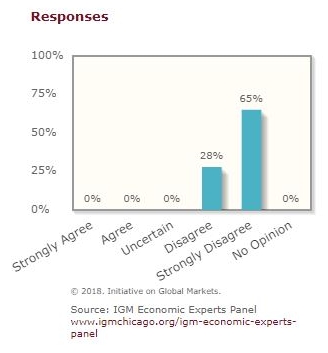
And yes 100% of those who answered either disagreed or strongly disagreed with the statement (Three people did not answer, if you want to know why the numbers only add up to 93%.)
Yes 100%.
In short, economists do sometimes agree, and one thing they agree on is that tariffs are bad.
Politicians take note.
Wednesday, 7 March 2018
Steve Hanke on Trump's protectionist policies
From RNZ's Morning Report comes this discussion with Professor Steve Hanke of Trump's recent protectionist policies.
China has responded to Donald Trump's threat of a trade war with a warning that it won't sit idly by if its economy is hurt by new protectionist policies by the United States. The US President openly talked of starting a trade war late last week when he announced stiff new tariffs on imported steel and aluminium. He tweeted: "Trade wars are good, and easy to win. Example, when we are down $100 billion with a certain country and they get cute, don't trade anymore-we win big. It's easy!" Mr Trump also threatened to impose a tax on EU-made cars. His comments have drawn strong criticism from the International Monetary Fund, the World Trade Organisation and trading partners including Canada and China. Professor of Applied Economics at Baltimore's Johns Hopkins University and a former senior economic advisor to President Ronald Reagan, Steve Hanke, has described Mr Trump's proposed new tariffs as a "horror".
Monday, 5 March 2018
Milton Friedman on the protection of the US steel industry
Protection is, unfortunately, in the news again. The US may be starting a trade war by imposing steep tariffs on imported steel and aluminum. Milton Freedman explains why protection is a bad idea.
Subscribe to:
Posts (Atom)