Monday, 13 April 2015

Modelling science as a contribution good 2

Continuing on with the Kealey and Ricketts paper, Modelling science as a contribution good we see that in section 7.2 Kealey and Ricketts discuss "Science and the firm". They write,
The contribution good model requires that scientists are able to gain financial rewards from the common pool of science. The institutional mechanisms that enable these rewards to be claimed are not modelled explicitly but are simply assumed to exist. The contribution good model of science has direct relevance, therefore, for research programmes in business structure and organisation. In modern Institutional Economics the firm is seen (i) as a substitute for relatively high costs of transacting in the market, after Coase (1937); (ii) as a means of coping with uninsurable uncertainty and continual change, after Knight (1921); and (iii) as a vehicle for instigating technological innovation, after Schumpeter (1934, 1943). The conversion of scientific knowledge into new tradable goods and services confronts obvious transactional difficulties between scientists and technologists, technologists and entrepreneurs, and entrepreneurs and financiers. Cooperation between these elements entails high costs of transacting and is likely to involve the formation of firms with internal labour markets and specially designed incentive arrangements to mitigate them. Hansmann’s (1996) proposition that ownership rights tend to be assigned to the group that faces the highest transactions costs might suggest, for example, the development of scientist-owned firms or firms with significant control rights in the hands of the knowledge creators and users.
There are a number of reasons for thinking that the development of scientist-owned firms could occur.

Within the property rights (also often referred to as the incomplete contracts approach) approach to the firm Brynjolfsson (1994) and Rabin (1993) show that there are adverse selection and moral hazard reasons why a scientist-entrepreneur may have to form their own firm to develop their ideas. In Rabin (1993) Rabin shows that adverse selection problems can be such that, in some situations, an informed party (the scientist-entrepreneur in this case) has to take over or form a firm to show that their information is indeed useful. For Rabin an informed party has information about how to make a firm more productive but can't reveal the information to the owners of a current firm. If the information is revealed the current firm can produce using it without any payment to the informed party. If the information is not revealed why should the firm believe the information is in fact useful? Within the Rabin framework it is suggested that firms are more likely to trade through markets when informed parties are also superior providers of productive services that are related to their information but if, on the other hand, information is a firm’s only competitive advantage, it is likely to obtain control over assets, possibly by buying firms that currently own those assets or setting up his own firm.

The Brynjolfsson (1994) model on the other hand works within a moral hazard framework. Brynjolfsson considers a situation where an scientist-entrepreneur has some expertise needed to run a firm but no value can be created without both the knowledge asset of the scientist-entrepreneur and the physical assets of a firm. He assumes that no comprehensive contract can be written between the entrepreneur and the firm. If the scientist-entrepreneur does not own the firm and he makes an investment in effort and creates value, he can be subject to hold-up by the other party since he needs the firm's physical assets. If the scientist-entrepreneur owns the firm then clearly the hold-up problem ceases to exist. The most obvious interpretation of Brynjolfsson model is as a model of a labour-owned firm (scientist-owned firm in this case). Brynjolfsson argues that it is optimal to give the entrepreneur ownership of the physical assets of the firm since he has information that is essential to its productivity. This result is obviously just an application of Hart and Moore’s proposition that an agent who is ‘indispensable’ to an asset should own it (Hart and Moore 1990). Here, firms are owned by the indispensable human capital (a scientist), or, as is more usual, by a small section of the human capital, e.g. a partnership between a number of scientists.

The above arguments support the Kealey and Ricketts notion that scientist-owned firms are a viable form of governance to allow the scientists to capture the returns from their work. However we should ask if there are limits to such arguments? Walker (forthcoming) suggests their may be such limits. In this model the reference point approach to contracts (Hart and Moore 2008) is applied to the modelling of a human-capital based firm. First a model of firm scope is offered which argues that the organisation of a human-capital based firm depends on the "types" (a crude interpretation of a "type" in this context could be the kind of scientist involved in the project, e.g. chemist, microbiologist or may be both.) of human capital involved. Having a homogeneous group of human capital leads to a different governance structure for a firm than that of a firm which involves a heterogeneous group of human capital. For a homogeneous group of human capital, say just chemists, a labour (scientist) owned firm is viable but for a heterogeneous group, say chemists, microbiologists and physicists, ownership by the owners of the firm's non-human capital may be optimal (that is an investor-owned firm may develop). This is because the more heterogeneous the human capital, the more likely it is that some groups will be "aggrieved" (a party is aggrieved when they do not receive the payoff they think they should) and will therefore "shade" on their performance (i.e. they put in a low level rather than a high level of performance) thereby creating deadweight losses. A firm which involves heterogeneous human capital will more more unstable due to the greater amount of a aggrievement/shading and will therefore require some "glue"”, in the form of non-human capital of some kind, to keep the human capital together and thus keep the firm viable. Given the importance of this glue to the firm, ownership of the firm by the owner of the non-human capital is likely.

Thus while it is possible that Kealey and Ricketts are right that scientist-owned firms will develop such a governance arrangement is not the only possibility. What is likely is that we would see what we see today in terms of firm's governance structures with a range of different governance structures being utilised depending on the exact circumstances.

Refs.:
  • Brynjolfsson, E. (1994). Information assets, technology, and organization. Management Science, 40, 12, pp. 1645–62.
  • Hart, O.D. and Moore, J. (1990) Property rights and the nature of the firm. Journal of Political Economy 98(6): 1119–1158.
  • Hart, O.D. and Moore, J. (2008). Contracts as reference points, Quarterly Journal of Economics, 123(1), 1–48.
  • Rabin, M. (1993). Information and the control of productive assets, Journal of Law, Economics, and Organization, 9(1), 51–76.
  • Walker, P. (forthcoming). Simple Models of a Human-Capital-Based Firm: a Reference Point Approach, Journal of the Knowledge Economy.

Modelling science as a contribution good

is the title of a recent paper by Terence Kealey and Martin Ricketts in the journal Research Policy (Volume 43, Issue 6, July 2014, Pages 1014–1024).

The paper makes a contribution to "the new economics of science" in that it argues that science is not a pure public good, as is often believed, but is, rather, a contribution good. Pure public goods are both non-excludable and non-rival. A contribution good, in contrast, is like a club good in that it is non-rivalrous but at least partly excludable. The excludability is due to the fact that not everyone is a member of the "club". To be a member of the "club" you have to be able to understand the science at issue. Also consumption is tied to contribution. If you want to be able to make use of the science you need to have mastered the underlying material which normally means you have to be trained as a scientist - you are a member of the "club". This in turns means you will be contributing to the subject.

The important problem here is not, as is the case for public goods, that of free riding but rather being able to create a critical mass of scientists. The club must be of a size large enough to generate both private and social gains.

The abstract reads
The non-rivalness of scientific knowledge has traditionally underpinned its status as a public good. In contrast we model science as a contribution game in which spillovers differentially benefit contributors over non-contributors. This turns the game of science from a prisoner's dilemma into a game of ‘pure coordination’, and from a ‘public good’ into a ‘contribution good’. It redirects attention from the ‘free riding’ problem to the ‘critical mass’ problem. The ‘contribution good’ specification suggests several areas for further research in the new economics of science and provides a modified analytical framework for approaching public policy.

Sunday, 12 April 2015

Just when you thought things couldn't get any worse in Venezuela ....

it looks like they have.

Andrew Rosati writes at Bloomberg Business
Venezuela, which already has the world’s fastest inflation rate at a reported 69 percent in December, could see that rate more than double this year as it struggles to respond to falling oil prices.

“We may end up this year with inflation at close to 200 percent,” Alberto Ades, co-head of global economics research at Bank of America, said in an interview on Bloomberg Surveillance Friday.
and
Annual inflation could rise to as much as 150 percent in 2015, and climb as high as 250 percent if the Central Bank included factors currently being omitted in the official statistics, he said.
But interestingly the inflation numbers have not been released so far this year.
The central bank, which typically releases inflation data each month, has yet to publish any information for this year.

[...]

“It’s a strictly a political decision,” Asdrubal Oliveros, director of the Caracas-based consultant Ecoanalitica, said Friday in an interview, referring to the data delays. “It’s not like they’ve stopped calculating inflation. The director of the Central Bank knows what the rate is.”
Not releasing the numbers is not a good look. It does suggest that they are bad and the government doesn't want people to know just how bad.

Part of the problem is that Venezuela relies on oil for the vast majority of its foreign-exchange earnings and the price of oil is dropping. Its almost half of what it was last year.
Venezuela has received an average $45.21 a barrel for its exports so far this year compared with $88.42 in 2014, according to the oil ministry. The nation relies on oil for about 95 percent of its foreign-currency earnings.
Loss of foreign exchange means that imports have to be cut.
Venezuela has responded to falling oil prices by reducing imports, which dropped 18 percent in January compared with the same month last year, BofA Merrill Lynch Global Research said in a report on April 7.

“The Maduro administration is in the midst of undertaking one of the largest import adjustments in Venezuelan history,” the bank said, adding that many of the country’s economic problems are “to a large extent self-inflicted.”
and the economy is suffering,
He [Alberto Ades] forecast the economy would shrink 4 percent. “Venezuela is in a dire crisis.”

The 50 percent drop in oil prices in the past year has buffeted Venezuela’s economy and forced it to reduce imports, exacerbating shortages of everything from shampoo to beef. On the black market, the bolivar has weakened 74 percent in the past year to about 257 bolivars per dollar, compared with the official rate of 6.3 for priority imports.
Are we watching an economy implode simply because of its government's policies?

Saturday, 11 April 2015

Should we be spooked by deflation?

Concerns about deflation – falling prices of goods and services – have loomed large in many recent policy discussions. In such discussions deflation is seen as always and everywhere a bad phenomenon. But as I have discussed a number of times before, see for example here, here and here, you need to draw a distinction between good and bad deflation The basic point is that we indeed do have two forms of deflation, the bad driven by demand shrinking and the good caused by supply expanding. The good kind of deflation is the result of increases in productivity. Research and development means new technology, efficiency gains, cost-cutting, price-cutting and, yes, deflation. Productivity gains mean that businesses could afford to sell their products for less since it is costing less to make them. The bad kind usually follows a collapse of aggregate demand. There is a severe drop in spending: producers have to cut prices to find buyers. This has the effect of causing recession, high unemployment and widening financial stress. This the 1930s type deflation that people fear.

The deflation debate is shaped by the deep-seated view that deflation, regardless of context, is an economic pathology that stands in the way of any sustainable and strong expansion. This view is largely based on the experience of the Great Depression. But in a new column, Should we be spooked by deflation? A look at the historical record by Claudio Borio, Magdalena Erdem, Andrew Filardo and Boris Hofmann, at VoxEU.org it is argued that it is misleading to draw inferences about the costs of deflation from the Great Depression since it was the archetypal example.

Borio, Erdem, Filardo and Hofmann write,
The evidence from our historical analysis raises questions about the prevailing view that goods and services price deflations, even if persistent, are always pernicious. It suggests that asset price deflations, and particularly house price deflations in the postwar era, have been more damaging. And it cautions against presuming that the interaction between debt and goods and services price deflation, as opposed to debt’s interaction with property price deflations, has played a significant role in past episodes of economic weakness.

Inevitably, our results come with significant caveats. The data set could be further improved. We have focused on only a few drivers of output costs. We have only a few episodes of persistent deflation in the postwar period. And present debt levels are at, or close to, historical highs in relation to GDP. This should caution against drawing sweeping conclusions or firm inferences about the future.

Even so, the analysis does suggest a number of considerations relevant for policy.
  • First, it is misleading to draw inferences about the costs of deflation from the Great Depression, as if it was the archetypal example.
The episode was an outlier in terms of output losses; in addition, the scale of those losses may have had less to do with the fall in the price level per se than with other factors, including the sharp fall in asset prices and associated banking distress.
  • Second, and more generally, when calibrating a policy response to deflation, it is critical to understand the driving factors and, as always, the effectiveness of the tools at the authorities’ disposal.
This can help to better identify the benefits and risks involved.
  • Finally, there is a case for policymakers to pay closer attention than hitherto to the financial cycle – that is, to booms and busts in asset prices, especially property prices, alongside private sector credit [...].
So deflation is not a good reason for running round screaming the sky is falling as many commentators, journalists and politicians seem to want to do. Reality is more complex and subtle. The VoxEU.org column finds a link between output growth and asset price deflations, particularly during postwar property price deflations, that there is no evidence that high debt has so far raised the cost of goods and services price deflations, in so-called debt deflations and that the most damaging interaction appears to be between property price deflations and private debt.

Richie Benaud on the "underarm" incident

Benaud taking his own country's national team and captain to task over a disgraceful bit of play.

Assessing Böhm-Bawerk's contribution to economics

A good weekend read. 2014 was the 100th anniversary of the death of the economist Eugen von Böhm-Bawerk (1851-1914). From the Online Library of Liberty at Liberty Fund comes this Liberty Matters debate on:

"Assessing Böhm-Bawerk’s Contribution to Economics after a Hundred Years"

The aim is to evaluate von Böhm-Bawerk contributions as one of the founders of the Austrian school of economic theory with his theoretical work at the University of Vienna, a leading critic of Marxism, and a the Minister of Finance in the Austro-Hungarian Empire.

The Debate

Lead Essay: Richard M. Ebeling, “Eugen von Böhm-Bawerk: Leading Austrian Economist and Finance Minister of Fiscal Restraint” [Posted: April 1, 2015]

Responses and Critiques
  1. Joseph T. Salerno, "Eugen von Böhm-Bawerk: Pioneer of Causal-Realist Price Theory" [Posted: April 3, 2015]
  2. Roger W. Garrison, “Böhm-Bawerk as Macroeconomist” [Posted: April 6, 2015]
  3. Peter Lewin, "Eugen von Böhm-Bawerk – A man for his time, and ours" [Posted: April 7, 2015]
The Conversation
  1. Richard M. Ebeling, "Böhm-Bawerk’s Enduring Legacy: The Pricing Process, the Savings-Investment Nexus, and the Capital Structure in the Context of Time" [Posted: April 9, 2015]

Friday, 10 April 2015

So it's all endogenous

There has been much comment around the traps about a study that claims that ageing populations  hinder economic growth.The study predicts the effect of demographic change on growth rates in the current decade and shows that an ageing population will knock over a percentage point off growth rates for some countries, including New Zealand - see the graphic below.


But now James Zuccollo at the TVHE blog points out that the effect may be endogenous. Zuccollo writes,
In a ray of light, this morning’s FT (£) reported a study of over 15,000 German employees that examined the relationship between ageing and productivity. One of the authors is quoted saying:
As workforces age, employers are concerned that productivity will decrease. That is not so. What matters is not chronological age but subjective age.
The research suggests that older people are systematically excluded from training activities, and are relegated to less creative and meaningful work, which renders them less productive. As the workforce ages, that may begin to change. As it changes, the relationship between growth and age structures is likely to weaken.
Getting cause and effect right is important. This highlights why when thinking about topics like productivity you need to think at the firm level. How firms react to changes in the demographics of their workforce will help determine the rate of productivity growth. Just looking at aggregate data can obscure such effects.

The exchange rate is just a price

How often must this be said?

Oliver Hartwich writes in the latest New Zealand Initiative Insights (Insights 12: 10 April 2015 ),
The Reserve Bank of Australia’s surprise decision not to cut interest rates only postponed the expected “parity party” between the Kiwi and the Aussie dollars. The way things are going, it is a matter of time until both currencies are of equal value.

The currency development leaves politicians and commentators divided. On Wednesday, The New Zealand Herald was jubilant (“Transtasman parity worth a celebration”) whereas the Waikato Times played the party-pooper (“Dollar parity bad news”).

Unsurprisingly, Prime Minister John Key claimed the strong Kiwi as an indication of a strong economy while his counterpart, Labour leader Andrew Little warned of negative side effects of our strong dollar.
But why are they talking about parity at all? The exchange rate is just a price like any other price in the economy. The exchange rate being talked about in this case is just the price of the Australian dollar, which given it is floating will go up and down when the demand for and supply of the two currencies change. Just like every other good in he economy. If there are changes in the supply and /or demand for bread, the price of bread changes but we don't see stupid comments by politicians and newspaper editors about it. Why not? If changes in one price are worthy of comments why not changes in all prices?

At best changes in exchange rates may act as an indicator that something is amiss in some sector of the economy. But if this is so then the proper reaction should be to identify the problem and curing it at its source. Not with going on about the exchange rate. Don't shoot the messenger.

Can these commentators just get over their unjustified obsession with exchanges rates. Also why are they getting excited about the nominal exchange rate without asking questions about what is happening to the real exchange rate?

Wednesday, 8 April 2015

Academic freedom at the University of Chicago and Princeton

The following comes from the website of The National Association of Scholars (NAS) who in turn got it from the Facebook page of NAS board of advisors member Robert P. George (McCormick Professor of Jurisprudence at Princeton University).

Every now and then sanity still manages to prevail. The worrying thing is that academics at these universities find it necessary to have to make such statements at all.
At campuses across the country, traditional ideals of freedom of expression and the right to dissent have been deeply compromised or even abandoned as college and university faculties and administrators have capitulated to demands for language and even thought policing. Academic freedom, once understood to be vitally necessary to the truth-seeking mission of institutions of higher learning, has been pushed to the back of the bus in an age of "trigger warnings," "micro-aggressions," mandatory sensitivity training, and grievance politics. It was therefore refreshing that the University of Chicago, one of the academic world's most eminent and highly respected institutions, in the face of all this issued a report ringingly reaffirming the most robust conception of academic freedom. The question was whether other institutions would follow suit.

Yesterday, the Princeton faculty, led by the distinguished mathematician Sergiu Klainerman, who grew up under communist oppression in Romania and knows a thing or two about the importance of freedom of expression, formally adopted the principles of the University of Chicago report. They are now the official policy of Princeton University. I am immensely grateful to Professor Klainerman for his leadership, and I am proud of my colleagues, the vast majority of whom voted in support of his motion.

At Chicago and Princeton, at least, academic freedom lives!

Here are the principles we adopted:
Education should not be intended to make people comfortable, it is meant to make them think. Universities should be expected to provide the conditions within which hard thought, and therefore strong disagreement, independent judgment, and the questioning of stubborn assumptions, can flourish in an environment of the greatest freedom' ... Because the University is committed to free and open inquiry in all matters, it guarantees all members of the University community the broadest possible latitude to speak, write, listen, challenge, and learn. Except insofar as limitations on that freedom are necessary to the functioning of the University, the University of Chicago fully respects and supports the freedom of all members of the University community “to discuss any problem that presents itself.” Of course, the ideas of different members of the University community will often and quite naturally conflict. But it is not the proper role of the University to attempt to shield individuals from ideas and opinions they find unwelcome, disagreeable, or even deeply offensive. Although the University greatly values civility, and although all members of the University community share in the responsibility for maintaining a climate of mutual respect, concerns about civility and mutual respect can never be used as a justification for closing off discussion of ideas, however offensive or disagreeable those ideas may be to some members of our community.

The freedom to debate and discuss the merits of competing ideas does not, of course, mean that individuals may say whatever they wish, wherever they wish. The University may restrict expression that violates the law, that falsely defames a specific individual, that constitutes a genuine threat or harassment, that unjustifiably invades substantial privacy or confidentiality interests, or that is otherwise directly incompatible with the functioning of the University. In addition, the University may reasonably regulate the time, place, and manner of expression to ensure that it does not disrupt the ordinary activities of the University. But these are narrow exceptions to the general principle of freedom of expression, and it is vitally important that these exceptions never be used in a manner that is inconsistent with the University’s commitment to a completely free and open discussion of ideas. In a word, the University’s fundamental commitment is to the principle that debate or deliberation may not be suppressed because the ideas put forth are thought by some or even by most members of the University community to be offensive, unwise, immoral, or wrong-headed. It is for the individual members of the University community, not for the University as an institution, to make those judgments for themselves, and to act on those judgments not by seeking to suppress speech, but by openly and vigorously contesting the ideas that they oppose.

Indeed, fostering the ability of members of the University community to engage in such debate and deliberation in an effective and responsible manner is an essential part of the University’s educational mission. As a corollary to the University’s commitment to protect and promote free expression, members of the University community must also act in conformity with the principle of free expression. Although members of the University community are free to criticize and contest the views expressed on campus, and to criticize and contest speakers who are invited to express their views on campus, they may not obstruct or otherwise interfere with the freedom of others to express views they reject or even loathe. To this end, the University has a solemn responsibility not only to promote a lively and fearless freedom of debate and deliberation, but also to protect that freedom when others attempt to restrict it.
Now is it time for New Zealand's universities to think about the adoption of such principles.

Tuesday, 7 April 2015

EconTalk this week

Vernon Smith and James Otteson talk with EconTalk host Russ Roberts about Adam Smith in front of a live audience at Ball State University. Topics discussed include Smith's view of human nature, the relevance of Smith for philosophy and economics today, and the connection between Smith's two books, The Theory of Moral Sentiments and The Wealth of Nations.

A direct link to the audio is available here.

Video for this special edition of EconTalk, "Will the Real Adam Smith Please Stand Up?" is available below.

GDP and social welfare in the long run

A few weeks ago over at the Offsetting Behaviour blog Eric Crampton was talking about The Case for Economic Growth, a new report put out by the New Zealand Initiative. An obvious question to ask about growth is, What's so great about it? Why should we care if the economy grows or not? After all GDP, and thus growth in GDP, is not identical to social well-being or growth in social well-being. The answer many economists would give, and the New Zealand Initiative report gives, is that growth of GDP over time has a positive correlation with human well-being broadly understood.

It turns out that Offsetting Behaviour isn't the only blog where the advantages of growth are being thought about. At the Conversable Economist blog Timothy Taylor takes a look at an OECD report from last year which asks, How Was Life? Global Well-Being Since 1820, edited by Jan Luiten van Zanden, Joerg Baten, Marco Mira d’Ercole, Auke Rijpma, Conal Smith and Marcel Timmer.

Taylor writes,
So how have other dimensions of human well-being been correlated with this rise in per capita GDP, both over time and across countries? The short answer is that there is a strong positive correlation between per capita GDP and and indicators of education and health status. There is a weaker but still positive correlation between higher per capita GDP and participatory political institutions. There is no clear-cut correlation between per capita GDP and personal security. The relationship between per capita GDP and the environment (viewed as a whole) seems to be an inverted U-shape: that is, growth of per capita GDP is first associated with higher environmental damage, but at some point it seems to be associated with lower damage. The relationship between per capita and income inequality seems to follow a regular U-shape: that is, growth of per capita GDP is first associated with greater within-country income equality up to about the 1970s, but since then is associated with greater inequality. Here are some details.

1) Education

Gains in education have a strong positive correlation with per capita GDP over time and across countries, probably a part of a virtuous circle: that is, a more educated workforce helps economic growth, and an economy with higher per capita income can afford to spend more on education.

[...]

2) Health status over the long-term can be proxied by measures like life expectancy and height. It seems clear that higher per capita GDP is associated with gains in both, although there is some evidence that at the highest levels of GDP, higher incomes are not associated with larger health gains. The report says:
"Life expectancy at birth was about 33 years in Western Europe around 1830, 40 years in 1880, and almost doubled in the period after, with the largest improvements occurring in first half of the 20th century. In the rest of the world, life expectancies started to increase from much lower levels, rising in particular after 1945. Worldwide life expectancy increased from less than 30 years in 1880 to almost 70 in 2000. There is strong evidence of a shift in the relationship between health status and GDP per capita over the past two centuries. Life expectancy improved around the world even when GDP per capita stagnated, due to advances in knowledge and the diffusion of health care technologies."
[...]

3) Personal security over the long-run can be approximated by using data on homicide rates and on war. The report summarizes the evidence on per capita GDP and homicide rates like this: "Western Europe was already quite peaceful from the 19th century onwards, but homicide rates in the United States have been high by comparison. Large parts of Latin America and Africa are also violent crime “hotspots”, and so is the former Soviet Union (especially since the fall of communism), while large parts of Asia show low homicide rates. Homicide rates are in general negatively correlated with GDP per capita – the richer a country, the lower the level, but there are important exceptions."

[...]

4) The overall pattern of political institutions over time is toward greater participation, but the path has often been a bumpy one. [...] an Index of Democracy, where the measure of competition is based on what share of the vote is received by the winning party (when a winning party receives nearly all the votes, competition is low) and a measure of participation based on the share of the adult population that votes. On a worldwide basis, both are rising since 1820. But the rise is bumpy and spiky at times.

[...]

5) Environmental quality is proxied by three measures in this report: biodiversity, and emissions of sulfur dioxide and carbon dioxide. The summary reads: "A negative correlation with GDP per capita is clearly in place when looking at quality of the environment. Biodiversity declined in all regions and worldwide as land use changed dramatically. Per capita emissions of CO2 increased after the industrial revolution in Western Europe and its Offshoots, accelerating in the mid-20th century as other regions increased their GDP, and is still increasing globally. Per capita emission of SO2 (a local pollutant) also increased alongside higher industrial production, but were curbed since the 1970s thanks to the advent of cleaner technologies."

[...]

A key question is whether countries will tend to find ways to reduce environmental damage as their per capita GDP rises--as appears to be happening with SO2. Another way of making the point is that the ways in which economic growth affects the environment are strongly affected by public policy choices. As the report notes:
To some extent SO2 emissions follow an environmental Kuznets curve, with declining emissions beyond a certain level of GDP per capita, and in recent periods biodiversity is also less directly (negatively) related to real income levels. Overall, there is still a rather strong negative link between environmental quality (as measured by these indicators) and GDP per capita, but this link has been weakening in recent years (since the 1970s), probably as a result of successful policies to lower emissions (SO2 probably being the best example).

[...]

6) Inequality of incomes is hard to summarize, in part because we live in a time when there is growing inequality of incomes within countries at the same time that global inequality of incomes is falling (with the rise of incomes in countries like China and India).

[...]

For the global distribution of income, the curves [...] are gradually moving out to the right as economic growth raises the average world income. The area under the curves is also getting larger, which captures the fact that world population has dramatically expanded. It's interesting to notice that in 1970 and 1980, the global distribution of income had two humps, one at a lower income level and one at a higher income level. By 2000, the world is back to a one-hump income distribution.

From a national and regional level, the patterns show look different: "Long-term trends in income inequality, as measured by the distribution of pre-tax household income across individuals, followed a U-shape in most Western European countries and Western Offshoots. It declined between the end of the 19th century until about 1970, followed by a rise. In Eastern Europe, communism resulted in strong declines in income inequality, followed by a sharp increase after its disintegration in the 1980s. In other parts of the world (China in particular) income inequality has been on the rise recently. The global income distribution, across all citizens of the world, was uni-modal in the 19th century, but became increasingly bi-modal between 1910 and 1970 and suddenly reverted to a uni-modal distribution between 1980 and 2000."
What then is the take home measure from this? For a start it is clear that GDP is not the same thing as real social welfare. However, it tends to be true that countries with a higher level of per capita GDP are better off on other dimensions of well-being, not just the consumption of goods and services, but also other factors like education, health, and even personal freedom.

Both the New Zealand Initiative report and the OECD report make the same basic point, growth is good.

Walter Williams on the great thing that is profit

Is profit a dirty word? For many people it seems to be. Would the world be better off without them? Or are profits progressive -- the only thing that can move potatoes from Idaho to Manhattan and medicine from America to Africa? Economist Professor Walter Williams of George Mason University explains.


(HT: Cafe Hayek)

From the comments: A strange view of economics

Jd Dalisay kindly left the following comment on my posting on A strange view of economics which raised some questions about the ideas underlying Dalisay's blog Socioeconomic Science:
Here are the answers to most of your questions:

what are we make of the work of people like Amartya Sen or Tony Atkinson.. and subjects like welfare economics?

I'm unfamiliar with those. Though I know a little of Sen in that he said that famines are caused by lack of freedom or 'failure of exchange entitlements', which was already explained by Smith earlier: "A famine only arose from the government’s violence in attempting to remedy a dearth by improper means."

How does behavioural economics fit into jundalisay's framework?

Behavioural economics has its roots in psychology which sees the mind as an entity subordinate to the brain. Smith's and Hume's political economy is based on metaphysics which sees the mind as an entity which can exist without the brain, as a soul. This is taboo now because metaphysics is regarded as pseudoscience. In Smith's time it made 1/3 of the sciences: Natural Philosophy, Metaphysics, and Logic: “This general division seems perfectly agreeable to the nature of things" (5.1.151)

Much of post-19th century economics is to do with proper government policies and regulation.. So how does standard economics and 'Political Economy version 2.0' differ in this regard?

Economics needs many regulations because its underlying philosophy is utility or personal desire, begun by Say and Mill. Because personal desires vary per person, it creates many complexities which likewise need complex regulations. Metaphysicians such as Smith, Hume, Buddha and Laotzu never advocated utlity because it leads to selfishness and destruction: "Power and riches are enormous and operose machines ready at any moment to crush their unfortunate possessor." (TMS Part 4). Socio-economics replaces utility with 'natural self-interest in the context of one's society'. To avoid ambiguity, I equated this term to svadharma, which roughly translates in English as own dharma, own path, in existence. A baker bakes because he naturally loves baking (cause), not because it will bring him cash (effect), otherwise he would've been banker.

Who in post-19th century economics is it that championed the cause of businesses?

Says Law. It says "Supply creates its own demand". Smith pointed out that this 'Production Motive' is a mercantilist sophistry. In reality, the wealth of a society is in the purchasing power of its people: "The net revenue is their stock which they can..spend on their subsistence, conveniencies, and amusements.." In Smith's system, the wealth of countries will be measured in Purchasing Power, or in how much each citizen can buy, not on Gross Domestic Product or how much its businesses can sell. Thus GDP is the first proof of the business-cause.

It's irrelevant whether a business is called a firm, corporation, or company. The main guide is if it earns by profits. The dominance of profit maximization is another proof of the business-cause. In Smith's system, ordinary profits is the target and is defined as the minimum profit needed by the owner/s to continue their business. This minimum profit translates to maximum benefit to all members: "The increased competition would reduce the profits of the masters and the wages of the workmen. The trades, the crafts, the mysteries, would all be losers. But the public would be a gainer because the work of all artificers would become cheaper this way. All corporations and most of corporation laws have been established to prevent this reduction of price by restraining that free competition which would most certainly occasion it."
Let me just a a quick comment on the last point. Gross domestic product can be determined in three ways all of which give the same result. They are the production (or output or value added) approach, the income approach, or the expenditure approach.

The production approach sums the outputs of every class of enterprise to arrive at the total. The expenditure approach works on the principle that all of the product must be bought by somebody, therefore the value of the total product must be equal to people's total expenditures in buying things. The income approach works on the principle that the incomes of the productive factors ("producers," colloquially) must be equal to the value of their product, and determines GDP by finding the sum of all producers' incomes.

So by the expenditure approach GDP is basically what people spend on their "subsistence, conveniencies, and amusements".

I take Say's Law to be a point about macroeconomics, not micro. As Mark Blaug has said:
The assertion that 'products are paid for by products' [the gist of Say's Law] is by no means trivial. In one sense it is the beginning of sound thinking in macroeconomics.
The important point is that I don't see it as having anything to do with firms, that is, with what institutional arrangement is used to produce goods and services. Say's Law doesn't depend on firms being private for-profit organisations. Output could be produced by not-for-profit firms, worker cooperatives, SOEs or whatever and Say's Law would not be affected. Say's Law just implies that in aggregate it is impossible for all goods to be produced in relative excess. That is, general overproduction is impossible. Also Say's Law had nothing to do with mercantilism. I am sure Say would have rejected mercantilism, as do modern economists.

Note also that that in perfect competition a profit maximising firm will make zero economic profit and will, in partial equilibrium terms, maximise welfare by maximising the sum of consumer plus producer surplus. So within a standard economic model, maximum profits equals minimum profits, ie zero, and benefits to all members of society is  also maximised.

The dominance in economics of using the idea that firms maximise profits is, in part, due to the obvious point that most firms in an economy are for-profit firms.

One more point about this comment,
Economics needs many regulations because its underlying philosophy is utility or personal desire, begun by Say and Mill.
Actually thinking in terms of utility goes back well before Say or Mill. As D. P. O'Brien has written,
He [Smith] inherited a subjective value theory: and, instead of developing this, he largely substituted for it a "cost of production" theory of value. A developed subjective theory was available in the works of Pufendorf, Smith's teacher Hutcheson, and Hutcheson's teacher Carmichael. These writers made value dependent on usefulness and relative scarcity-just as has been done in economics since the Marginal Revolution of the 1870s. Adam Smith himself advanced a somewhat similar value theory in his Lectures and there solved the paradox that water is very useful but valueless, while diamonds are useless but valuable, on the basis of relative scarcity.

Monday, 6 April 2015

You know your economy is in trouble when ....

hotels start asking guests to bring their own toilet paper and soap.

Not exactly a common practise in tourism unless you are holidaying in Venezuela.

Manuel Rueda at Fusion is reporting that
Venezuela’s product shortages have become so severe that some hotels in that country are asking guests to bring their own toilet paper and soap, a local tourism industry spokesman said on Wednesday.

[...]

“It’s an extreme situation,” says Xinia Camacho, owner of a 20-room boutique hotel in the foothills of the Sierra Nevada national park. “For over a year we haven’t had toilet paper, soap, any kind of milk, coffee or sugar. So we have to tell our guests to come prepared.”
But if you have price controls and a very weak currency then you get smuggling and a black market.
“Five hotels have told me they are going through this situation, where they have to ask guests to bring their own toilet paper,” Montilla told Fusion. “We’re near the border with Colombia, just two and a half hours away, and lots of [Venezuelan] goods are taken there, because they sell for more money in Colombia.”

Montilla says bigger hotels can circumvent product shortages by buying toilet paper and other basic supplies from black market smugglers who charge up to 6-times the regular price.
And the government response?
Recently, Venezuelan officials have been stopping people from transporting essential goods across the country in an effort to stem the flow of contraband. So now Camacho’s guests could potentially have their toilet paper confiscated before they even make it to the hotel.
Can't help thinking removing price controls and letting the price mechanism work would fit the problem most quickly.

Sunday, 5 April 2015

A strange view of economics

From Gavin Kennedy at the Adam Smith's Lost Legacy blog comes this bit of information:
jundalisay has authored an interesting new Blog HERE:

“This is the public site of the new proposed science of socio-economics or ‘Smithonomics’ or ‘Political Economy version 2.0′ which is meant as an alternative to economics.”

“Economic science was created in the 19th century by intellectuals who championed the cause of businesses, which is to maximize profits based on the paradigm of personal utility or pleasure for the benefit of the self. This is in stark contrast to the old science of the Political Economy which advocated to maximize the benefit of the whole society through proper government policies and regulation and was based on moral philosophy.
This all sounds a bit strange to me. For a start if economics today is about businesses and their profits and not about the benefit of the whole society then what are we make of the work of people like Amartya Sen or Tony Atkinson? I don't see much an emphasis on firms and their profits in their work. Also, if the benefit of the whole society isn't an issue in economics what do we do with the subjects like welfare economics? In addition how do we interpret work like that of Bergson, Samuelson or, most famously, Arrow on social welfare functions (SWFs)? Isn't the whole point of an SWF to get a measure of total welfare of a society? Also even when working within a partial equilibrium framework the standard measure of welfare in the sum of producer and consumer surplus, not just producer surplus. So there is no singling out of firms' welfare for special treatment. How does behavioural economics fit into jundalisay's framework? Much of post-19th century economics is to do with proper government policies and regulation. The most obvious example would be that of Pigou and his taxes and subsidies for negative and positive externalities. Also what of competition policy? And there are a seemingly endless number of regulations on all aspects of the economy which are justified with reference to modern economics. So how does standard economics and 'Political Economy version 2.0' differ in this regard?

Who in post-19th century economics is it that championed the cause of businesses? Even today businesses are one of the most ignored institutions in economic theory.
"The theory of the firm has been a neglected area of study in mainstream economics. Despite Ronald Coase bringing the issue up for discussion in 1937, it was not on the research agenda until the 1970s. Even now, as both Coase and Oliver Williamson, the founder of and prominent scholar in the transaction cost-focusing analysis of firm organization, have received the Nobel Prize in economics, the area remains in the periphery of economic analysis” (Bylund 2011: 189).
Coase and Wang (2011: 1) remark,
“[b]ut the gain in rigor achieved in modern price theory comes with a heavy price tag. The most obvious and serious omission in price theory is that it sees no role for production, let alone entrepreneurship. How goods and services are actually produced, how new goods and services and new ways of production are constantly invented in the economy, how production and innovation are organized, and what forces are at work are rarely on the research agenda in economics. It is extraordinary that the process of production is virtually invisible in economic theory”
while Coase himself commented in an 2013 interview that
"[m]odern economics shows little interest in production” (Wang 2014: 118).

If we look back in the history of economics we find business have been ignored by most groups of economic thinkers.

With regard to the relationship between economic theory and business Edwin Cannan wrote,
“I do not mean to argue that a knowledge of economic theory will enable a man to conduct his private business with success. Doubtless many of the particular subjects of study which come under the head of economics are useful in the conduct of business, but I doubt if economic theory itself is. [ ...] economic theory does not tell a man the exact moment to leave off the production of one thing and begin that of another; it does not tell him the precise moment when prices have reached the bottom or the top. It is, perhaps, rather likely to make him expect the inevitable to arrive far sooner than it actually does, and to make him underrate, not the foresight, but the want of foresight of the rest of the world” (Cannan 1902: 459-60).
Cannan was not alone in making this type of argument. Arthur Pigou wrote:
“[ ...] it is not the business of economists to teach woollen manufacturers to make and sell wool, or brewers how to make and sell beer, or any other business men how to do their job. If that was what we were out for, we should, I imagine, immediately quit our desks and get somebody - doubtless at a heavy premium, for we should be thoroughly inefficient - to take us into his woollen mill or his brewery” (Pigou 1922: 463-4).
Lionel Robbins argued similarly, in that
“[t]he technical arts of production are simply to be grouped among the given factors influencing the relative scarcity of different economic goods. The technique of cotton manufacture [ ...] is no part of the subject-matter of Economics [ ...]” (Robbins 1935: 33).
In fact in the period following the classical economists, with the possible exception of Alfred Marshall, few economists, be they mainstream or heterodoxy, wrote anything much on the firm. When reviewing the contribution of the old institutionalists to the theory of the firm Hodgson (2012: 55) writes,
“[ ...] we search in vain for a well-defined ‘theory of the firm’ within the old institutional economics”.
Carl M. Guelzo argues that one of the leading old institutionalists, John R. Commons,
“[ ...] did not construct a rigorous theory of the firm since this was never his purpose” (Guelzo 1976: 45).
With reference to the German historical school Le Texier (2013: 80) writes
“[m]embers of the German historical school such as Gustav von Schmoller analysed at length the birth and growth of the business enterprise, but they were more historians than economists. None of these thinkers proposed a theory of the business firm”.
When writing about the work of Joseph Schumpeter, Hanappi (2012: 62) says
“[a] well-defined theory of the firm thus cannot be found in Schumpeter’s oeuvres”.
As to Austrian economics Per Bylund writes,
“[b]ut despite the focus in Austrian economics on [ ...] “mundane economics,”
and the fact that
“the Austrians [have] so many necessary ingredients for a theory of the firm” [ ...], there is no Austrian theory of the firm” (Bylund 2011: 191)
and
“[w]hereas the theory of the firm has been a neglected area of study in mainstream economics, it has been missing from the Austrian economics literature” (Bylund 2011: 191).
Hutchison (1953: 308) comments
“[t]he Austrian School, with the exception of Auspitz and Lieben, did not concern themselves much with the analysis of markets and firms, except in respect to their general principle of imputation”.
Hutchison also summarised the early neoclassical contributions to the theory of the firm, and markets, as
“Jevons has little on the firm. [ ...] Walras’s assumptions of perfect competition (maintained virtually throughout) and of fixed technical ‘coefficients’, limited his contribution to the analysis of firms and markets, [ ...]. Pareto’s contribution to the theory of firms and markets were not rounded off, and of very varying value, [...]” (Hutchison 1953: 307).
So where the idea that economics was created in the 19th century by intellectuals who championed the cause of businesses comes from I don't know.

Also there have been a number of alternatives to profit maximisation put forwards. We have seen models based on utility maximisation, sales revenue maximisation and output maximisation. There have been behavioural models put forward, along with cost-plus pricing and growth models but none of these have won out in the market place for idea since as a starting place, at least, profit maximisation is the most useful assumption. In addition there are models of no-for-profit firms and worker/consumer/producer cooperatives which are relevant in certain areas of the economy and need not assume profit maximisation.

So profit maximisation is the most common but not the only assumption utilised in the theory of the firm. Actually, for the neoclassical model at least, profit maximisation isn't technically an assumption at all, its a result. Utility maximisation implies profit maximisation. Crudely put, to maximise utility a consumer wants to maximise income and as part of their income comes from forms' profits they want firms to maximise profits. One could also add that there are not firms in the textbook approach to the production so championing the cause of businesses in the neoclassical model is championing something that doesn't exist.

Saturday, 4 April 2015

John von Neumann documentary

From the Mathematical Association of America comes this video of a 1966 documentary on John von Neumann.

While a mathematician and physicist von Neumann made three fundamental contributions to economics
The first is a 1928 paper written in German that established von Neumann as the father of game theory. The second is a 1937 paper, translated in 1945, that laid out a mathematical model of an expanding economy and raised the level of mathematical sophistication in economics considerably. The third is a book coauthored with his Princeton colleague, economist Oskar Morgenstern, titled Theory of Games and Economic Behavior, after Morgenstern convinced von Neumann that game theory could be applied to economics.


Refs.:
  • 1928 "Zur Theorie der Gesellschaftsspiele", Mathematische Annalen 100 (1): 295–320. English translation: "On the Theory of Games of Strategy," in A. W. Tucker and R. D. Luce, ed. (1959), Contributions to the Theory of Games, v. 4, p. 42. Princeton University Press.
  • 1944 (with Oskar Morgenstern). Theory of Games and Economic Behavior. Princeton: Princeton University Press.
  • 1945–1946. “A Model of General Equilibrium.” Review of Economic Studies 13: 1–9.

No Prime Minister!: Margaret Thatcher tries to abolish economists

The "Yes Real Prime Minister" (AKA The Thatcher) Sketch from 1984 staring Paul Eddington, Nigel Hawthorne and Margaret Thatcher. In this sketch, written by Thatcher, the Prime Minister, played by Thatcher, wants the Minister, Eddington, and Sir Humphrey Appleby, Hawthorne, to abolish economists.


One problem with the sketch is that if you watched Yes Minister you would know that Sir Humphrey had a 1st from Oxford in classics, not a double first in politics and economics.

Friday, 3 April 2015

The first privatisation programme?

While I knew there were one-off sales of state-owned firms (e.g. the sale of a majority share in Volkswagen by the German government in 1961 and the sale of Veba shares in 1965) before the 1970s, my understanding had been that the use of systematic, on going, asset sales programmes did not begin until 1974 with a little known privatisation programme in Chile. (On the Chilean programme see Bitran and Saez (1994), Hachette and Luders (1993) and Luders (1991).) Note that this was a few years before the first widely known privatisation programme of the first Thatcher government in the U.K.

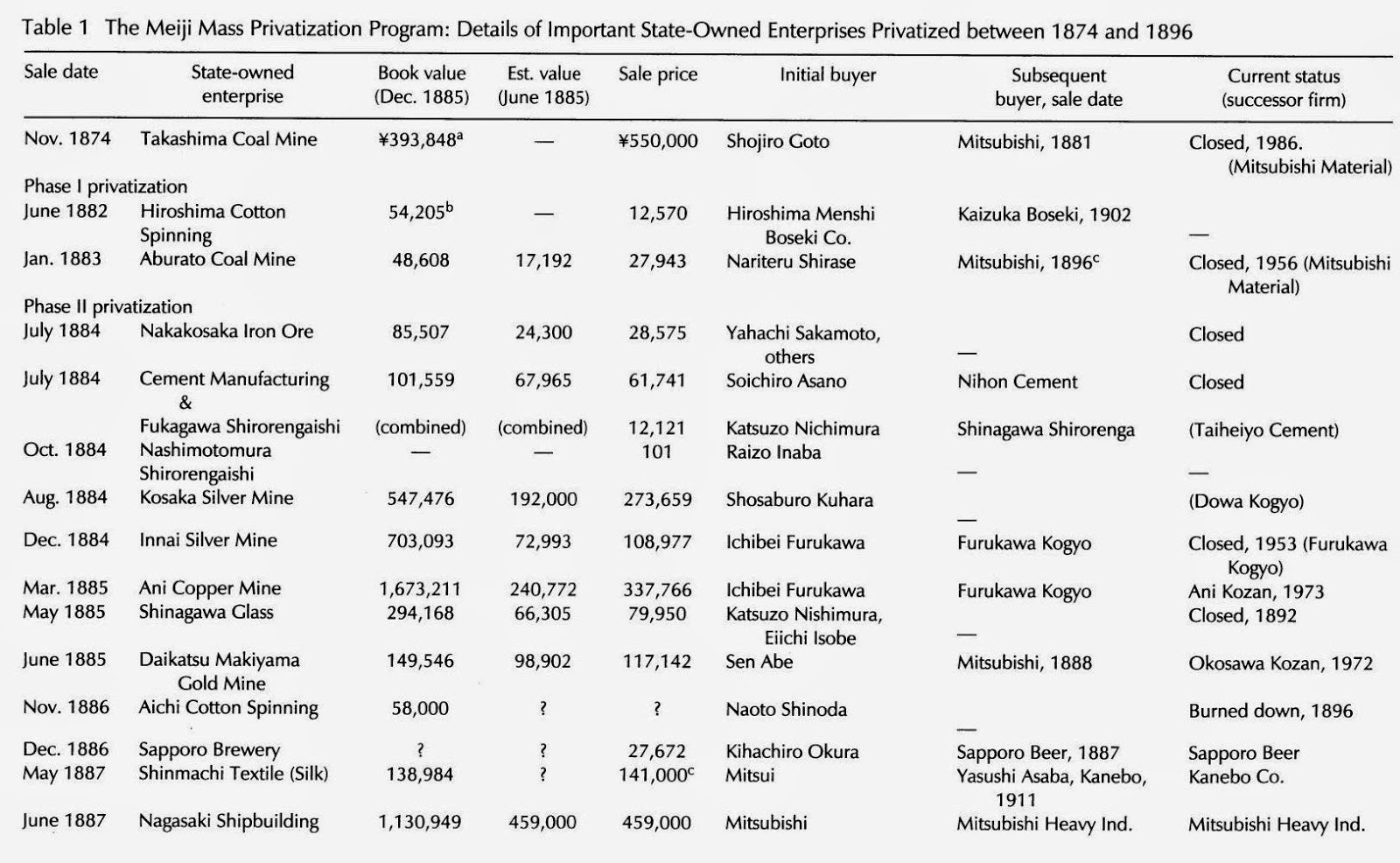
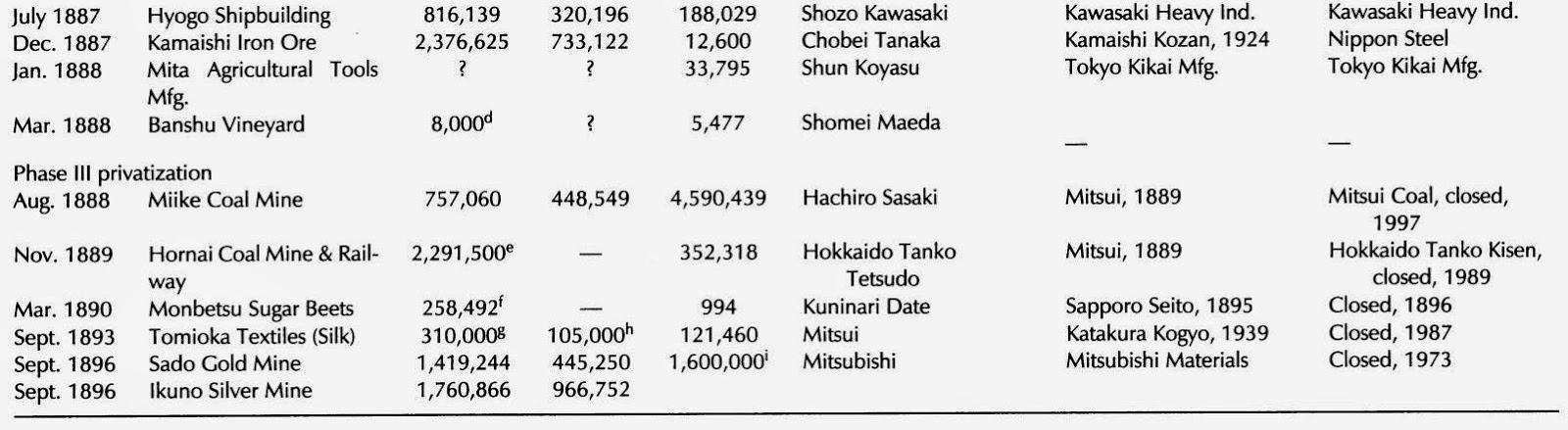
But I have now learnt that I was very wrong, 1974 is way too recent. It turns out that the Japanese may have had the first mass privatisation programme. During the period 1874 to 1896 the Japanese government sold 26 large SOEs  (Morck and Nakamura 2007).

Details of the sales are given in the tables below (click to make larger), which is Table 1 from Morck and Nakamura (2007: 566-7). It lists the SOEs divested, details of the transactions, and both the immediate and ultimate buyers:


The motivation, as you may well have guessed, was escalating fiscal pressure on the government, and the reluctant acknowledgement that most SOEs were not worth their gross book values. This lead to the beginning of the SOE sales in 1874 with the Takashima coal mine being offered to the highest bidder. Sales continued for the next 20 years, with the last of the 26 sales taking place in 1896. Only a few SOEs escaped the mass privatization—military suppliers, mints, government printing, railways, postal services, and telegraphs.

Refs.:
  • Bitran, Eduardo and Raul E. Saez (1994). 'Privatization and Regulation in Chile'. In Barry P. Bosworth, Rudiger Dornbusch and Raul Laban (eds.), The Chilean Economy: Policy Lessons and Challenges (pp. 329-68), Washington D.C.: The Brookings Institution.
  • Hachette, Dominique and Rolf Luders (1993). Privatization in Chile: An Economic Appraisal, San Francisco: ICS Press.
  • Luders, Rolf J. (1991). 'Massive Divestiture and Privatization: Lessons from Chile'. Contemporary Economic Policy, 9(4) October: 1-19.
  • Morck, Randall and Masao Nakamura (2007). 'Business Groups and the Big Push: Meiji Japan's Mass Privatization and Subsequent Growth', Enterprise & Society, 8(3) September: 543-601.

Are economists the only people who think like this?

This is from Diane Coyle at her The Enlightened Economist blog:
I wonder what Professor Kotz would have thought of the arrangement at dinner at the Royal Economic Society conference. There were two options for each course, and staff served each one to alternating places at the table. If you preferred the other, you had to exchange. Perfectly efficient and logical – surely only an economist could have thought of it? I’m tempted to do this every time I invite people round for a meal in future, unless that would be a bit neoliberal.
One assumes that side-payments made be necessary to clear the market. But who other than economists would use such a mechanism?

Tuesday, 31 March 2015

EconTalk this week

Cat owner David Skarbek of King's College London and author of The Social Order of the Underworld: How Prison Gangs Govern the American Penal System talks with EconTalk host Russ Roberts about the written and unwritten rules in America's prisons for the most violent and dangerous criminals. Skarbek explains how and why prison gangs emerged in the last half of the 20th century, their influence both inside and outside of prisons, and how their governance structure is maintained.

A direct link to the audio is available here.

Russ Roberts open the conversation by saying,
So, I want to warn listeners this episode of EconTalk may be a lot more disturbing than our usual fare. If you are listening with young children, you may want to preview before you share it with them. This has--I forget what the language is in the movie--I think it's 'thematic,' PG-13 for thematic material, or something like that. So I just wanted to let people know up front that there may be some disturbing images or conversation here.

Thursday, 26 March 2015

Effect of board quotas on female labour market outcomes in Norway

And the short answer is, not much.

After Norway passed a law, in late 2003, mandating that public limited-liability corporations create boards with no less than 40 percent of each gender represented, the number and quality of women board directors rose and the pay gap vis-a-vis male board members shrank. But 10 years into this experiment, which now is being copied in other countries, there's not much evidence of a trickle-down effect for other women in the workforce,

In their paper Breaking the Glass Ceiling? The Effect of Board Quotas on Female Labor Market Outcomes in Norway authors Marianne Bertrand, Sandra E. Black, Sissel Jensen, and Adriana Lleras-Muney write,
We find no evidence of significant differential improvements for women in the post-reform cohort, either in terms of average earnings or likelihood of filling in a top position in a Norwegian business.
At best, the reform may have increased women's representation in the C-suite - top executive positions in the firm - of targeted firms, a very small group of individuals.
The representation of women does not improve anywhere else in the [targeted] firms' income distribution (top 95th percentile, top 90th percentile, top 75th percentile). We also see no improvements on gender wage gaps among top earners and find no evidence of changing work environments in affected firms.
Additionally, there is no evidence that the rise in female board members inspired younger women to consider business careers or delay child-rearing in order to further careers. In the authors' survey of 763 students at the prestigious Norwegian School of Economics, from which many board members have graduated in the past, fewer than 10 percent of women said the reform encouraged them to get a business degree.
If anything, the share of women obtaining business degrees fell after 2004 (except for 2007).
The authors also note that
[...] we see no apparent reduction in the large gender gap in earnings that emerge in the first few years post graduation.
Now what of the law of unintended consequences?

When faced with the quota, firms could either choose to comply with the law or change their status from public to private. The paper shows that a large number of public limited liability companies changed their status to private after 2003. Of the 563 companies that were ASA - that is, public limited liability companies in Norway - in 2003, only 346 remained ASA by 2005 and only 179 by 2008. Focusing on companies listed on the stock exchange prior to the reform (a strict subset of all ASA firms), it has been shown that the likelihood of delisting anytime between 2003 and 2009 was larger among those with a smaller pre-quota share of women on their board, suggesting that many firms might have delisted to avoid complying with the mandate. Thus the final number of new positions reserved for women was ultimately smaller than expected when the law was passed.

Also, using publicly available data, Matsa and Miller (2013) examine the effect of the quota on accounting performance. Using firms in Sweden as a control group, they show that the change in the board quota law led to a decline in operating profits.

Isn't this the real issue? If having more women on company boards really does lend to reduced profits then you can see why firms may not be too keen on having them.

The paper's abstract reads:
In late 2003, Norway passed a law mandating 40 percent representation of each gender on the board of publicly limited liability companies. The primary objective of this reform was to increase the representation of women in top positions in the corporate sector and decrease gender disparity in earnings within that sector. We document that the newly (post-reform) appointed female board members were observably more qualified than their female predecessors, and that the gender gap in earnings within boards fell substantially. While the reform may have improved the representation of female employees at the very top of the earnings distribution (top 5 highest earners) within firms that were mandated to increase female participation on their board, there is no evidence that these gains at the very top trickled-down. Moreover the reform had no obvious impact on highly qualified women whose qualifications mirror those of board members but who were not appointed to boards. We observe no statistically significant change in the gender wage gaps or in female representation in top positions, although standard errors are large enough that we cannot rule economically meaningful gains. Finally, there is little evidence that the reform affected the decisions of women more generally; it was not accompanied by any change in female enrollment in business education programs, or a convergence in earnings trajectories between recent male and female graduates of such programs. While young women preparing for a career in business report being aware of the reform and expect their earnings and promotion chances to benefit from it, the reform did not affect their fertility and marital plans. Overall, in the short run the reform had very little discernible impact on women in business beyond its direct effect on the newly appointed female board members.

Ref.:
  • Matsa, David A., and Amalia R. Miller, 2013. “A Female Style in Corporate Leadership? Evidence from Quotas.” American Economic Journal: Applied Economics, 5(3): 136-69.

Tuesday, 24 March 2015

EconTalk this week

Campbell Harvey of Duke University talks with EconTalk host Russ Roberts about his research evaluating various investment and trading strategies and the challenge of measuring their effectiveness. Topics discussed include skill vs. luck, self-deception, the measures of statistical significance, skewness in investment returns, and the potential of big data.

A direct link to the audio is available here.

Wage inequality and firm growth

At VoxEU.org Holger Mueller, Paige Ouimet and Elena Simintzi look at the relationship between Wage inequality and firm growth. Rising wage inequality has received much attention recently and this column describes new evidence on the determinants of the 'skill premium'.

There are two basic findings:
1) larger firms have grown substantially and
2) skill premia are larger at larger firms.
They therefore conclude that the growth of larger firms could help explain growing wage inequality.

To get to these results first it is necessary to identify the 'skill premium' and know how to measure it. The 'skill premium' is simply the wage difference between high and low skill workers. Defining the skill premium is one thing, measuring it is another.
Existing measures of skill premia, such as education, experience, or even occupations, are not adequate as they do not reflect a one-to-one mapping between job tasks and skill requirements. [...].

In our data, provided by Income Data Services (IDS), we observe how much a firm pays workers employed in different occupations and, crucially, how these occupations map into broader ‘job level’ categories which are comparable across firms. Since job levels are determined based on the skills required for the job, comparing wages for a worker classified at a high job level to a worker classified at a low job level allows us to more directly measure the skill premium. Moreover, since we have these data for a broad cross-section of firms measured at multiple points in time, we can observe within-firm and across-time patterns in the skill premium.

To provide further detail, consider a cleaner and a finance director. The cleaner corresponds to job level 1, work that “requires basic literacy and numeracy skills and the ability to perform a few straightforward and short-term tasks to instructions under immediate supervision”. The finance director corresponds to our highest skill category – job level 9 and involves “very senior executive roles with substantial experience in, and leadership of, a specialist function, including some input to the organisation’s overall strategy”. We measure skill premium using a ratio of a high-skill to low-skill job, at the same firm, in the same year.
Importantly,
When examining ‘top-bottom’ wage ratios in our sample (e.g., the wage associated with job level 8 divided by the wage associated with job level 1 within the same firm and year), we find they increase with firm size. A similar, albeit weaker, relationship arises when we look at ‘top-middle’ wage ratios (e.g. the wage associated with job level 8 divided by the wage associated with job level 4 within the same firm and year). In contrast, ‘middle-bottom’ wage ratios (e.g. the wage associated with job level 4 divided by the wage associated with job level 1 within the same firm and year) stay flat, or if anything slightly decrease with firm size.
  • What is interesting is that when low job levels (1 to 5) are compared to one another, an increase in firm size has no effect on within-firm skill premia.
  • In contrast, when high job levels (6 to 9) are compared to either one another or low job levels, an increase in firm size widens the wage gap between higher and lower skill categories.
The question this give rise to is Why do wages in high-skill job categories increase with firm size but not wages in low- and medium-skill job categories?
We provide two possible explanations.
  • First, larger firms invest more in automation which allows them to replace labour with technology in certain routine jobs [...].
Consistent with this hypothesis, we find that wages associated with routine jobs decline relative to those associated with non-routine jobs as firms become larger, especially in medium-skill job categories.
  • Second, larger firms may pay relatively lower entry-level managerial wages in return for providing better career opportunities [...].
Consistent with this hypothesis, we find that managerial wages in low- to medium-skill job categories are relatively lower in larger firms, while those in high-skill job categories are relatively higher in larger firms.
Is there a third factor here? We know that the division of labour is limited by the extent of the market and bigger firms have larger internal labour markets which gives raise to a greater levels of specialisation with some areas of specialisation being more valuable than others. These higher value jobs receive greater remuneration.

The last question is, What do the results say about overall wage inequality?
An increasing skill premium at larger firms will lead to greater wage inequality inside those firms. But how has the size of the median employer changed over the last two decades? US firms with 500 or more employees accounted for 51.5% of all employment in 2011. As such, we measure firm size by focusing on the largest firms and find evidence of strong firm growth among larger firms in practically all of the developed countries in our sample. These results suggest that part of what may be perceived as a global trend toward more wage inequality may be driven by an increase in employment by the largest firms in the economy.
So the upshot of this is that the growth of larger firms in the economy may partially explain the rise in wage inequality seen over the last few decades.

Wednesday, 18 March 2015

The eugenic effects of minimum wage laws

I came across a bit of the history of the minimum wage that I didn't know today. A 2005 article by Thomas C. Leonard in the Journal of Economic Perspectives (Vol. 19 No. 4 Fall 2005) discusses Eugenics and Economics in the Progressive Era. Leonard opens the article by noting,
American economics transformed itself during the Progressive Era. In the three to four decades after 1890, American economics became an expert policy science and academic economists played a leading role in bringing about a vastly more expansive state role in the American economy. By World War I, the U.S. government amended the Constitution to institute a personal income tax, created the Federal Reserve, applied antitrust laws, restricted immigration and began regulation of food and drug safety. State governments, where the reform impulse was stronger still, regulated working conditions, banned child labor, instituted “mothers’ pensions,” capped working hours and set minimum wages.

Less well known is that a crude eugenic sorting of groups into deserving and undeserving classes crucially informed the labor and immigration reform that is the hallmark of the Progressive Era (Leonard, 2003). Reform-minded economists of the Progressive Era defended exclusionary labor and immigration legislation on grounds that the labor force should be rid of unfit workers, whom they labeled “parasites,” “the unemployable,” “low-wage races” and the “industrial residuum.” Removing the unfit, went the argument, would uplift superior, deserving workers.
He goes on in the article to write about "The eugenic effects of minimum wage laws".
During the second half of the Progressive Era, beginning roughly in 1908, progressive economists and their reform allies achieved many statutory victories, including state laws that regulated working conditions, banned child labor, instituted “mothers’ pensions,” capped working hours and, the sine qua non, fixed minimum wages. In using eugenics to justify exclusionary immigration legislation, the race-suicide theorists offered a model to economists advocating labor reforms, notably those affiliated with the American Association for Labor Legislation, the organization of academic economists that Orloff and Skocpol (1984, p. 726) call the “leading association of U.S. social reform advocates in the Progressive Era.”

Progressive economists, like their neoclassical critics, believed that binding minimum wages would cause job losses. However, the progressive economists also believed that the job loss induced by minimum wages was a social benefit, as it performed the eugenic service ridding the labor force of the “unemployable.” Sidney and Beatrice Webb (1897 [1920], p. 785) put it plainly: “With regard to certain sections of the population [the “unemployable”], this unemployment is not a mark of social disease, but actually of social health.” “[O]f all ways of dealing with these unfortunate parasites,” Sidney Webb (1912, p. 992) opined in the Journal of Political Economy, “the most ruinous to the community is to allow them to unrestrainedly compete as wage earners.” A minimum wage was seen to operate eugenically through two channels: by deterring prospective immigrants (Henderson, 1900) and also by removing from employment the “unemployable,” who, thus identified, could be, for example, segregated in rural communities or sterilized.
While both progressive economists and their neoclassical critics believed that a minimum wage caused unemployment, it was the neoclassical economists of the time, like Alfred Marshall, Philip Wicksteed, A. C. Pigou in the U.K. and John Bates Clark in the U.S, who regarded the job losses as a social cost of minimum wages, not as a putative social benefit as the progressives saw them.

Leonard continues,
Columbia’s Henry Rogers Seager, a leading progressive economist who served as president of the AEA in 1922, provides an example. Worthy wage-earners, Seager (1913a, p. 12) argued, need protection from the “wearing competition of the casual worker and the drifter” and from the other “unemployable” who unfairly drag down the wages of more deserving workers (1913b, pp. 82–83). The minimum wage protects deserving workers from the competition of the unfit by making it illegal to work for less. Seager (1913a, p. 9) wrote: “The operation of the minimum wage requirement would merely extend the definition of defectives to embrace all individuals, who even after having received special training, remain incapable of adequate self-support.” Seager (p. 10) made clear what should happen to those who, even after remedial training, could not earn the legal minimum: “If we are to maintain a race that is to be made of up of capable, efficient and independent individuals and family groups we must courageously cut off lines of heredity that have been proved to be undesirable by isolation or sterilization ... .”

The unemployable were thus those workers who earned less than some measure of an adequate standard of living, a standard the British called a “decent maintenance” and Americans referred to as a “living wage.” For labor reformers, firms that paid workers less than the living wage to which they were entitled were deemed parasitic, as were the workers who accepted such wages—on grounds that someone (charity, state, other members of the household) would need to make up the difference.

For progressives, a legal minimum wage had the useful property of sorting the unfit, who would lose their jobs, from the deserving workers, who would retain their jobs. Royal Meeker, a Princeton economist who served as Woodrow Wilson’s U.S. Commissioner of Labor, opposed a proposal to subsidize the wages of poor workers for this reason. Meeker preferred a wage floor because it would disemploy unfit workers and thereby enable their culling from the work force. “It is much better to enact a minimum-wage law even if it deprives these unfortunates of work,” argued Meeker (1910, p. 554). “Better that the state should support the inefficient wholly and prevent the multiplication of the breed than subsidize incompetence and unthrift, enabling them to bring forth more of their kind.” A. B. Wolfe (1917, p. 278), an American progressive economist who would later become president of the AEA in 1943, also argued for the eugenic virtues of removing from employment those who “are a burden on society.”
Frank Taussig, one of the leading economists of the time, asked the question “how to deal with the unemployable?” in his book Principles of Economics (Taussig 1921, pp. 332–333)
Taussig identified two classes of unemployable worker, distinguishing the aged, infirm and disabled from the “feebleminded . . . those saturated with alcohol or tainted with hereditary disease . . . [and] the irretrievable criminals and tramps. . . .” The latter class, Taussig proposed, “should simply be stamped out.” “We have not reached the stage,” Taussig allowed, “where we can proceed to chloroform them once and for all; but at least they can be segregated, shut up in refuges and asylums, and prevented from propagating their kind.”
The idea held by progressive economists that the unemployable could not earn a living wage was bound up with the progressive view of wage determination.
Unlike the economists who pioneered the still-novel marginal productivity theory, most progressives agreed that wages should be determined by the amount that was necessary to provide a reasonable standard of living, not by productivity, and that the cost of this entitlement should fall on firms.

But how should a living wage be determined? Were workers with more dependents, and thus higher living expenses, thereby entitled to higher wages? Arguing that wages should be a matter of an appropriate standard of living opened the door, in this era of eugenics, to theories of wage determination that were grounded in biology, in particular to the idea that “low-wage races” were biologically predisposed to low wages, or “under-living.” 7 Edward A. Ross (1936, p. 70), the proponent of race-suicide theory, argued that “the Coolie cannot outdo the American, but he can underlive him.” “Native” workers have higher productivity, claimed Ross, but because Chinese immigrants are racially disposed to work for lower wages, they displace the native workers.
John R. Commons, one of the leading (old) institutional economists (the new institutional economics follows from the work of Ronald Coase) argued that wage competition not only lowers wages, it also selects for the unfit races.
“The competition has no respect for the superior races,” said Commons (1907, p. 151), “the race with lowest necessities displaces others.” Because race rather than productivity determined living standards, Commons could populate his low-wage-races category with the industrious and lazy alike. African Americans were, for Commons (p. 136), “indolent and fickle,” which explained why, Commons argued, slavery was required: “The negro could not possibly have found a place in American industry had he come as a free man . . . [I]f such races are to adopt that industrious life which is second nature to races of the temperate zones, it is only through some form of compulsion.” Similarly, Wharton School reformer Scott Nearing (1915, p. 22), volunteered that if “an employer has a Scotchman working for him at $3 a day [and] an equally efficient Lithuanian offers to the same work for $2 . . . the work is given to the low bidder.”
Leonard continues by looking at the reaction of the progressives to the situation in other countries,
When U.S. labor reformers reported on labor legislation in countries more precocious with respect to labor reform, they favorably commented on the eugenic efficacy of minimum wages in excluding the “low-wage races” from work. Harvard’s Arthur Holcombe (1912, p. 21), a member of the Massachusetts Minimum Wage Commission, referred approvingly to the intent of Australia’s minimum wage law to “protect the white Australian’s standard of living from the invidious competition of the colored races, particularly of the Chinese.” Florence Kelley (1911, p. 304), perhaps the most influential U.S. labor reformer of the day, also endorsed the Australian minimum-wage law as “redeeming the sweated trades” by preventing the “unbridled competition” of the unemployable, the “women, children, and Chinese [who] were reducing all the employees to starvation . . .”

For these progressives, race determined the standard of living, and the standard of living determined the wage. Thus were immigration restriction and labor legislation, especially minimum wages, justified for their eugenic effects. Invidious distinction, whether founded on the putatively greater fertility of the unfit, or upon their putatively greater predisposition to low wages, lay at the heart of the reforms we today see as the hallmark of the Progressive Era.
As an aside, Austria wasn't the only place down-under which tried to protect the white workers standard of living against competition from the Chinese. New Zealand however used a taxes rather than labour regulation. The 1881 Chinese Immigrants Act has imposed a 10 pound poll tax on Chinese immigrants. There were also steep custom duties on opium.

So the history of the minimum wage isn't, unfortunately, just about making the worst-off better-off.

Tuesday, 17 March 2015

EconTalk this week

Paul Romer of New York University talks with EconTalk host Russ Roberts about reforming cities to allow growth and human flourishing. Topics discussed include charter cities, the role of population density in city life, driverless cars, and various ways to help the poorest people in the world.

A  direct link to the audio is available here.

Monday, 16 March 2015

Short-term, long-term, and continuing contracts

The reference point approach to incomplete contracts as developed by Hart and Moore (2008) has in the last few years been applied to an increasing number of issues to do with contracts and related areas. According to this approach one role of a contract is to get parties "on the same page", so as to avoid future misunderstanding. Misunderstanding leads to "aggrievement" and "shading" (in the form of departures from consummate (or welfare-maximising) performance), and consequent deadweight losses. For examples of a couple of areas to which the reference point approach has been applied see Walker (2013) for a survey of the application of the reference point approach to the theory of the firm and Halonen-Akatwijuka and Hart (2013) which looks at why parties may intentionally write incomplete contracts.

Now Halonen-Akatwijuka and Hart have a new NBER working paper out on Short-term, Long-term, and Continuing Contracts, NBER Working Paper No. 21005, issued in March 2015. The basic idea being that there are 3 forms of contract that we can write: short-term (a one period contract) long-term  (a multi-period contract) and continuing (a contract that is normally rolled over each period). There is a growing literature on why parties write long-term contracts. A leading explanation is that such contracts are useful to support specific investments, and there is much empirical support for this. As to why parties write short-term contracts, that is, contracts that are shorter than the likely term of their relationship a commonly seen answer is that it is costly for the parties to anticipate the contingencies that will arise during the latter part of their relationship and to write down unambiguously how to deal with them. The disadvantage of the long-term contract is that costly renegotiation may be necessary if there are no gains from trade in some future period covered by the contract. A short-term contract is disadvantaged because a new contract needs to be negotiated for each future period in which there are gains from trade.

A continuing contract - that is, a contract which is neither long-term nor short-term but usually rolled over each period - can be better than both these other types of contract. Examples of such contracts would be rental contracts where the lease is typically renewed; month to month rental contracts with no lease; employment contracts where each party can (under some conditions) terminate the relationship, but where they usually do not – most of the time business continues "as usual". In a continuing contract there is no obligation to trade in a future period but if there are gains from trade the parties will bargain "in good faith" using the first period contract as a reference point. This has the advantage that it can reduce the cost of negotiating the next contract.

Unfortunately such contracts also have a down side in that good faith bargaining may preclude the use of outside options in the bargaining process and as a result parties will sometimes fail to trade when this is efficient. So no one contract type is superior in all situations.

Refs.:
  • Halonen-Akatwijuka, Maiji and Oliver D. Hart (2013). `More is Less: Why Parties May Deliberately Writes Incomplete Contracts', National Bureau of Economic Research, NBER Working Papers No. 19001, April.
  • Hart, Oliver D. and John Moore (2008). `Contracts as Reference Points', Quarterly Journal of Economics, 123(1) February: 1-48.
  • Walker, Paul (2013). `The `Reference Point' Approach to the Theory of the Firm: An Introduction', Journal of Economic Surveys, 27(4) September: 670-95.

Sunday, 15 March 2015

EconTalk for two weeks

David Zetland of Leiden University College in the Netherlands and author of Living with Water Scarcity talks with EconTalk host Russ Roberts about the challenges of water management. Issues covered include the sustainability of water supplies, the affordability of water for the poor, the incentives water companies face, and the management of water systems in the poorest countries. Also discussed are the diamond and water paradox, campaigns to reduce water usage, and the role of prices in managing a water system.

A direct link to the audio is available here.

Lawrence H. White of George Mason University talks with EconTalk host Russ Roberts about the possibility of a monetary constitution. Based on a new book, Renewing the Search for a Monetary Constitution, White explores different constitutional constraints that might be put on the government's role in money and monetary policy. Topics discussed include cryptocurrencies, the gold standard, the Taylor Rule, the performance of the Fed, free banking, and private currency.

A direct link to the audio is available here.

Contracts, entrepreneurs, market creation and judgement: the contemporary mainstream theory of the firm in perspective

A great new paper is out in the Journal of Economic Surveys, Vol. 29, No. 2, 2015, pp. 317–338 on Contracts, entrepreneurs, market creation and judgement: the contemporary mainstream theory of the firm in perspective.

The paper surveys the contemporary mainstream theory of the firm. Contemporary meaning post-1970 while the mainstream "[...] consists of the ideas that are held by those individuals who are dominant in the leading academic institutions, organisations and journals at any given time, especially the leading graduate research institutions. Mainstream economics consists of the ideas that the elite in the profession finds acceptable, where by elite we mean the leading economists in the top graduate schools. It is not a term describing a historically determined school, but is instead a term describing the beliefs that are seen by the top schools and institutions in the profession as intellectually sound and worth working on".

As far as the theory is concerned, two general groupings of theories are briefly discussed: principal–agent models and incomplete contract models. Each of these general groups can be subdivided to give an elementary organisational structure for the contemporary theory of the firm. The principal agent groups contains three sub-groups: 1) the nexus of contracts view, 2) the firm as a solution to moral hazard in teams approach and 3) the firms as an incentive system view, while the incomplete contracts group contains five subgroups: 1) the authority view, 2) the firm as a governance mechanism, 3) the firm as an ownership unit, 4) implicit contracts and 5) the firm as a communication-hierarchy. Then, three of the most recent contributions regarding firms are considered. The reference point approach is looked at first followed by a discussion of Spulber's book The Theory of the Firm. Last, the "entrepreneurial judgement" perspective of Foss and Klein is considered.

A wonderful little paper. Not that I'm biased or anything.

Tuesday, 24 February 2015

EconTalk this week

Michael Munger of Duke University talks with EconTalk host Russ Roberts about his latest book (co-authored with Kevin Munger), Choosing in Groups. Munger lays out the challenges of group decision-making and the challenges of agreeing on constitutions or voting rules for group decision-making. The conversation highlights some of the challenges of majority rule and uses the Lewis and Clark expedition as an example.

A direct link to the audio is available here.

Tuesday, 17 February 2015

EconTalk this week

Benn Steil of the Council on Foreign Relations and author of The Battle of Bretton Woods: John Maynard Keynes, Harry Dexter White, and the Making of a New World Order talks with EconTalk host Russ Roberts about Bretton Woods, the conference that resulted in the IMF, the World Bank, and the post-war international monetary system. Topics discussed include America and Britain's conflicting interests during and after World War II, the relative instability of the post-war system, and the personalities and egos of the individuals at Bretton Woods, including John Maynard Keynes and Harry Dexter White.

A direct link to the audio is available here.

A firm with no employees is not a firm

or so says Jim Rose at the Utopia - You are standing in it! blog.

As a practical notion the statement is ok but as a theoretical statement it is not.

The most obvious counter to it is the Grossman-Hart-Moore approach (or property rights approach, also sometimes called the incomplete contracts approach) to the firm under which a firm is defined to be a collection of jointly-owned (non-human) assets. Ownership of an asset is the possession of the residual control rights over that asset. So a firm could involve having no employees, it would just have owners and assets. Some worker cooperatives would be like this.

This means, for example, that the distinction between an independent contractor and an employee, if there is one,  turns on who owns the non-human assets with which the agent works. An independent contractor owns his own `tools' while an employee does not.

Note also that ownership does not involve having residual income rights. One problem with using income rights as a definition of ownership is that they are too easy to contract away. Consider, for example, a manager who is on an incentive contract which involves him getting a percentage of the profits of the firm. This makes him a residual claimant to the firm's profits but does not make him an owner.

Thursday, 12 February 2015

EconTalk this week

Daniel Sumner of the University of California talks with EconTalk host Russ Roberts about agricultural subsidies in the United States, the winners and losers from those subsidies, and how the structure of subsidies has changed from the New Deal to the present. Sumner also explains how American policies have affected foreign farmers.

A direct link to the audio is available here

Thursday, 5 February 2015

And the Canterbury econ department goes to hell in a handbasket

It has been pointed out to me that the graduate offerings in economics at Canterbury this year are
ECON 610-S1/S2 Directed Readings in Economics I
ECON 613-S1/S2 Directed Readings in Economics II
ECON 641-S2 Monetary Economics: Theory
ECON 642-S1 Monetary Economics: Policy
ECON 643-S2 International Finance
ECON 644-S2 Microeconomics I
ECON 667-S1 Behavioural Economics
ECON 668-S2 Experimental Economics
Now one semester of micro, one of 'metrics and no macro at all is not a grad program. The offerings in non-core papers are thin on the ground as well.

What was once the best econ department in the country has been, deliberately we assume, turned to crap. Not a good look.

Wednesday, 4 February 2015

Philippe Aghion on Jean Tirole's contribution to economics

From VoxEU.org comes this audio in which Philippe Aghion is interviewed by Viv Davies on the subject of the recent Noble prize winner Jean Tirole’s contribution to economics.

A direct link to the audio is available here

Tuesday, 3 February 2015

EconTalk this week

Luigi Zingales of the University of Chicago talks with EconTalk host Russ Roberts on whether the financial sector is good for society and about the gap between how banks and bankers are perceived by the public vs. finance professors. Zingales discusses the costs and benefits of financial innovation, compares the finance sector to the health sector, and suggests how business education should talk about finance to create better behaviour.

A direct link to the audio is available here.