Dan Ariely's Predictably Irrational and Tim Harford's The Logic of Life, have a pretty basic disagreement. Ariely, says his book jacket, "refutes the common assumption that we behave in fundamentally rational ways," while Harford's book jacket replies, "Under the surface of everyday insanity, life is logical after all." So, underneath it all, are we irrational or rational? (Or is one man's irrationality another's rationality?)Should be an interesting debate. Worth keeping an eye on.
Thursday, 17 April 2008
Harford v. Ariely
Tim Harford and Dan Ariely go One-on-One over at Amazon. The problem:


Wednesday, 16 April 2008
Food shortages: think big (updated)
Oxford economist Paul Collier, writing in the Times, argues that when it comes to Food shortages: think big. Collier asks
Collier ends his article by noting that,
Update: Johan Norberg comments on The global food crisis.
Why have food prices rocketed?His answer,
[p]aradoxically, this squeeze on the poorest has come about as a result of the success of globalisation in reducing world poverty. As China develops, helped by its massive exports to our markets, millions of Chinese households have started to eat better. Better means not just more food but more meat, the new luxury. But to produce 1kg of meat takes 6kg of grain. Livestock reared for meat to be consumed in Asia are now eating the grain that would previously have been eaten by the African poor. So what is the remedy?Here Collier answers,
[t]he best solution to the rise in food prices is not to arrest globalisation. China's long march to prosperity is something to celebrate. The remedy to high food prices is to increase supply.He argues that the most realistic way to achieve extra output is
... to replicate the Brazilian model of large, technologically sophisticated agro-companies that supply the world market. There are still many areas of the world - including large swaths of Africa - that have good land that could be used far more productively if it were properly managed by large companies. To contain the rise in food prices we need more, globalisation not less.But, says Collier, while large-scale commercial agriculture is productive it is also, sadly, unromantic. Yes unromantic. In Colliers' view,
[w]e laud the production style of the peasant: environmentally sustainable and human in scale. In respect of manufacturing we grew out of this fantasy years ago, but in agriculture it continues to contaminate our policies. In Europe and Japan huge public resources have been devoted to propping up small farms. The best that can be said for these policies is that we can afford them.May be the rich west can afford them, but Africa cannot. But as Collier points out
...the World Bank and the Department for International Development have orientated their entire efforts on agricultural development to peasant-style production. Africa has less large-scale commercial agriculture than it had 60 years ago. Unfortunately, peasant farming is not well suited to innovation and investment. The result has been that African agriculture has fallen farther and farther behind.As Zimbabwe shows, African countries can also make problems of their own. Collier goes on
[o]ur longstanding agricultural romanticism has been compounded by our newfound environmental romanticism. In the United States fear of climate change has been manipulated by shrewd interests to produce grotesquely inefficient subsidies to biofuel. Around a third of American grain production has rapidly been diverted into energy production. This demonstrates both the superb responsiveness of the markets to price signals, and the shameful power of subsidy-hunting lobby groups. However, just as livestock are eating the food that would have been consumed by poor Africans, so Americans are running their SUVs on it. One SUV tank of biofuel uses enough grain to feed an African family for a year.This point about US biofuels is the one made in my previous message, More on food prices. Things go from bad to worse because
[g]overnments in grain-exporting countries, such as Argentina, have swung prices in favour of their consumers and against their farmers by banning or restricting exports. But such tariffs and export bans make investing in commercial-scale food production less attractive, drive up prices further still in the food-importing countries, and discourage farmers from increasing their yields, exacerbating global food shortages.As I noted here, exports from rice-producing countries, such as India and China, have also been limited to assure adequate supplies at home. This creates a similar problem for rice importing countries as for the grain importing countries. Again, if prices in the rice producing countries don't rise because of the export controls, what incentives do farmers in these places have to expand production?
Collier ends his article by noting that,
[u]nfortunately, trade in agricultural produce has been the main economic activity to have resisted the force of globalisation. The cost of this is now being picked up by the poorest people in the world.The economics here is simple, but the effects of bad economic policies are deadly.
Update: Johan Norberg comments on The global food crisis.
More on food prices (updated)
James Hamilton at Econbrowser looks at the problem of food prices and asks
Update: Kiwblog comments on the Unintended consequences of the biofuels issue.
How should a well-fed American react when some of the world's poorest citizens in Haiti and Bangladesh riot over the rising price of food?He writes
To be sure, there are many factors influencing food prices. But to me it's natural to begin with the element that represents a deliberate policy choice on the part of the United States. I refer to America's decision to divert a significant part of our agricultural production for purposes of creating a fuel additive for motor vehicles. USDA Chief Economist Joseph Glauber predicts that 4.1 billion bushels, or 31% of the entire U.S. corn crop, will be devoted to ethanol production for the 2008/09 season.and goes on the say
But I'm thinking that the profound inefficiencies associated with this particular disposition of resources may also be relevant. As a result of ethanol subsidies and mandates, the dollar value of what we ourselves throw away in order to produce fuel in this fashion could be 50% greater than the value of the fuel itself. In other words, we could have more food for the Haitians, more fuel for us, and still have something left over for your other favorite cause, if we were simply to use our existing resources more wisely.Hamilton then makes the point
We have adopted this policy not because we want to drive our cars, but because our elected officials perceive a greater reward from generating a windfall for American farmers.In other words vote buying by politicians has, yet again, lead to a totally inefficient allocation of resources.
Update: Kiwblog comments on the Unintended consequences of the biofuels issue.
Privatization: reviving the momentum
The Adam Smith Institute has released its latest report, Privatization: Reviving the Momentum (pdf). The report recommends that the UK government sell assets including the Royal Mail, Channel 4, BBC Worldwide, Scottish Water, Northern Ireland Water, Glas Cymru, the National Air Traffic Control System, as well as government stakes in British Energy and the Nuclear industry. It argues that such sales could net the exchequer in excess of £20bn. Given the worsening state of the economy and the increasing tightness of the public finances, the report notes that such an inflow of funds would be very welcome.
This is very bad thinking. The point of privatization isn't the amount of money raised for the government-that's just a one-off windfall gain to public finances. In fact some welfare maximising methods of privatisation yield no revenue to the government. Anbaric and Karaaslan (1998) provide one such mechanism.
The benefits of privatisation come, not from the revenue raised, but rather from the longer term efficiency gains that flow from private ownership. The report does go on to make this point. It argues that a new wave of privatizations would deliver significant operational benefits. Previous privatizations have delivered a wide range of improvements, including increased investment, lower prices, greater choice and better service for customers. Megginson (2005) and Nellis (2006) provide useful surveys of privatisation experience worldwide. Nellis, for example, summaries this experience as
This is very bad thinking. The point of privatization isn't the amount of money raised for the government-that's just a one-off windfall gain to public finances. In fact some welfare maximising methods of privatisation yield no revenue to the government. Anbaric and Karaaslan (1998) provide one such mechanism.
The benefits of privatisation come, not from the revenue raised, but rather from the longer term efficiency gains that flow from private ownership. The report does go on to make this point. It argues that a new wave of privatizations would deliver significant operational benefits. Previous privatizations have delivered a wide range of improvements, including increased investment, lower prices, greater choice and better service for customers. Megginson (2005) and Nellis (2006) provide useful surveys of privatisation experience worldwide. Nellis, for example, summaries this experience as
The vast majority of economic studies praise privatization's positive impact at the level of the firm, as well as its positive macroeconomic and welfare contributions. Moreover, contrary to popular conception, privatization has not contributed to maldistribution of income or increased poverty - at least in the best-studied Latin American cases. In sum, the technical picture is generally positive.As to the UK, Parker (2006) says
But as part of the wider restructuring of the economy that occurred in the 1980s, involving tax cuts, public spending caps, trade union reform and the closure of declining industries, it [privatisation] has contributed to reversing the perception of the UK as ‘the sick man of Europe’... privatisation has played an important part in reducing the burden of the state in the UK economy.The ASI report's author, Nigel Hawkins, notes
Privatization in the UK remains unfinished business. The task for Government, of whatever colour, should be to complete it and to reap the many benefits ....This is true not just in the UK, it is also true in New Zealand. But we are in the unfortunate position of having the current government opposed to any further privatisation and the leader of the National Party equally opposed. We are told
That in the first term of the National government there will be no state assets that will be sold either partially or fully.This is unfortunate, to say the least.
- Nejat Anbarcia and Mehmet E. Karaaslan (1998) "An efficient privatization mechanism", Journal of Economic Policy Reform, 2(1) February:73-87.
- William L. Megginson (2005). The Financial Economics of Privatization. New York: Oxford University Press.
- John Nellis (2006) "Privatization—A Summary Assessment", Center for Global Development Working Paper Number 87 March.
- David Parker (2006) "The United kingdom's Privatization Experiment: The Passage of Time Permits a Sober Assessment" in Privatization Experiences in the European Union, edited by Marko Kothenburger, Hans-Werner Sinn and John Whalley, The MIT Press, Cambridge Mass.
Tuesday, 15 April 2008
Pricing parking space
From the San Francisco Chronicle we learn of an idea to micromanage San Francisco's scarce parking spaces. Congestion pricing applied to parking. The newspaper reports
We would expect to see that pricing this scare resource will lead to a more efficient use of it.
(HT: Greg Mankiw)
As SFpark [a pilot project intended to test changes to the way the city manages parking at street meters and in city-owned parking lots] is envisioned, parking rates would be adjusted based on time of day, day of week and duration of stay. People would be able to pay not just with coins, but with credit cards, prepaid debit cards and even by cell phone. If a meter is set to expire, a text message could be sent to the driver. More time could be purchased remotely.Later the article says
People also would be able to check parking availability before arriving at their destination via the Internet, handheld devices such as BlackBerrys, or cell phone. Sensors would be embedded in the asphalt to keep track of when a parking spot is empty.
Under the program, which will focus on 10 neighborhoods, the city will adjust hourly parking rates based on demand - the price will go up when spaces are scarce and go down when plenty are available.and
SFpark won't stop at tweaking parking rates. It also will adjust time limits. Drivers, for instance, may be allowed to park for no more than an hour in a particular neighborhood commercial district during the day, when shopkeepers benefit from high turnover, but may be able to park longer at night, so they can linger at a restaurant or catch a show. Hours of meter operation might be expanded.An interesting idea worth watching to see how it works in practice. For comparison some areas will be designated as so-called control areas; rates and regulations there will remain as they are now. It will interesting to see how the new parking restrictions and prices in a given neighbourhood influence parking in adjacent areas. Will we see more people walking another few blocks if they can spend less for parking? Will they pay a premium if they can park in front of their favourite restaurant or shop? What will be the unintended consequences of the changes?
We would expect to see that pricing this scare resource will lead to a more efficient use of it.
(HT: Greg Mankiw)
Diane Coyle on EconTalk
Diane Coyle talks with EconTalk host Russ Roberts about the ideas in her new book, The Soulful Science: What Economists Really Do and Why it Matters. The discussions starts with the issue of growth--measurement issues and what economists have learned and have yet to learn about why some nations grow faster than others and some don't grow at all. Subsequent topics include happiness research, the politics and economics of inequality, the role of math in economics, and policy areas where economics has made the greatest contribution.
I have read parts of the book and while I'm not sure I agree with everything Coyle says the book is worth a read, and the interview worth a listen.
I have read parts of the book and while I'm not sure I agree with everything Coyle says the book is worth a read, and the interview worth a listen.
Monday, 14 April 2008
Food prices (updated) x3
Earlier I blogged on the price of rice in Asia. I now see that Gary Becker is discussing Rising Food Prices and Public Policy. Richard Posner comments on Food Prices and Malthusian Economics.
Update: Michael Giberson at Knowledge Problem comments on Becker and Posner on food prices and the new Neo-Malthusians.
Update 2: At Economic Logic they are posting About the food price crisis. It is noted that
Update: Michael Giberson at Knowledge Problem comments on Becker and Posner on food prices and the new Neo-Malthusians.
Update 2: At Economic Logic they are posting About the food price crisis. It is noted that
Some governments in developing economies have already taken actions: price controls and export restrictions. Great, exactly what they should not do, attacking the symptoms: prices are high, and local production can be sold at such prices elsewhere and gets exported. But the root of the problem that creates this discontent is the poverty, not the high prices. Thus the answer is some sort of income support.Update 3: Addendum on Rising Food Prices by Gray Becker.
Why should prices not be prevented to increase? Because this will spur production. As Zimbabwe is dramatically showing currently, price controls dry up the supply. Why should borders be kept open? For the same reason: it encourages production, plus brings income home.
Auckland airport
I have blogged on this earlier, but now its official, the government has blocked the sale of 40% of Auckland International Airport (AIAL) to the Canada Pension Plan Investment Board on the grounds that
The visible hand in economics may have it right,
"In this case we are not satisfied that the ‘benefit to New Zealand' criterion is met."What is the "benefit to New Zealand" criteria? How could it ever be met? The newspaper report on the decision notes
Auckland airport shares fell 25 cents, or 11 per cent, to $2.10 in early sharemarket trading.So the government is stopping people from selling their property at a price they are willing to accept. And they wipe off 11 per cent of the asset's value in doing so. One has to ask how this decision leads to an efficient outcome. Clearly the asset is not owned by those who value it most.
Auckland airport shareholders had approved the $3.60 a share bid from CPPIB, which would hold voting rights for just 24.9 per cent of Auckland airport's shares.
The visible hand in economics may have it right,
Ultimately I can’t help but feel this is the political decision of a government that is scared of being associated with “asset sales” coming into an election year, rather than a decision that has been based on any sound economic reasoning.
The next defender of the market (updated)
Peter Boettke over at The Austrian Economists is Desperately Seeking Ludwig, F. A., and Milton. Boettke is worried, with good reason, that rhetoric of economic statism is yet again on the rise in the US, and other places eg New Zealand, and he fears that the rhetoric will soon be followed by policy action. Boettke argues
Update: Not PC points out you have to Speak up, the statists can't hear you!
Right now the economics profession has not had a clear intellectual leader step forward to challenge the emerging statist hegemony in the wake of our current financial situation. We are in a state of desparately seeking the next Ludwig, F. A., and Milton.He goes on to ask
Where is the next intellectual figure that will explain the impossibility of socialism, why the worst get on top, and why government policies are counter-productive?But isn't the answer, all of us. We have the intellectual heritage of von Mises, Hayek and Friedman etal, what greater weapon do we need. We have great ideas and this is a battle to do with ideas, not men. Let us use these ideas ourselves to argue as to why statism is wrong. We can not wait for someone else to do the job for us, it is time for a marginal revolution, we must convince other people one at time.
Update: Not PC points out you have to Speak up, the statists can't hear you!
Sunday, 13 April 2008
Resource nationalism
Oil prices have hit record levels on world markets bringing in huge revenues for oil companies. But these high prices are a mixed blessing for private companies. Along with the increased revenues comes "resource nationalism": some governments in oil rich areas deny private companies access to new oil fields and nationalise the fields that the private companies have started to develop.
Sergei Guriev, Anton Kolotilin and Konstantin Sonin explain in an article, High oil prices and the return of “resource nationalism”, on VoxEU.org that
Guriev, Kolotilin and Sonin go on to explain
Sergei Guriev, Anton Kolotilin and Konstantin Sonin explain in an article, High oil prices and the return of “resource nationalism”, on VoxEU.org that
The recent record-breaking spike in oil prices has already claimed a number of casualties. In June 2007, ExxonMobil and ConocoPhillips, both major U.S.-based oil companies, were forced to abandon their multi-billion dollar investments in Venezuela. Some other international majors, including French Total SA, Norwegian Statoil, the UK’s BP, and American Chevron, though not squeezed away, had to concede their controlling interests to the state-run PDVSA company. Neighbouring Bolivia and Ecuador forced international companies to make similar concessions. During the same summer, TNK-BP, a Russian subsidiary of BP, had to sell a major stake in its oil business to the national gas monopoly Gazprom. Before that, in December 2006, Royal Dutch Shell had to sell a 50%-plus-one-share stake in the Sakhalin-2 oil field to Gazprom after the international major was threatened with license withdrawal by a state environmental agency. In August 2007, the government of Kazakhstan also cited environmental violations to suspend Eni’s development of Kashagan, a large oil field.This raises an important question in the mind of the authors
The issue of forced nationalisations goes back to the most important question in economics: if economists believe in a crucial role of property rights for investment and efficiency, why are the property rights so hard to uphold?The literature on privatisation (for a survey see Megginson 2005) shows us that switching to private ownership does increase productive efficiency. Thus governments stand to benefit from selling the property rights to the most efficient producer and then taxing the revenues generated. The benefits from private ownership are as large in the oil sector as any other. Due to their economies of scale and better human capital, multinational oil companies are more efficient. Past expropriations of private companies has resulted in losses of output and national income.
Guriev, Kolotilin and Sonin go on to explain
Yet, nationalisations of oil companies do happen. In a recent paper (Guriev et al. 2008), we analyse the determinants of oil nationalisations around the world from1960 to2002 (a total of 73 nationalisations). One immediate observation is that the nationalisation of oil companies took place when oil prices were high (see Figure1). Specifically, most nationalisations took place in the 1970s, when oil prices were at historically high levels. Once the oil price came down in the 1980s and 1990s, nationalisations virtually disappeared and re-emerged only in the last decade when oil prices climbed back to 1970s' levels.Up to a point it seems natural that the higher is the price of oil, the more valuable oil assets become and thus the more incentive a government has to expropriate a company. But given the costs of expropriation, it is far from obvious as to why a government would respond to a positive oil price shock with expropriation rather than just with imposing higher taxes. Guriev, Kolotilin and Sonin note
Figure 1. Number of oil expropriations and oil price deviation from long-run trend, 1910-2006 (Source: Guriev et al. 2008)

Using taxes contingent on (observable and verifiable) oil prices, the government can preserve oil companies' incentives for investment in new fields and cost-reducing technologies. This straightforward solution, however, relies on the external enforcement of contracts, which is not the case: the government is both an enforcer and a contracting party. Therefore, this contract can only be self-enforced. As BP’s then-CEO recently said, “There is no such thing in the [Petroleum] E[xploration] & P[roduction] business as a contract that is not renegotiated” (Weiner and Click, 2007). The only protection for a private company is the government's desire to benefit from more efficient production in the future and checks and balances that assure that the government in office pursues the long-term national interest.Guriev et al. (2008) considers a simple theoretical model of a self-enforced contract. Their analysis provides a straightforward prediction:
when current oil prices are high, (inefficient) expropriations may take place in equilibrium. In this case the immediate prize is too valuable relative to future revenues. Therefore, we should expect more expropriations in periods of higher oil prices. Another prediction is that expropriation is more likely when there are fewer checks on the government so that the government cannot commit to not expropriating.Guriev et al. (2008) then test their predictions on a data set involving all of the expropriations of foreign-owned, oil-producing companies around the world in 1960-2002, using and extending the dataset compiled by Kobrin (1984). They focus on oil as the expropriation of an oil company is a high-profile event and relatively easy to observe and quantify. In addition, oil is a globally traded commodity with a long time series of prices.
[They] show that expropriations are indeed more likely to take place when oil price (controlling for its long-term trend) is high and in countries where political institutions are weak. The results hold for both measures of institutions that we use (constraints on the executive and the level of democracy from the Polity IV dataset). Most importantly, the results hold even if we control for country fixed effects; in other words, in a given country, expropriation is likelier in periods of weakened institutions.Therefore the Guriev et al. (2008) results are consistent with the notion that high oil prices do induce "resource nationalism," and thus high prices are not as good news for global oil companies as they may at first look.
- Guriev, Sergei, Anton Kolotilin, and Konstantin Sonin (2008). “Determinants of Expropriation in the Oil Sector: A Theory and Evidence from Panel Data.” CEPR Discussion Paper 6755.
- Kobrin, Stephen J. 1984. The Nationalization of Oil Production: 1919-1980. In D. Pearce et al. (eds.) Risk and the Political Economy of Resource Development. New York: St. Martin's Press: 137-164.
- Megginson, William L. 2005. The Financial Economics of Privatization. New York: Oxford University Press.
- Weiner, Robert J. and Click, Reid W., “Political Risk and Real-Asset Values: M&A Evidence.” (January 2007). Available at SSRN: http://ssrn.com/abstract=971147
Most unfortunately for the heavy-handed nations, nationalisation and the threat of nationalisation are inefficient, leading to underinvestment in exploration and production. By seizing their oil fields, then, nations reduce the expected take from their resources. The inability to enforce the contract between the government and the private firm robs the government, and the citizenry, of the full value of their oil.
Labour problem solving chart
New Zealand Labour Party problem solving wallchart:
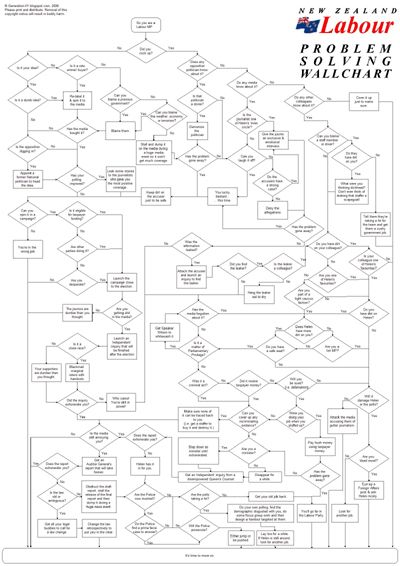
(HT: Generation XY via Heterosexual middle class white male)
(HT: Generation XY via Heterosexual middle class white male)
Saturday, 12 April 2008
Rice in Asia
Lynne Kiesling at Knowledge Problem notes that The price of rice in Vietnam is high. Kiesling explains that this is in line with the prices of most commodities worldwide. There is growing demand across Asia because of economic growth and there have been poor yields recently and thus rice prices are rising. Kiesling goes on to say
This NPR story from this morning did a good job of discussing the nuanced situation for rice farmers in Vietnam; they get higher prices per unit of output, but poor yields have meant less output, and then as consumers they also face higher food prices.Exports from rice-producing countries, such as India and China, have been limited to assure adequate supplies at home. This makes the problem only worse for importing countries. Also, if prices in large rice-producing countries like China and India don't rise because of the export controls what incentives do farmers in these places have to expand production?
Incentives matter: red-light camera file 2
Alex Tabarrok at Marginal Revolution points out that, Incentives are everywhere. His example is
[t]he introduction of automated cameras that ticket people who run a red light has given some cities a "clever" idea - let's reduce the yellow-light period and increase ticket revenue. Here's one example from Dallas.For more on incentive effects of red light cameras see my previous posting, Incentives matter: red-light camera file. Here I point out that red light cameras provide no real safety benefits but do provide revenues, at least until drivers change their behaviour because of them. But now it appears city authorities can change their behaviour to.An investigation by KDFW-TV, a local TV station, found that of the ten cameras that issued the greatest number of tickets in the city, seven were located at intersections where the yellow duration is shorter than the bare minimum recommended by the Texas Department of Transportation (TxDOT).
The city’s second highest revenue producing camera, for example, was located at the intersection of Greenville Avenue and Mockingbird Lane. It issued 9407 tickets worth $705,525 between January 1 and August 31, 2007. At the intersections on Greenville Avenue leading up to the camera intersection, however, yellows are at least 3.5 or 4.0 seconds in duration, but the ticket-producing intersection’s yellow stands at just 3.15 seconds. That is 0.35 seconds shorter than TxDOT’s recommended bare minimum.
Friday, 11 April 2008
Benefits of economic freedom
Roger Kerr has an article (pdf) in the Otago Daily Times today on the benefits of economic freedom using Hong Kong as an example. Kerr makes the point that
In addition it is noted that
Kerr goes on to make the interesting observation
Kerr continues
Hong Kong has essentially a flat income tax regime and as Kerr explains
Kerr ends his article by noting that
At the end of World War II Hong Kong was a small fishing port with a dirt-poor population of 600,000 – its per capita income was about one-quarter that of Britain.An interesting point of comparison is that in 1958 Cuba's per capita GDP was $3,170 while Hong Kong had a per capita GDP of $2,924. Since then these two countries have followed very different development paths in terms of economic freedom . Today Cuba is one of the poorest countries in Latin America, very different from today's Hong Kong.
Today, with a population of around 7 million, Hong Kong enjoys a per capita gross national income (purchasing power parity basis) of US$38,200, above that of Britain and Australia and 40% higher than New Zealand, according to World Bank figures.
In addition it is noted that
... Hong Kong continues to get richer. Over the 10 years 1999-2008, Hong Kong’s real GDP grew by an average of 5.3% a year, compared with New Zealand’s average growth rate of 3.3% in that period, according to the International Monetary Fund.While it is true that Hong Kong’s proximity to mainland China has been a factor in its recent development, it must also be noted that Hong Kong became wealthy before China's rapid increase in economic growth.
Kerr goes on to make the interesting observation
As the Financial Secretary said in the 2008/09 budget in February, Hong Kong upholds “the principle of ‘Big Market, Small Government’, so that the share of public expenditure will be maintained at 20 percent or below of GDP.”As a comparison, according to the OECD New Zealand's total government spending 42%.
Kerr continues
The Financial Secretary went on to say, “A big market can increase the share of the private sector in the economy and allow market forces to allocate our limited resources in the most efficient way for the maximum benefit of the community as a whole. A small government can prevent the public sector from acquiring excessive resources and thus reducing efficiency in the allocation and use of resources.The way Hong Kong got a "big market", given its small internal market, was international trade. The ratio of trade (imports plus exports) to gross domestic product (GDP) is usually larger than 2. For instance, in 2001, the ratio of trade to GDP is pegged at 2.825, the exports to GDP ratio is 1.439, and the imports to GDP ratio is 1.386. For New Zealand, in 2001 the trade to GDP ratio was about 0.7, by 2004 it had fallen to around 0.6.
Hong Kong has essentially a flat income tax regime and as Kerr explains
... the government’s view is that it “should not attempt to narrow the wealth gap by redistributing wealth through high levels of tax and welfare. Such a measure would only inhibit people’s incentive to work hard and, in turn, undermine the productivity and competitiveness of theHong Kong also has an very open labour market with has no statutory minimum wage. Interestingly, it does not have a general competition law regulator, that is there is not Commerce Commission in Hong Kong. Rather it relies on competition in opens markets to control market abuses.
community as a whole.”
Kerr ends his article by noting that
As with other countries, it is not hard to find aspects of Hong Kong’s economic arrangements to cavil at.But also notes, correctly, that
... for countries aspiring to prosperity (getting into the top half of the OECD?) it is a model well worth studying.Not that there are too many politicians in New Zealand who would want to do so.
Thursday, 10 April 2008
A little light reading
The papers for the Brookings Papers on Economic Activity: Spring 2008 Conference should provide a bit of light reading, if you need some. The papers are
- Macroeconomic Crises since 1870 by Robert Barro and Jose Ursua
- The Economics of Place-Making Policies by Edward Glaeser and Josh Gottlieb
- Economic Growth and Subjective Well-Being: Reassessing the Easterlin Paradox by Betsey Stevenson and Justin Wolfers
- Earning from History? Financial Markets and the Approach of World Wars by Niall Ferguson
- When Does Policy Reform Work? The Case of Central Bank Independence by Daron Acemoglu, Simon Johnson, Pablo Querubín, and James Robinson
- Trade and Wages, Reconsidered by Paul Krugman
US starting salaries
From the Kids Prefer Cheese blog we get the following graphic on the average starting salaries by major taken at university for the US. Economics comes in at number 4, but bad news for philosophy majors though. I wonder how different is the situation in New Zealand?

One question is what does the list tell us about the skills required in the modern economy. In particular what do we learn from the top three? All three are basically quantitative, logical and analytical. There looks to be an advantage to critical thinking and problem solving and to some degree being able to do data analysis.

One question is what does the list tell us about the skills required in the modern economy. In particular what do we learn from the top three? All three are basically quantitative, logical and analytical. There looks to be an advantage to critical thinking and problem solving and to some degree being able to do data analysis.
Wednesday, 9 April 2008
The Dismal Science
In a message on his blog, Gavin Kennedy makes the point that Malthus Was Not the Author of the 'Dismal Science'. Most people seem to believe that the term "Dismal Science" was applied to economics because of the writings of Thomas Malthus. In particular his gloomy prediction that population would always grow faster than food, resulting in mankind suffering unending poverty. This is not so, as Kennedy points out
David M. Levy and Sandra J. Peart summarise the story of the naming of the Dismal Science as
Given the true origins of the term, most economists are proud to be members of the Dismal Science.
As for the allusion to Malthus and the ‘dismal; science’ that too is a matter of ignorance (wilful or accidental). It qualifies as an ‘urban myth’.The full title of the Carlyle essay is "Occasional Discourse on the Negro Question" and it appeared in Fraser's Magazine for Town and Country 40: 670-79, 1849. A reply to Carlyle was made by John Stuart Mill under the title "The Negro Question". It was published as an anonymous letter in Fraser's Magazine for Town and Country 41: 25-31 in 1850. A slightly expanded and revised version of Carlyle's 1849 Fraser's Magazine essay was published in 1853 as a separate pamphlet entitled "Occasional Discourse on the Nigger Question".
The notion of economics as the dismal science comes from a pamphlet written by Thomas Carlyle attacking John S. Mill in 1849, not Malthus or Ricardo in the early 19th century.
The cause was a slave rebellion in Jamaica of which Mill advanced the perfectly respectable notion that black slaves were every bit as human as their white slave masters and should be treated as such.
Carlyle was enraged at such a notion and railed against economists for purveying such notions in what, can only be described, as the most disgusting of terms. I leave it to readers to Google Carlyle on slavery to read his words, which was published in his pamphlet, ‘On the Negro Question’, an edition of which was published as ‘On the Nigger Question’.
David M. Levy and Sandra J. Peart summarise the story of the naming of the Dismal Science as
Everyone knows that economics is the dismal science. And almost everyone knows that it was given this description by Thomas Carlyle, who was inspired to coin the phrase by T. R. Malthus's gloomy prediction that population would always grow faster than food, dooming mankind to unending poverty and hardship.Their longer essay on the story is available at The Secret History of the Dismal Science. Robert Dixon discusses the subject in his essay, The Origin of the Term "Dismal Science" to Describe Economics, while the most comprehensive telling of the story is the book How the Dismal Science Got Its Name: Classical Economics and the Ur-Text of Racial Politics by David M. Levy.
While this story is well-known, it is also wrong, so wrong that it is hard to imagine a story that is farther from the truth. At the most trivial level, Carlyle's target was not Malthus, but economists such as John Stuart Mill, who argued that it was institutions, not race, that explained why some nations were rich and others poor. Carlyle attacked Mill, not for supporting Malthus's predictions about the dire consequences of population growth, but for supporting the emancipation of slaves. It was this fact—that economics assumed that people were basically all the same, and thus all entitled to liberty—that led Carlyle to label economics "the dismal science."
Given the true origins of the term, most economists are proud to be members of the Dismal Science.
Peters on trade (updated)
Winston Peters has come out against the trade deal between New Zealand and China. This article from the New Zealand Herald outlines Peters's argument. The article says
The article goes on
The article goes on
Update: Not PC comments on a report of the Peters statement here.
Mr Peters said NZ First wasn't necessarily against trade deals, but the China FTA did not go far enough to address a $3.6 billion trade deficit.But why do we want to "address" the trade deficit? There is nothing wrong with a deficit or a surplus. Why we would want to import the same amount of goods as we export to any particular country is not clear. Should the South Island of New Zealand force the North Island to "import" as many goods from the South as its "exports" to the South? Imports of goods between any two countries will be determined by the demand in each country for the goods of the other country, why should these demands be the same? Even if it is believed that balanced trade for the economy as a whole is a good thing, it doesn't follow that we need have balanced trade with very country we trade with.
The article goes on
"Just over two decades ago the trade doors to New Zealand were thrown wide open in the vain hope that the rest of the world would reciprocate but that has still not happened.But we don't need the rest of the world to reciprocate for trade to make us better off. We gain more if they do reciprocate but we still gain if they don't.
The article goes on
Other reasons he outlined for opposing the deal were:Again why do we care?
FTAs with both Thailand and Singapore had resulted in a worse imbalance of trade.
China's low wages and labour standards made it difficult for local firms to compete;It doesn't matter what the difference in wages is as long as the difference in productivity is greater. So long as the New Zealand-China productivity difference is greater than the New Zealand-China wage difference New Zealand workers can, and will, compete.
The provisions allowing 1800 Chinese workers into New Zealand outside normal immigration channels;Xenophobia aside, the problem is?
providing up to 1000 young Chinese with working holiday visas without any reciprocal arrangement for young New Zealanders;And the problem is?
increasing levels of food imported from China which was threatening domestic sale of New Zealand primary goods.Either locals will buy the imported goods or they won't. If they don't, no problem. If they do, it must be because they prefer them to the local substitutes and so consumers are better of. Local producers can either start producing better goods that the local consumers actually want, or export them - if they can - or both. Competition benefits the local consumer. This looks like an argument for New Zealand producers being able to dump crap products on the local market that they can't sell overseas.
Update: Not PC comments on a report of the Peters statement here.
Moore on trade deal
Mike Moore, former Prime Minister of New Zealand and former Director-General of the WTO has an opinion piece in the New Zealand Herald under the title Global alliances training the tiger. He writes
China has only become integrated into the global economy over the past 20 years. The results for China have been stunning - hundreds of millions of people have been lifted out of extreme poverty.Progress has been made in China on many fronts, economic, social and political. Clearly there is much more to be done, as the situation in Tibet shows, but the way to influence China is to engage with it, to integrate it into the world economy so that world opinion, on issues like human rights, can not be ignored. The more China integrates into the world economy the more it depends on the rest of the world and so the less it can afford to ignore outside views.
This is lifting living standards worldwide, has kept global inflation down, and stretched families' purchasing power. And in part, this is why the last 10 years has seen the most sustained economic growth in history.
There are some who oppose New Zealand's trade deal with China, and want a boycott of the Olympics. It's precisely because China depends on the global trading system that world opinion on human rights now matters to the Chinese.
Thirty million people perished during the cultural revolution and Mao's great leap backwards. World opinion didn't matter to the Chinese then. Now it does, and that's a good thing.
China is going through the same process as Japan, Singapore, and places like Taiwan. As living standards rise, a middle class emerges that seeks out better social outcomes. Wages in the Pearl River delta in China rose 13 per cent last year.
Seven thousand factories will close this year because wages have moved up and these jobs will head inland, or to Vietnam, even Africa. This is the virtue of free markets and globalisation.
For the first time the Chinese Government is answerable to its own laws - you can now sue the Government.
Tuesday, 8 April 2008
Might the Worst Be Over for Africa?
David Warsh at this website Economic Principals asks Might the Worst Be Over for Africa? He writes
At first glance, the news from Zimbabwe last week seems bleak: armed guards, police squads marching in the streets, army veterans threatening to deploy in defense of a dictator Robert Mugabe, whose 28-year-rule unexpectedly has been threatened by the ballot box. Granted, the situation is not as disappointing as in Kenya last winter, where ethnic fighting broke following the disputed election in that nation. Kenya has long been held to be one of Africa’s success stories, whereas Zimbabwe, the once-prosperous Rhodesia, has been in increasingly steep decline ever since hand-over of power from a all-white regime in 1980. Still, the atmosphere in its capital, Harare, is being described by the correspondents there as thundery, at best.The Bates, Williamson, and Coatsworth paper argues
A longer, broader perspective suggests that things may be on the verge turning up for Africa – that, indeed, the election in Zimbabwe may even be a token of just such change. That is the possibility raised by an intriguing paper by Robert Bates and Jeffrey Williamson, of Harvard University, and John Coatsworth, of Columbia University. Published since by the Economic History Review, the working paper from the National Bureau of Economic Research makes fascinating reading for anyone who likes comparative political economy.
Africa and Latin America secured their independence from European colonial rule a century and half apart: most of Latin America after 1820 and most of Africa after 1960. Despite the distance in time and space, they share important similarities. In each case independence was followed by political instability, violent conflict and economic stagnation lasting for about a half-century (lost decades). The parallels suggest that Africa might be exiting from a period of post-imperial collapse and entering a period of relative political stability and economic growth, as did Latin America a century and a half earlier.Walsh goes on to give an interesting discussion as to what the future may hold for Africa in light of what we have learnt from Latin America. Following Bates, Williamson, and Coatsworth he notes that Latin America, like Africa, suffered from internecine warfare, political instability and economic stagnation, after it gained independence. But at a certain point it stabilized and began to grow. Africa’s experience may turn out to be the same, for many of the same reasons. Indeed, the possibility exists that Africa’s evolution could avoid some of the worst side effects of Latin America’s successful transition. Walsh's article is a good read on an important topic. One just have to hope the answer to his question is yes.
Christopher Coyne on EconTalk
This week on EconTalk Russ Roberts gets to talk with Christopher Coyne of West Virginia University and George Mason University's Mercatus Center. They discuss Coyne's book After War: The Political Economy of Exporting Democracy. They talk about the successes and failures of America's attempts to export democracy after a war. In some cases, Japan and Germany, for example, after World War II, American efforts have led to stability and democratic institutions. In many other cases, Cuba, Somalia, and Haiti, for example, and so far, Iraq, American efforts have failed, often repeatedly and have sometimes made things worse. Coyne tries to identify factors that lead to an improved likelihood of success or failure. Ultimately, he concludes that a non-interventionist posture accompanied by unilateral free trade is more likely to benefit citizens under repressive governments.
Monday, 7 April 2008
More Cowen on Sachs
Tyler Cowen has more on Jeff Sach's new book Common Wealth: Economics for a Crowded Planet both here and here.
Adam Smith on the Economics of Wine Making
Gavin Kennedy has an interesting message, at his Adam Smith's Lost Legacy blog, on Adam Smith being not only the father of economics but more importantly the father of wine economics.
I'll drink to that!
I'll drink to that!
Minto on trade (updated x2)
Is it possible to know less about economics than John Minto? I am really beginning to think not. His recent piece in the Christchurch Press on the China free trade deal is a good example as to why I think this. Minto writes
Minto goes on to note that
Later Minto tells us that
It should be pointed out to Mr Minto that the effect of trade on the total number of jobs in an economy is approximately zero. As Paul Krugman has written,
It should also be noted that in a similar way jobs could be created by stopping the use of modern technology. Just imagine how many more jobs there would be in New Zealand in the production of radios, or any good for that matter, if only manufacturers would destroy all of their computers and other technology and replace assembly line production with handicraft manufacturing! Trade displaces (and creates) jobs in the same way as technology does. So if you don't want trade, you also don't want technology improvements.
Professor of Economics at George Mason University, Russell Roberts, makes these points in the context of NAFTA in this blog posting
Minto then says
Mr Minto should enrol in a first year economics course, he would learn much. But he would then have to buy the textbook ... and that is most likely to be imported.
Update: Not PC makes the point that Even free-ish trade is a good thing
Update 2: Kiwiblog outlines the China FTA Details and adds a Well done Helen & Phil.
The government claims New Zealand will benefit from millions of dollars in extra trade which will grow our economy and make us richer.On this point the government is right in the sense that trade will increase the average national income. That means, there will be winners and losers from trade but the winners win more than the losers lose. Hence on average we gain. Another way to look at this result is that the winners can compensate the losers and still be better off.
Minto goes on to note that
Back in the late 1980s New Zealand enjoyed a trade surplus with China. We exported more than we imported.Enjoyed? He goes on
This reversed dramatically when import tariffs were removed or phased out. There was a flood of cheap imports from China which turned the trade surplus into a billion-dollar deficitWhy would we care about a trade surplus (deficit) with anyone? Mr Minto has a trade deficit with his supermarket I'm sure, but does he care? Does he lie awake at night trying to work out ways to "fix" his deficit with the supermarket? If not, why does he worry about a deficit with China? This imports bad, exports good line of thinking is little more than mercantilism. One must ask why the mercantilist myth is still alive today. After all Adam Smith showed the errors inherent in mercantilist thinking more than 200 years ago. Is Minto really that far behind the times?
Later Minto tells us that
The Ministry of Economic Development has estimated 16 jobs are lost for every $1 million of imported products we could make here.A meaningless number if every there was one. To follow this "logic", does it mean that the South Island loses 16 jobs for every $1 million of products imported from the North Island? If so then the South should stop trading with the North. But would this really help the South?
It should be pointed out to Mr Minto that the effect of trade on the total number of jobs in an economy is approximately zero. As Paul Krugman has written,
Constant employment is a reasonable approximation: The standard textbook version of the Ricardian model assumes full employment in both countries. But in reality unemployment is constantly a concern of economic policy -- so why is this the usual assumption? There are two answers. One -- the answer that Ricardo would have given -- is that international trade is a long-run issue, and that in the long run the economy has a natural self-correcting tendency to return to full employment. The other, more modern answer is that countries have central banks, which try to stabilize employment around the NAIRU; so that it makes sense to think of the Federal Reserve and its counterparts acting in the background to hold employment constant. This is not at all the way that non-economists think about the issue. Both supporters and opponents of free trade normally claim that their preferred policies will create jobs; free-traders are forever warning that the Smoot-Hawley tariff caused the Great Depression. And the alternative view does not come at all naturally. During the NAFTA debates I shared a podium with an experienced, highly regarded U.S. trade negotiator, a strong NAFTA suppporter. At one point a member of the audience asked me what I thought the effect of NAFTA would be on the number of jobs in the United States; when I replied "none", based on the standard arguments, the trade official exploded in anger: "It's remarks like that which explain why people hate economists!"Trade will move jobs around an economy but has little effect on the total number of them.
It should also be noted that in a similar way jobs could be created by stopping the use of modern technology. Just imagine how many more jobs there would be in New Zealand in the production of radios, or any good for that matter, if only manufacturers would destroy all of their computers and other technology and replace assembly line production with handicraft manufacturing! Trade displaces (and creates) jobs in the same way as technology does. So if you don't want trade, you also don't want technology improvements.
Professor of Economics at George Mason University, Russell Roberts, makes these points in the context of NAFTA in this blog posting
The most well-known think tank that views NAFTA negatively, the Economic Policy Institute, argues that between 1993 and 2004, Ohio lost 49,886 jobs because of NAFTA.May be the MED should be looking into the number of jobs lost due to the use of technology which has made New Zealand's workers more productive.
Not 50,000, but 49,886.
For the U.S. as a whole, EPI estimates that 1,015,290 jobs have been lost. Not a million, but 1,015,290.
But it's not just the precision of the estimate that makes the calculation ridiculous. It's the methodology that measures jobs displaced (the verb the EPI study usually uses) by assuming that imports destroy jobs and exports create jobs. With this methodology, a trade deficit reduces the number of jobs.
By this logic, America would have fewer jobs if foreigners suddenly decided to give us cars rather than selling them to us. Free foreign cars would destroy jobs in the American car industry. Inexpensive foreign cars do the same thing. So do cars made by Americans that are produced with robots instead of human welders. If you believe that imports destroy American jobs, so does better technology that makes workers more productive.
If the EPI was as anti-technology as they are anti-trade deficit, they could go out and measure the number of buggy manufacturing jobs destroyed by the auto industry and the number of eyeglass manufacturing jobs destroyed by lasik surgery or the number of jobs in the medical profession destroyed by pharmaceutical innovation. Surely those numbers could be estimated with some rough accuracy.
And surely they would tell us nothing about whether the world is a better place because of those innovations. And they would tell us nothing about the impact of those innovations on total employment.
But most of us understand that higher productivity doesn't mean fewer jobs in the United States overall. There are two ways to see it. One is to see the increase in the total number of jobs over time as we have replaced people with machines in every corner of the economy where it's possible. So this suggests that technology doesn't destroy jobs.
The same is true of the apparent effect of trade deficits. Manufacturing employment was shrinking as a share of the total employment between 1950 and 1975 when the trade deficit was essentially zero. We run a trade surplus in agriculture. Yet agricultural employment shrinks rather than rises.
There appears to be no relationship between the number of jobs in America (or in Ohio for that matter) and the trade deficit or increased productivity.
Minto then says
Is it free trade when New Zealand workers are expected to compete with workers paid less than $1 an hour for 16-hour days?The short answer being yes. It doesn't matter what the difference in wages is as long as the difference in productivity is greater. So long as the New Zealand-China productivity difference is greater than the New Zealand-China wage difference New Zealand workers can, and will, compete.
Mr Minto should enrol in a first year economics course, he would learn much. But he would then have to buy the textbook ... and that is most likely to be imported.
Update: Not PC makes the point that Even free-ish trade is a good thing
Update 2: Kiwiblog outlines the China FTA Details and adds a Well done Helen & Phil.
5 Myths About NAFTA
Given that trade deals are in the news here in New Zealand, this Washington Post article on 5 Myths About NAFTA by Philippe Legrain is a useful read. Most of the issues raised are not just issues to do with NAFTA, they apply to trade deals more generally and are sure to be raised in the context of the New Zealand-China free trade agreement. The 5 myths being
- NAFTA has transformed the U.S. economy.
- NAFTA has put countless Americans out of work.
- "Fixing" NAFTA would be easy and cost-free.
- Making NAFTA's labor and environmental regulations stricter would benefit U.S. workers.
- Renegotiating NAFTA should be a priority for the new president.
Sunday, 6 April 2008
Empirical Research on Firms’ Boundaries
In an earlier message I referred to the Lafontaine and Slade survey paper "Vertical Integration and Firm Boundaries: The Evidence" which appeared in the Journal of Economic Literature, Vol. XLV (September 2007). Now the May 2008 issue of the Canadian Journal of Economics, contains a another review article covering the same area. Thomas Hubbard writes on the "Empirical Research on Firms’ Boundaries." Hubbard's aim is not to give a survey of the empirical literature in the normal sense but rather he tries to give sense of where he thinks the literature is, how it got there, and where it might go next. The four main points he makes in the essay are:
(HT: Organizations and Markets)
- A large share of the empirical literature has examined whether firms’ boundaries vary with the degree of asset specificity. Most papers in this literature find evidence that integration is more likely where asset specificity is higher, though many of them examine contexts where assets are large and long-standing and relationship-specific investments are accordingly large.
- A more recent literature, which emphasizes incentives and control, has examined contexts where relationship-specific investments are not as prominent. Variation in the contracting environment plays an important role in these studies. My general inference from this literature is that outsourcing implies strong, but not necessarily good, incentives. Whether outsourcing’s strong incentives are good incentives depends critically on the contracting environment and the interaction between asset ownership and the division of labor. The specific implications of this general conclusion thus depend on context-specific details.
- The empirical literature is long on examining the nature of firms’ boundaries in specific contexts and relating it to theory, but short on quantifying the effect of this organizational decision and on establishing general cross-industry patterns. More evidence on these fronts would usefully complement the theory-testing industry studies that have dominated the literature to date.
- Researchers have made important methodological advances, though not in the same sense as in other empirical fields where such advances are more rooted in econometrics. This progress has led researchers to establish strong ties between theoretical concepts, the applied context, and the data in the context of these industry studies. These advances have led to a more-or-less standard way of conducting and communicating theoretically motivated industry studies; advances in other dimensions are necessary for broader or more quantitatively oriented research to become equally developed.
(HT: Organizations and Markets)
The "French way"
On the website of the Conservative Institute of M. R. Stefanik in Bratislava, Pierre Garello, Professor of Economics at the Univeristy Paul Cézanne Aix-Marseille, gives his view of the French economy and the French way of thinking about the economy and society. He argues that the "French way" approach to economic and social policies is nothing more than the "third way" and in many aspects is the "socialist way". A way, in Garello's view, to a dead end.
Garello says,
Garello says,
... that the French economy is doing poorly is obvious. Unemployment is still fairly high (7.8% end of 2007); so that nearly 3 millions individuals would like to work but don’t find a job. GDP growth is sluggish (1.7% in 2005, 2.2. in 2006 and below 2% in 2007) so that, in a once wealthy country, GDP per capita is now close to the average for OECD countries.He goes on to say that to find the cause of such problems is not easy
Prospects for the future are not good either. France has one of the fastest growing national public debts (14% of State revenues serves the interest of the debt) and the money borrowed has not been used for investment. Worse: France has left almost untouched its pay-as-you-go system so that taxpayers will have to make a tremendous effort in the coming decades.
[b]ut it can surely not be imputed to France endorsing free market policies! As a matter of fact, regardless of their political circle, French politicians (and citizens) despise the market system and, if they have to put with it, they attempt to regulate it by every possible mean.Garello illustrates this anti-market view with a few examples. He writes,
I have already mentioned that France has a fully State-run retirement pension system, hence avoiding the capital market. The education system, with 1.2 millions civil servants, is another illustration of “the French way”. This system is indeed close to breaking a world record in terms of centralization. Hence, if greater autonomy was recently given to universities, this does not include the possibility to select students or ask for tuition. Besides retirement scheme and education, the State interferes in many fields and the consequences are invariably the same. Hence, even though we are able to walk on the Moon, in France there is a shortage of housing. This housing crisis is due to a long-standing desire to regulate urban development and control rents. Another issue that concerns the present government is the high price of basic products (such as food and cleaner). From both the politicians’ and the consumers’ perspective, retailers are to be blamed; they raise prices to increase their profits at the expense of consumers. The truth, however, is that this is due to a regulation limiting the creation of new malls and of hard discounters and therefore limiting competition. Finally, to give the right dimension of the involvement of the State in economic and social life, let us recall that France is today second among OECD countries in terms of public spending (54% of GDP), just after Sweden (at 56% but down from 67.5% in 1993).The "French way" does appear to be having a (bad) effect on the young.
In a recent poll (L’Express 2948, January 3rd, 2008) some questions were put to individuals between 16 and 29 years of age from various countries. As it turns out, in France only 27% of them believe they have a bright future ahead of them (compare to 60% in Denmark), only 26% believe they will get a good job (compare to 60% in the US). Also, a record low 20% of the youth thinks that globalization brings new opportunity and a record low 11% say they are ready to pay taxes for the older generations.This is not a good look for the future of a country. Garello concludes by noting that even if the French can not see the dangers of the third way
... let’s hope, at least, that the French experience will lead other countries to opt for wiser policies. That is, to stick to the principles of free market and individual responsibility and to refuse to entrust to the State everything. Including their soul.
Incentives matter: red-light camera file
We learn from this article at the msnbc website that red-light cameras, installed for "safety reasons", but which also just happen to to increase ticket revenues for the city authorities, since they record those who run red lights and issue fines automatically, are in fact bringing city revenues down. Since drivers at those intersections monitored by cameras learn not to run red lights they reduce ticket revenues. Naturally, city authorities are upset and are planning to remove the cameras.
But not running red lights at least looks good from a safely point of view, if not for revenues. But even this is not so clear cut. The law of unintended consequences comes into play. As the article says,
But even this isn't the end of the story. While rear-end collisions go up, right-angle collisions — "T-bone crashes," when a car comes across the intersection and hits you from the side — go down. But a study by the Federal Highway Administration in the US argues that overall red light cameras led to no real change in the number of accidents and they reduce the number of people hurt in those accidents by just less than 5 percent. The msnbc article states,
(HT: Peter Klein at Organizations and Markets)
But not running red lights at least looks good from a safely point of view, if not for revenues. But even this is not so clear cut. The law of unintended consequences comes into play. As the article says,
In Lubbock, Texas, the City Council shut down all its cameras last month, citing a report that showed statistically significant increases in rear-end collisions at intersections, including those with cameras.Image it, people changing their behaviour when you change the incentives they face, who would have thought?
Rear-end collisions, in fact, have been cited in numerous reports and lawsuits questioning the benefits of red light cameras. Opponents claim that the cameras actually create more hazardous conditions.
“When people know there’s a red light camera, they change their driving behavior, and they slam on their brakes trying to avoid a ticket,” said Tom McCarey, an activist for the National Motorists Association.
But even this isn't the end of the story. While rear-end collisions go up, right-angle collisions — "T-bone crashes," when a car comes across the intersection and hits you from the side — go down. But a study by the Federal Highway Administration in the US argues that overall red light cameras led to no real change in the number of accidents and they reduce the number of people hurt in those accidents by just less than 5 percent. The msnbc article states,
The FHA concluded that cameras provide, at best, a “modest aggregate crash-cost benefit.”So red light cameras provide no real safety benefits but do provide revenues ... until drivers change their behaviour.
(HT: Peter Klein at Organizations and Markets)
Saturday, 5 April 2008
Incentives matter: petrol prices file
An article at Boston.com notes
The number of T [public transport] trips rose from 27 million in February 2007 to nearly 30 million in February 2008, up more than 11 percent for the month, Massachusetts Bay Transportation Authority officials said. The numbers were up about 5 percent for January. Combined, the average increase is 8.3 percent.Why? According to the article
The rising MBTA numbers follow a national trend. More Americans rode public transportation last year than at any time in history, according to the American Public Transportation Association, ...
The high cost of gasoline has helped fuel a sharp increase in MBTA riders over the first two months of the year and a decrease in the number and length of traffic jams, according to T officials and traffic specialists.
Tsvangirai on the economy in Zimbabwe
Morgan Tsvangirai, the leader of the Movement for Democratic Change in Zimbabwe, had an article in the Wall Street Journal just before the seemingly never ending presidential election in Zimbabwe got under way. Tsvangirai wrote
Economic mismanagement by Mr. Mugabe's government is an even more serious problem. Zimbabwe's inflation and unemployment rates are 150,000% and 80% respectively. Infrastructure is crumbling, and education and health-care systems have collapsed. Life expectancy is now among the lowest in the world, having declined, since 1994, to 34 years from 57 years for women, and to 37 years from 54 for men. Some four million of my fellow citizens have fled the country, taking with them both human and financial capital.Later he writes
Today, Zimbabwe ranks last out of the 141 countries surveyed by the Fraser Institute's Economic Freedom in the World report. According to 2007 World Bank estimates, it takes 96 days to start a business in Zimbabwe. It takes only two days in Australia. Waiting for necessary licenses takes 952 days in Zimbabwe, but only 34 days in South Korea. Registering property in Zimbabwe costs an astonishing 25% of the property's value. In the United States, it costs only 0.5%.On the size of government he notes
The third factor responsible for the country's decline is the size and rapaciousness of the government. Today, that size is determined by the requirements of patronage. But a government that provides hardly any public services cannot justify the need for 45 ministers and deputy ministers, all of whom enjoy perks ranging from expensive SUVs to farms that were confiscated from others.The central bank in Zimbabwe is also criticised
The Central Bank too has departed from its traditional role of stabilizing prices. Instead, it dishes out money to dysfunctional, government-owned corporations that are controlled by the ZANU-PF and are accountable to no one. The result is runaway growth in the money supply, and the highest inflation rate in the world. Zimbabwe's potential for economic growth cannot be realized without macroeconomic stability. Hyperinflation must be tamed, in part by taming the government's appetite for spending.Zimbabwe's SOEs are in Tsvangirai view
... woefully inefficient, a strain on the budget and a much-abused vehicle for ZANU-PF patronage. They will be privatized or shut down.Nothing in the article makes for good reading, but its all the worse because Zimbabwe was, not so long ago, a rich, by African standards, country. Today its a cot-case, even by African standards.
Cuss-o-meter
Created by OnePlusYou

After having checked for swearing I redid the Blog Readability Test. The last time I did this I was told you needed a postgraduate education to read this blog. Now I discover the reading level is ..............

Irrational compeittion?
As many will already know Tim Harford gives rational advice on all subjects in his column, "Dear Economist". In the past Harford has offered advice on things from romance, odd socks and intimate waxing all based on good rational economic theory. But now he has "irrational" competition. Dan Ariely, author of the book Predictably Irrational, proposes to offer "irrational" advice to one and all. Check out his page here.
Economic models and geographical maps
At the Free Exchange blog they make a nice point about the use of models in economics by using an analogy between economic models and geographical maps.
(HT: The visible hand in economics)
Most are equilibrium models, which means they rely on a set of assumptions that rarely hold in the market. That does not diminish their value. Economic and financial models can be thought of as a map. If a map included every detail in the geography (trees, country roads, etc.) it would be intractable, rendering it useless. Maps do give you a sense of scale and how variables relate. This facilitates your journey, but does not eliminate unforeseen diversions and the potential for accidents.Economic models aren't perfect, and they don't have to be, they just have to be better than the alternative. Economists know their models are not perfect and thus are constantly trying to improve them. But as with all models it is the ability to simplify, sensibly, that makes an economic model useful in the first place.
(HT: The visible hand in economics)
Friday, 4 April 2008
Support an Academic Future for Adam Smith's House (updated)
Below I have reproduced the whole of a message from Gavin Kennedy's blog Adam Smith's Lost Legacy (A very interesting blog if you want to learn about Adam Smith). It is I think self explanatory:
URGENT: Support an Academic Future for Adam Smith's House in Edinburgh The closing date and time for the purchase of Adam Smith's "Panmure House" in Edinburgh (off the famous Royal Mile between the Castle and Holyrood Palace) is tommorow, Friday 4 April, 12 noon. Bids will be considered and decided upon by the City Council, probably by Tuesday (due to holidays).Update: Eamonn Butler of the Adam Smith Institute comments on Adam Smith's house.
It has been put on the market for sale by its current owners, Edinburgh City Council, and advertised as a 'development opportunity'.
The 'Panmure House Project' has been working away to raise awareness of the sale and to seek support for its purchase by a body that will restore it sympathetically as a 16th century building (the external building is in good condition) and as Adam Smith's home from 1778-1790.
The Panmure Poject's web site HERE contains links to 29 external and internal pictures of its current condition and you are invited to visit its webpages, and to pass the link to colleagues and friends.
The signed letter that has been sent to the City Council is on the Panmure Project web site site and you can email your agreement to add signatures to it for the second posting. Economists from various countries, including Scotland, of course, have already lent their support.
Please consider sending your named of support that can be mustered the more likely that the City Council will add to their criteria of a suitable purchaser the need to show that the restoration and the use of Panmure House will have significant 'public benefits'. Funding is being sought from private sources (no taxpayers' money is involved - as you would expect in Adam Smith's name!).
Such persuasion will likely be forthcoming from those intending to create in Panmure House a centre of academic excellence in Adam Smith and the Enlightenment, disseminating education in economics at all levels, from schools to university post-graduate, and as a centre within Edinburgh's most famous 'tourist' attraction, the Royal Mile, for increasing the awareness of Adam Smith's Works.
Adam Smith is buried 100 yeards from Panmure House and he worked at the Royal Exchange and Customs House (now Edinburgh's City Chambers) about 500 yards up the hill in the High Street, opposite which, on the 4th July, a 20-foot statue of Adam Smith will be unveiled. The date is auspicious given Adam Smith's empathy with the case of the British colonists in America up to 1776, when Wealth Of Nations was first published.
Visit the web site of the Panmure Project HERE and please pass on the link as much and as far as you can.
Economic freedom and inequality
Tim Worstall brings to our attention this new paper entitled, Economic Freedom and the Trade-off between Inequality and Growth (pdf). In the paper economic growth is defined as the real growth in per capita gross domestic product (GDP) in U.S. dollars. The results of the paper are given as
As Worstall puts it
All else equal, the central findings are:So the study tell us that the largest economic benefits for those who are the lowest income earners comes from a relatively free market with a limited role for government. The upshot being that the greater income that comes from economic growth ultimately raises the incomes of the low-income groups more than an increase in the equality of incomes brought about by a redistribution of income.Conversely, nations in which the government more aggressively redistributes income have significantly lower rates of economic growth. In the long run, this income redistribution hurts the poor. For example, among the countries analyzed in this study:
- Freer economies enjoy higher rates of economic growth than less free ones.
- Freer economies are more equal economies; economic freedom reduces inequality by increasing the share of market income going to the poor and lowering the share going to the rich.
- Economic growth increases income inequality, but the effect is small.
- Overall, the increase in inequality from economic growth is outweighed by the reduction in inequality caused by greater economic freedom — creating a net benefit to lower income groups.
- Lowering a country’s Gini coefficient by 0.01 would require reducing the income share of the rich by 0.6 percent and redistributing it to others.
- However, this would lower the economic growth rate by 1.6 percentage points (from 2.3 percent to 0.7 percent).
- With the transfer, but a lower growth rate, average household income in the lowest group would reach only $8,050 after 25 years, instead of the $10,320 that would be achieved without the transfer.
As Worstall puts it
... we can be more free, more equal and richer, or less free, less equal and poorer.The choice does seem obvious.
The State of the State in New Zealand
At the website of the The New Zealand Centre for Political Research the former Secretary of the New Zealand Treasury, Graham Scott has written recently on Some Concerns about the State of the State in New Zealand. He writes about the ever increasing influence of politicians in the New Zealand economy and society more generally. He points out that the state is becoming more involved in many areas. His list includes,
Scott continues by noting
Its not clear that the government's interventions have been in areas where the Hart, Shleifer and Vishny arguments would suggest the government should be involved. Banking, for example, is not a area where cost reduction come at the expense of quality, where innovation is unimportant or where there are any problem with government procurement. So why have the government owning a bank? Also government involvement in Air New Zealand is hard to justify on these grounds. As noted above, the case for private sector provision is stronger when quality reducing cost reduction can be controlled through competition, and the airline industry is very competitive, when quality innovations are important, and we want a high quality and innovative airline industry, and when patronage and powerful unions are a severe problem inside the government, which are things we wish to avoid with an airline. Here private provision makes sense.
Scott also makes the important point that
Our Universities are to be guided and planned by a politically appointed Tertiary Education Commission that is to be brought into the inner circle of – until now – apolitical policy advisers. The primary industries are to be fed taxpayer resources to pursue government initiated strategies for breakthrough technical innovations. Air New Zealand has been partially nationalised and then criticised for not conforming to government policies that are not in law. The Government is trying to prohibit shareholders in Auckland Airport from selling their shares to a Canadian pension fund – scarcely a threat to national sovereignty. The rail lines were nationalised – or more accurately the massive costs of maintaining them were - and there is talk of further nationalisation. Spending under the public health system has been tilted strongly towards public providers that are subject to detailed ministerial intervention. A commissioner has been appointed in two DHBs.He also notes that
Directors of state enterprises are complaining about the level of political intervention and the balance of political connections and professional skills in choosing boards has shifted towards the former. The State has returned to the banking business.More than 10 years ago Spicer, Emanuel and Powell (Transforming Government Enterprises: Managing Radical Organisational Change in Deregulated Environments (1996)) warned of the possibility that the government would want to take control of some firms again. They wrote,
[a]lthough New Zealand's SOE legislation is a paragon of clarity and simplicity, what can be expected of corporatised entities is limited as the SOE model on which corporatisation is based is itself inherently fragile and unstable.They argue that there are two pressures on SOE's: the first being towards privatisation since the productivity and efficiency gains achieved by SOE are in danger of being eroded over time. Privatisation is a way of both cementing in the commercial orientation of enterprises and wringing out further gains resulting from the high powered incentive and control mechanisms which can be bought to bear in privately owned and publicly traded companies. The second pressure on SOEs is towards being pulled back into the public sector where social and political objectives can be more readily be meet. What we have seen under the Clark government is the second of these pressures being very strong. But not for socially useful reasons. Most interventions seem to be more politically motivated.
Scott continues by noting
This pattern of deeper political control was signalled early and has been implemented. So we are headed for an election debate not just about the usual tussle over policy settings but also about whether this expansion of state influence is desirable or whether it is undesirable.On whether is this is economically desirable or not we have to ask when is government control and production preferable? As a general guide, Hart, Shleifer and Vishny ("The Proper Scope of Government: Theory and an Application to Prisons", Quarterly Journal of Economics, 112(4): 1127-61, November 1997) argue that the case for government provision of goods or services is generally stronger when non-contractible cost reductions have large deleterious effects on quality, when quality innovations are unimportant and when corruption in government procurement is a severe problem. It has been argued that the case for government production is strong in such services as the conduct of foreign policy, police and armed forces. The case can also be made reasonably persuasively for the case of prisons. The case for private sector provision is stronger when quality reducing cost reduction can be controlled through contract or competition, when quality innovations are important and when patronage and powerful unions are a severe problem inside the government.
Its not clear that the government's interventions have been in areas where the Hart, Shleifer and Vishny arguments would suggest the government should be involved. Banking, for example, is not a area where cost reduction come at the expense of quality, where innovation is unimportant or where there are any problem with government procurement. So why have the government owning a bank? Also government involvement in Air New Zealand is hard to justify on these grounds. As noted above, the case for private sector provision is stronger when quality reducing cost reduction can be controlled through competition, and the airline industry is very competitive, when quality innovations are important, and we want a high quality and innovative airline industry, and when patronage and powerful unions are a severe problem inside the government, which are things we wish to avoid with an airline. Here private provision makes sense.
Scott also makes the important point that
It is also important to continue the search for more stable and predictable policy frameworks where the role of the state is prescribed and procedures defined for the use of its powers of intervention. Examples are the fiscal responsibility provisions in the Public Finance Act, The Reserve Bank Act, the State Owned Enterprises Act and the Commerce Act. New rules to stabilize the share of the state in the economy and impose a national benefit test on regulatory powers in the manner of the Regulatory Responsibility Bill before the Parliament would also help to establish a sounder basis for economic policy than the haphazard intervention of ministers with short political fuses. These practices typified the Muldoon administration and are in evidence again today as for example with the intervention of the Auckland Airport.Having well defined and enforced rules as to when and how the state can use its powers of intervention and coercion are needed not just to ensure an efficient and growing economy. But perhaps even more importantly they are needed to protect our individual freedoms from abuse by the state.
Thursday, 3 April 2008
CAFTA and Honduras
Many observers is somewhat sceptical about the supposed benefits of free trade deals. Think about some of the reactions to New Zealand and China negotiating a trade deal or the reactions to NAFTA of candidates in the current nomination races in the US. A lesser known trade deal is The Central American Free Trade Agreement (CAFTA). There is a new discussion paper from the International Food Policy Research Institute that looks at the impact that the CAFTA changes in tariffs and quotas are likely to have on producers, wages, national income, and poverty in Honduras.
The paper uses a computable general equilibrium (CGE) model and a microsimulation model to simulate the impact of the CAFTA changes. The abstract of the paper reads,
The paper uses a computable general equilibrium (CGE) model and a microsimulation model to simulate the impact of the CAFTA changes. The abstract of the paper reads,
In this paper we develop a dynamic CGE model to examine the impact of CAFTA on production, employment and poverty in Honduras. We model four aspects of the agreement: tariff reductions, quotas, changes in the rules of origin for maquila and more generous treatment of foreign investment. We first show that trade liberalization under CAFTA has a positive effect on growth, employment and poverty but the effect is small. What really matters for Honduras is the assembly (maquila) industry. CAFTA liberalized the rules of origin for imports into this industry. That raises the growth rate of output by 1.4% and reduces poverty by 11% in 2020 relative to what it would otherwise have been. Increasing capital formation through an increase in foreign investment in response to CAFTA has an even larger impact on growth, employment and poverty.
These simulations say something important about the growth process in a country like Honduras in which it seems reasonable to assume that there is underemployed, unskilled labor willing and able to work more at a fixed real wage. In such an economy changing the structure of demand in favor of sectors that use a lot of unskilled labor will have a big impact on growth. That is what the maquila simulation does, because maquila uses a lot of unskilled labor relative to skilled labor and capital. Alternatively the supply of capital can be increased by increasing the rate of capital formation. Either of these two has a far larger impact on growth and poverty than tariff reductions alone.
soc2econ
There is a blog soc2econ which is run by "... a group of sociologists trying to save economics from itself". May be it could be pointed out to these guys that economics doesn't need saving from itself. Also given my quick read of the site I'm not sure what they know about economics.
The Economic Logician goes further and makes comments on a number of points the site makes:
The Economic Logician goes further and makes comments on a number of points the site makes:
Economists barely do a literature review in their papers. Fair, economists know little about their previous generation, but that is also because the tool set has changed (for the better), we have learned a lot in the meanwhile, and some problems where simply not addressed forty years ago. I would rather argue that this obsessions with literature reviews that sociologists have is not moving research much forward, but rather in circles.
Neo-classical economics works on perfect information. Only on problems where imperfect information is not critical to answering the research question. There is ample literature that deals with imperfect information, in fact this is what all of game theory, principal-agent theory, and much of industrial organization, contract theory, law and economics, public economics and even macroeconomics is about!
The core of PhD schooling is not history of economic thought. While is it certainly interesting to learn how Economics got to where it is now, Economics is about concrete current problems, not philosophizing about past motivations of scholars with limited tools and data. Not disrespect to scholars of economic thought, but solving development problems does not hinge of our understanding of the debate between Ricardo and Malthus.
Mont Pelerin Society essay question
2008 Hayek Essay Topic
Question:For more information see here.
In The Constitution of Liberty Hayek says that "we are probably only at the threshold of an age in which the technological possibilities of mind control are likely to grow rapidly and what may appear at first as innocuous or beneficial powers over the personality of the individual will be at the disposal of government. The greatest threats to human freedom probably still lie in the future."1
Has Hayek's gloomy warning been borne out by events, or has technology become more a force for liberating people from government?
Prize Information
First prize: $2500 cash award + travel grant*
Second prize: $1500 cash award + travel grant*
Third prize: $1000 cash award + travel grant*
(HT: Not PC)
Subscribe to:
Posts (Atom)