Sunday, 25 November 2012


Friday, 23 November 2012
"What if?" lecture (Wednesday 28 November, 7.30 – 9.00pm)
Next week's University of Canterbury "What If?" lecture will be given by Dr Eric Crampton on the topic:
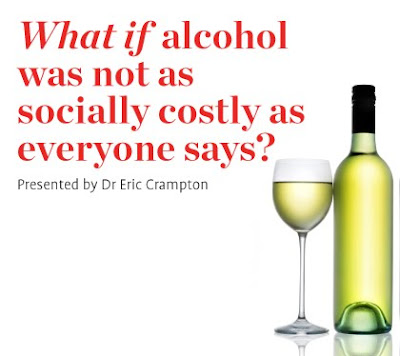
What if alcohol was not as socially costly as everyone says?

In his review of New Zealand's alcohol legislation, Law Commissioner Rt. Hon. Sir Geoffrey Palmer pointed to the large gap between alcohol's social costs, estimated at $5.3 billion, and the excise tax take of $795 million as justifying much tighter controls. But what if the cost figure were wildly wrong? Should we really consider, for example, $700 million of drinkers' own expenditures on alcohol as a social cost? Dr. Crampton will discuss his work comparing social costs, as measured in the public health literature, with more standard economic notions of cost. For economic numbers to meaningfully inform policy, they must be produced using standard economic methods that allow comparison of costs across different policy areas. Dr. Crampton will then discuss the influence of bad statistics around alcohol on the Law Commission's review and on legislation before noting some of the other, less publicized, findings around alcohol and moderate drinking. While the harms from hazardous drinking are very real, exaggerating alcohol's harmful effects while ignoring moderate drinkers' enjoyment makes for poor policy.
|
| Date: Wednesday 28 November Time: 7.30 – 9.00pm |
Innovative govenrment?
When writing, at the Groping towards Bethlehem blog, about how to make government more innovative Bill Kaye-Blake says that private business has a pretty clear goal - make money - and this forces them to be innovative. But he says,
Why the scope of government question may help us with the innovative question is the answer that HSV come up with when they examined the conditions which determine the relative efficiency of in-house provision versus outside contracting of government services. Their arguments suggest that the case for in-house provision is generally stronger when noncontractible cost reductions have large deleterious effects on quality, when quality innovations are unimportant, and when corruption in government procurement is a severe problem. In contrast, the case for privatisation is stronger when quality reducing cost reductions can be controlled through contract or competition, when quality innovations are important, and when patronage and powerful unions are a severe problem inside the government.
The bits in bold can help us think about the question of how to make government more innovative, let the private sector do it!
The incentives faced by the public sector just aren't those you want if you want innovation. The private sector lives or dies by how well they innovate. How well they improve the goods and services they provide to customers. How well they can reduce costs while improving quality. It is the high-powered incentives of the market, a bottom line that matters, that drives innovation. Governments use softer incentives because they have different aims, they have goals which are "fuzzy and changing", for which lower-powered incentives are appropriate. But this does mean that government, because of its very nature, is unlikely to be hugely innovative.
Government, on the other hand, doesn’t necessarily have clear goals. It’s a bit about keeping people happy, keeping things ticking over, improving the living standards of some people while not harming others too much, responding to pressures from all sides. The goals are fuzzy and changing. The bureaucracy compensates by creating clear processes. When things go wrong, bureaucracies often defend their actions by saying, ‘we followed the correct procedures.’We may be able to get a handle on how to make government more innovative by asking what could seem an odd question in this context: Which goods or services the government should provide? This question has addressed in a paper by Oliver D. Hart, Andrei Shleifer and Robert W. Vishny, 'The Proper Scope of Government: Theory and an Application to Prisons'. "Quarterly Journal of Economics", 112(4) November 1997: 1127-61.
The push for innovation puts government in a new quadrant. Now, bureaucrats are asked to challenge their own processes, to think continuously about how they can do better. The goals are still fuzzy — that’s the nature of governing — but now the process is, too. This quadrant creates a quandary: how are they to know what ‘better’ is?
Why the scope of government question may help us with the innovative question is the answer that HSV come up with when they examined the conditions which determine the relative efficiency of in-house provision versus outside contracting of government services. Their arguments suggest that the case for in-house provision is generally stronger when noncontractible cost reductions have large deleterious effects on quality, when quality innovations are unimportant, and when corruption in government procurement is a severe problem. In contrast, the case for privatisation is stronger when quality reducing cost reductions can be controlled through contract or competition, when quality innovations are important, and when patronage and powerful unions are a severe problem inside the government.
The bits in bold can help us think about the question of how to make government more innovative, let the private sector do it!
The incentives faced by the public sector just aren't those you want if you want innovation. The private sector lives or dies by how well they innovate. How well they improve the goods and services they provide to customers. How well they can reduce costs while improving quality. It is the high-powered incentives of the market, a bottom line that matters, that drives innovation. Governments use softer incentives because they have different aims, they have goals which are "fuzzy and changing", for which lower-powered incentives are appropriate. But this does mean that government, because of its very nature, is unlikely to be hugely innovative.
Thursday, 22 November 2012
Does economics need saving from economists?
In a piece in December 2012 issue of The Magazine Coase writes about Saving Economics from the Economists. He opens his article by noting,
Peter Klein argues that the inductive method being utilised by Coase has its limits,
Economics as currently presented in textbooks and taught in the classroom does not have much to do with business management, and still less with entrepreneurship.He continues,
The degree to which economics is isolated from the ordinary business of life is extraordinary and unfortunate.He goes on to write,
That was not the case in the past. When modern economics was born, Adam Smith envisioned it as a study of the “nature and causes of the wealth of nations.” His seminal work, The Wealth of Nations, was widely read by businessmen, even though Smith disparaged them quite bluntly for their greed, shortsightedness, and other defects. The book also stirred up and guided debates among politicians on trade and other economic policies. The academic community in those days was small, and economists had to appeal to a broad audience. Even at the turn of the 20th century, Alfred Marshall managed to keep economics as “both a study of wealth and a branch of the study of man.” Economics remained relevant to industrialists.My own experience as someone with an interest in the theory of firm certainly is one where "production is marginalized in economics". In New Zealand the production side of the economy receives much less emphasis than the demand/consumer/government parts of the economy. Coase sees the lack of interaction between the working economy and economics as damaging to both.
In the 20th century, economics consolidated as a profession; economists could afford to write exclusively for one another. At the same time, the field experienced a paradigm shift, gradually identifying itself as a theoretical approach of economization and giving up the real-world economy as its subject matter. Today, production is marginalized in economics, and the paradigmatic question is a rather static one of resource allocation. The tools used by economists to analyze business firms are too abstract and speculative to offer any guidance to entrepreneurs and managers in their constant struggle to bring novel products to consumers at low cost.
Since economics offers little in the way of practical insight, managers and entrepreneurs depend on their own business acumen, personal judgment, and rules of thumb in making decisions. In times of crisis, when business leaders lose their self-confidence, they often look to political power to fill the void. Government is increasingly seen as the ultimate solution to tough economic problems, from innovation to employment.As I have said before,
Economics thus becomes a convenient instrument the state uses to manage the economy, rather than a tool the public turns to for enlightenment about how the economy operates. But because it is no longer firmly grounded in systematic empirical investigation of the working of the economy, it is hardly up to the task. During most of human history, households and tribes largely lived on their own subsistence economy; their connections to one another and the outside world were tenuous and intermittent. This changed completely with the rise of the commercial society. Today, a modern market economy with its ever-finer division of labor depends on a constantly expanding network of trade. It requires an intricate web of social institutions to coordinate the working of markets and firms across various boundaries. At a time when the modern economy is becoming increasingly institutions-intensive, the reduction of economics to price theory is troubling enough. It is suicidal for the field to slide into a hard science of choice, ignoring the influences of society, history, culture, and politics on the working of the economy.
I see it as a social science with close relationship with moral and political philosophy, political science, psychology etc. But this it seems is a minority view.and I would argue that to include the "the influences of society, history, culture, and politics on the working of the economy" economics need to expand its interaction with the other social sciences and not just see itself as purely a handmaiden to management and accounting, as others I know seem to think.
Peter Klein argues that the inductive method being utilised by Coase has its limits,
Economics provides general principles, or laws, about human action and interaction, mostly stated as “if-then” propositions. Applying the principles to concrete, historical cases requires Verstehen, and is the task of economic historians (as analysts) and entrepreneurs (as actors), not economic theorists. Deductive theory does not replace judgment. Without deductive theory, however, we’d have no principles to apply, and nothing to contribute to our understanding of the economy except — to quote Coase’s own critique of the Old Institutionalists — “a mass of descriptive material waiting for a theory, or a fire.” To be sure, Coase’s own inductive method has led to several brilliant insights. Coase himself has a knack for intuiting general principles from concrete cases (e.g., theorizing about transaction costs from observing automobile plants, or about property rights from studying the history of spectrum allocation), though not perfectly. But, as I noted before, Coase himself is probably the exception that proves the rule — namely that induction is a mess.Coase turns 102 in December and yet he can still generate and stimulate debate about big issues in economics.
Economics is fun!
Beeronomics 2013 - The Economics of Beer and BrewingThis is one area where doing empirical work has a lot going for it!
Conference
18th to 21st September 2013
York, United Kingdom
Website: http://www.beeronomics2013.org
Contact person: Dr Ignazio Cabras
Beeronomics 2013 aims to be an ideal forum for high-quality economic research related to beer and brewing activities. The conference will cover topics such as economics, law and policy, marketing and consumption, industrial organisation, innovation.
Organized by: The York Management School, University of York
Deadline for abstracts/proposals: 8th March 2013
Check the event website for more details.
Is corruption bad for growth?
The obvious answer is yes, but is that right. As Peter Boettke argues it may not be
Chris Blattman argues that many development experts overstate the case against corruption. He argues that: "Most of us fail to imagine that corruption can also grease the wheels of prosperity. Yet in places where bureaucracies and organizations are inefficient (meaning entrepreneurs and big firms struggle to transport or export or comply with regulation), corruption could improve efficiency and growth. Bribes can act like a piece rate or price discrimination, and give faster or better service to the firms with highest opportunity cost of waiting." This is an important argument to consider.In a 1994 paper Shleifer and Vishny show that when side payments between a politician and the manager of a firm are allowed, or more bluntly, when the manager and the politician can freely bribe each other, then the manager and the politician will reach the jointly efficient solution independently of the initial allocation of ownership and control rights. Such analysis is a straightforward application of the Coase theorem to privatization and does suggest that.corruption does have its uses.
Wednesday, 21 November 2012
First it was price gouging now its rent gouging
New Zealand First shows off its level of economic understanding by saying:
More Evidence Of Rent Gouging In ChristchurchNo "rent gouging" is part of the solution to the housing shortage in Christchurch. Does Denis O'Rourke not realise that supply curves slope upwards. Yes as price (rent in this case) increases so does quantity supplied. If you want people to build more houses in Christchurch, or to supply more of the existing houses as rentals, the best incentive they can get in an increase in what they can rent those houses for. Letting the price system work for the best thing that can be done to fix the housing shortage. A rent freeze would just slow the rate of new house building and stop people from adjusting their living arrangements. A rent increase could mean, for example, that someone in a house that is too big for them would have an increase to sublease part of the house or move into a smaller home thereby freeing up their former house for someone who needs a larger home.
New Zealand First says more evidence of rent gouging has emerged with a Christchurch family with nine young children landed with a rent increase of $100 a week to take their weekly rental from $460 to $560.
Christchurch Earthquake Issues spokesperson Denis O'Rourke says this vindicates repeated calls from New Zealand First for a short term rent freeze in the city.
“This is irrefutable evidence that rent gouging is continuing as a result of the housing shortage in Christchurch in the aftermath of the earthquakes.
Tuesday, 20 November 2012
Diversity in academia?
From the Daily Princetonian:
The majority of University faculty and staff members who have donated to the 2012 presidential candidates have donated to President Barack Obama’s campaign, according to numbers tracked by the Center for Responsive Politics in Washington, D.C.The question is, How representative is Princeton?
A total of 157 University faculty and staff members donated directly to the presidential candidates, with only two of those donations going to Gov. Mitt Romney, the records show. Total donations directly to Obama exceeded $169,000, while donations to Romney summed to exactly $1,901.
Incentives matter: travel costs file
From the IEA, London, blog:
According to a review commissioned by the Department of Social Security, ‘the costs of travelling to work will ... be a factor in some people’s decisions about whether to look for or accept employment’. Indeed, one survey found that 50 per cent of unemployed people cited ‘extra costs such as travel’ as a major cause for concern about leaving benefits. Moreover, ‘travelling costs will also be a regular expense which may influence decisions about whether to remain in a particular job’. Studies of low-income families suggest that earnings from low-paid employment are significantly reduced by travel-to-work costs, with a particularly acute problem in rural areas.
EconTalk this week
John Cochrane of the University of Chicago and Stanford University's Hoover Institution talks with EconTalk host Russ Roberts about how existing regulations distort the market for health care. Cochrane argues that many of the problems in the health care market would go away if these distortions were removed. In this conversation, he explores how the market for health care might work in the United States without those distortions. He also addresses some of the common arguments against a more choice-oriented, less top-down approach.
You will be able to see Cochrane in person when you attend the 2012 Condliffe Memorial Lecture in Economics at Canterbury on Wednesday, 5 December, 6:30pm.
You will be able to see Cochrane in person when you attend the 2012 Condliffe Memorial Lecture in Economics at Canterbury on Wednesday, 5 December, 6:30pm.
Sunday, 18 November 2012
What’s a vote worth?
A question asked by John Gibson in a column at VoxEU.org. He notes that even before the turmoil of Hurricane Sandy, many Americans were considering not bothering to register a vote for their next president. By looking at the costs and benefits of voting, this column argues that not voting may actually be the rational choice.
Why bother voting? The probability of casting the deciding ballot is infinitesimally small in national elections. Hence, the cost of voting normally exceeds any plausible value of expected benefits from the preferred candidate winning.
It is highly unlikely that the benefits for a voter from any politician's platform are going to be large enough to counter the cost of voting. Thus if voting is rational it comes down to a comparison of the costs with the consumption benefits. But if these costs and benefits are small, the decision to vote is sensitive to small variations in either term. If these small effects are hard to measure, individual voter turnout will seem largely random and random voting presents a seemingly difficult challenge for the rational voter model.
Gibson offers some new research on the opportunity cost of voting.
Why bother voting? The probability of casting the deciding ballot is infinitesimally small in national elections. Hence, the cost of voting normally exceeds any plausible value of expected benefits from the preferred candidate winning.
It is highly unlikely that the benefits for a voter from any politician's platform are going to be large enough to counter the cost of voting. Thus if voting is rational it comes down to a comparison of the costs with the consumption benefits. But if these costs and benefits are small, the decision to vote is sensitive to small variations in either term. If these small effects are hard to measure, individual voter turnout will seem largely random and random voting presents a seemingly difficult challenge for the rational voter model.
Gibson offers some new research on the opportunity cost of voting.
Along with my collaborators, I have recently reported results in Public Choice [...] with very precise measures of the opportunity cost of voting. To calculate these costs we cross-referenced individual voter turnout in a general election from New Zealand with GIS estimates of the road distance from residential areas to the nearest polling station. By combining travel time estimates from Google Maps with estimated wages for the survey respondents, we obtained a detailed measure of the opportunity cost of time spent travelling to and from the polling station.So all of us who choose not to vote in elections are, as we have always thought, making a rational decision.
Our results show that even very small costs may deter voter turnout. Each extra kilometre – or two minutes’ driving time – to the nearest polling booth reduces turnout by one percentage point, all else the same. These effects are robust to various sources of confounding, including endogenous sorting of residential location, measurement error, and non-linearities. These results support one implication of rational voter theory [...] that “if the B (benefits) or PB (benefits weighted by the probability that a person’s vote matters) term is indeed quite small, then a small increase in the cost of voting – such as driving a mile instead of a half-mile to the polls – would significantly reduce turnout.”
Non-nested testing shows that using our new measure of the opportunity cost of time spent voting, formed by combining estimated travel time with imputed wages, outperforms simpler distance-based measures of costs. We find that small increases in the opportunity costs of time can have large effects in reducing voter turnout. For example, at an opportunity cost of NZ$10 (equivalent to US$8) the predicted national turnout would be just 75%, which is down seven percentage points from the mean. In urban areas, predicted turnout falls even more sharply with respect to opportunity costs.
While the external validity of findings from New Zealand would typically be limited, a number of features of this setting allow for especially clean estimates of the impacts of opportunity costs on turnout.
Hence, the triennial election for national parliament is the only politically important election in New Zealand, as well as the only one that involves in-person voting.
- First, the general election voting is on a Saturday and almost always in person, so it is reasonable to assume that people are travelling from their home (the locations of which we use in the GIS algorithm).
- Second, registering to vote is compulsory, while voting is not, so there is no two-stage decision to model of whether first to register and then to vote.
- Third, our measure of individual turnout comes from an electoral survey which is validated by checking against the electoral rolls, so there is no over-reporting of voting as often happens with other surveys.
- Finally, this is a setting with ample polling places per voter, little road congestion, little use of absentee ballots, and no state/provincial governments, upper house, or an elected executive or judiciary.
Showing that small opportunity costs of voting matter for voter turnout even in this setting extends and corroborates the findings of the previous, more spatially limited, case studies in the political science literature. An important implication follows from finding that opportunity costs are low, but that turnout is still sensitive to those low costs. If these low costs were not able to be accurately measured (as has typically been the case previously), then the decision to vote would (erroneously) appear largely to be random.
I, Pencil: the video version
The Competitive Enterprise Institute offers here this six-plus-minute-long video that brings “I, Pencil” to life. The video is written by Nicole Woods Ciandella and produced by Nick Tucker.
(HT: Cafe Hayek)
(HT: Cafe Hayek)
Saturday, 17 November 2012
Manufacturing fetishism
About a month ago Labour, New Zealand First and the Green party set out to create the perception that we have a manufacturing crisis in New Zealand when they launched a parliamentary inquiry into the manufacturing crisis. The use of such a political stunt does raise an interesting question, Why this obsession with manufacturing?
Why is it that these politicians - and others - seem to have a manufacturing fetish? They seem to think that only making physical things counts. "Thinking industries", for want of a better term, are discounted, they are subordinate to the real activity of making things.
Well the economist John Kay make have the answer: it's hard wired into us:
Why is it that these politicians - and others - seem to have a manufacturing fetish? They seem to think that only making physical things counts. "Thinking industries", for want of a better term, are discounted, they are subordinate to the real activity of making things.
Well the economist John Kay make have the answer: it's hard wired into us:
The rear cover of the iPhone tells you it is designed in California and assembled in China. The phone sells, in the absence of carrier subsidy, for about $700. Purchased components - clever pieces of design such as the tiny flash drive and the small but high-performing camera - may account for as much as $200 of this. The largest supplier of parts is Samsung, Apple's principal rival in the smartphone market. "Assembled in China" costs about $20. The balance represents the return to "designed in California", which is why Apple is such a profitable company.Our politicians should realise that in a globalised world the physical labour incorporated in manufactured goods is a cheap commodity. But the skills and capabilities that turn that labour into products of extraordinary complexity and sophistication, that is the "thinking" that underlies these products, are not.
Manufacturing fetishism - the idea that manufacturing is the central economic activity and everything else is somehow subordinate - is deeply ingrained in human thinking. The perception that only tangible objects represent real wealth and only physical labour real work was probably formed in the days when economic activity was the constant search for food, fuel and shelter.
A particularly silly expression of manufacturing fetishism can be heard from the many business people [PSW: and I would add politicians] who equate wealth creation with private sector production. They applaud the activities of making the pills you pop and processing the popcorn you eat in the interval. The doctors who prescribe the pills, the scientists who establish that the pills work, the actors who draw you to the performance and the writers whose works they bring to life; these are all somehow parasitic on the pill grinders and corn poppers. [Emphasis added]
Interesting blog bits
- Gavin Kennedy writes on A Must Read New Book on Friedrich Hayek
The publisher describes Eamonn Butler’s “Friedrich Hayek” as “a breath of intellectual fresh air”. I concur, for Butler is refreshingly easy to read. He is a brilliant communicator and needs to be to compress Hayek’s many volumes of his lifetime’s writings into 146 pages and hold his readers’ attention. Scholars familiar with Hayek’s works and general readers exposed to them for the first time will find much here worthy of their attention.
- Eric Crampton on Flynn effects
Professor Flynn is trying to help you improve your mind. My review of his latest book should be in today's Christchurch Press. They gave me 450 words; I took 480.
- James Zuccollo asks Have election turnouts been falling?
After appallingly poor turnouts in recent local elections in the UK The Guardian has a post implying that election turnouts have been falling over time.
- Matt Nolan on Careful with the CGT “silver bullet”
In New Zealand people are looking for a lot of ways to solve many perceived problems with a quick policy solution. One that is being suggested is a capital gains tax.
- Tim Harford on Growth or bust
If there were more corporate collapses, the economy would be a healthier place.
- Eric Crampton on Advertising, brands, and prices
Advertising both persuades and informs. Informative advertising makes markets more competitive, reducing prices faced by consumers; persuasive advertising that reinforces brand loyalty segments markets and increases prices paid by consumers.
- Peter Cresswell on Hard Labour is coming for you
Want to know what dangerous fantasies inhabit Labour activists’ minds? Wonder no longer, as all the dopy policy remits activists have dreamed up for consideration at this weekend’s Hard Labour conference have now been published online.
- Peter Cresswell on Deep Green
Since I’ve just posted below just some of the dopiness promoted by Hard Labour activists, I thought it only fair to update my on-going study of their coalition partners favourite word: “ban.”
- Greg Mankiw asks Should we repeal anti-gouging laws?
He gives some readings on this question.
- Jennifer Hunt on The impact of immigration on the educational attainment of natives
Are poorly-educated immigrants’ kids dragging native classmates down? Or do schoolchildren push themselves when new, smarter immigrants join their class? This column argues that although child immigrants may sometimes bring down native minorities, on the whole, poorly educated natives upgrade their education in response to new immigrants in the classroom.
- Tim Harford on How Adam Smith could help the Church
- Gavin Kennedy on Adam Smith's Authentic Views On Church and State
Tim Harford (of ”Undercover Economist” fame) writes in the Financial Times (16 November): “How Adam Smith could help the Church” “Laurence Iannaccone, an economist who has specialised in the economics of religion, developed an idea he drew from the writings of Adam Smith: that more competitive religious marketplaces lead to more dynamic churches.”
- Eric Crampton on Cheap plonk
It's not crazy to argue for the combination of a lower alcohol excise tax and a minimum per-unit price for alcohol if harm-causing drinkers disproportionately choose the cheapest plonk while moderate drinkers choose more expensive drinks.
Pay and the quality of journalism
When talking about what to do about bad journalism at the BBC Chris Dillow at the Stumbling and Mumbling blog writes, with regard to the idea that better pay may lead to better journalists and thus better journalism, that:
If we are dealing with a case of post-contractual asymmetric information then moral hazard is the issue. Here if a worker's "effort" is not overly important to the outcome or where a worker's effect can be monitored reasonably costlessly then moral hazard would not be a great problem. But again, such jobs are likely to be lower paid jobs. The big moral hazard problems are more likely to occur in positions for which effort can not be monitored and where this matters for the outcome. Such jobs are likely to be at the high end of the wage distribution so using higher pay, via say some form of performance pay, to counter moral hazard is more likely to be seen at the high wage end of the wage distribution.
Also the notion that
The claim that high pay is necessary to attract and motivate good workers is not merely an economic postulate. If it were, it could apply across the wage distribution. Instead, it functions as a defence of inequality - used to justify higher pay for the rich, rather than for any job. For grunt workers, wages are a cost to be minimized regardless of consequence.I don't follow Chris's argument. That pay can be used as a way of dealing with the problem of "low quality" workers arises in cases of asymmetric information. If we face pre-contractual asymmetric information then we have an adverse selection problem. If we are dealing with a low-skilled position, so even if we don't know the skills of a worker it may not matter much or the workers skills can be verified at relatively low cost, then adverse selection may not matter much. Such positions are likely to be at the lower end of the wage distribution while positions where a worker's skills matter and are unobservable are more likely to be high skilled jobs at the upper end of the wage distribution. Thus the use of high pay as a way of increasing the proportion of high quality workers in your pool of applicants is more likely to occur at the high wage end of the wage distribution.
If we are dealing with a case of post-contractual asymmetric information then moral hazard is the issue. Here if a worker's "effort" is not overly important to the outcome or where a worker's effect can be monitored reasonably costlessly then moral hazard would not be a great problem. But again, such jobs are likely to be lower paid jobs. The big moral hazard problems are more likely to occur in positions for which effort can not be monitored and where this matters for the outcome. Such jobs are likely to be at the high end of the wage distribution so using higher pay, via say some form of performance pay, to counter moral hazard is more likely to be seen at the high wage end of the wage distribution.
Also the notion that
For grunt workers, wages are a cost to be minimized regardless of consequence.makes no sense. A profit maximising firm will select the profit maximising combination of pay and effort. While lowering pay will lower costs it can also lower profits if the detrimental effects on "effort" are large enough and thus firms will not choose this low wage/low effort combination.
Effects of "local" trade
An idea that comes up every now and then when talking about trade is that we should only trade "locally". Somehow local trade is more virtuous than non-local trade. Leaving aside the obvious problem of defining the "local" in local trade trade there is still the problem of the actual effects of such a restriction. One issue to keep in mind is that restricting trade to the local region means you limit the size of the market and thus you are limited in your ability to take advantage of specialisation and the division of labour. As George Stigler put it “The Division of Labor is Limited by the Extent of the Market”. In short you make yourself poorer than you would otherwise be.
Matt Ridley offers a nice example of the problem in his book "The Rational Optimist":
Matt Ridley offers a nice example of the problem in his book "The Rational Optimist":
In the same vein, Kelly Cobb of Drexel University set out to make a man's suit entirely from materials produced within 100 miles of her home. It took twenty artisans a total of 500 man-hours to achieve it and even then they had to get 8 percent of the materials from outside the 100-mile radius. If they worked for another year, they could get it all from within the limit, argued Cobb. To put it plainly, local sourcing multiplied the cost of a cheap suit roughly a hundred-fold.So local production is possible but only at a high price.
Friday, 16 November 2012
Wise words
David Uren the economics editor at The Australian newspaper has written an article entitled Crude economic nationalism will impoverish us. A title that says it all really.
He writes,
He writes,
At the root of economic nationalism is a belief that foreigners are taking control of what is rightfully ours. The profits that they are generating belong to us, and our children. Economic nationalists believe the state should regulate foreign influence, promoting national interest over that of the foreigner.Yes the numbers are based on Australia data but the basic argument applies just as well to New Zealand. What makes us rich is having lots of goods and services to consume. Where the profits from producing these consumables goes doesn't matter. What does matter is making sure that the producers of the goods and services are the most efficient producers of them and allowing foreign investment increases the likelihood of having the most efficient firms doing the producing.
Treasury has usefully calculated what it would mean if Australia were to limit the inflow of foreign capital, which appears to be the preferred position of at least some in the Coalition.
In a new study, Treasury analysts consider what would occur if the inflow of foreign money, which has averaged about 4 per cent of gross domestic product over the past four decades, were restricted by one percentage point.
Certainly, Australia would accumulate fewer foreign liabilities, meaning that less would flow abroad in dividends and interest. The currency would fall with reduced demand for Australian dollars, and export volumes would rise as a result.
But these benefits would be outweighed by the fall in investment and the reduction in consumption. Wages would be lower over the long term, while employment would fall in the short term. People would be worse off overall, with national income falling by 0.5 per cent every year for at least a decade.
"Restrictions on capital inflow (including foreign investment) would reduce Australian investment, production and incomes," the study concludes.
It follows that liberalising capital flows would be wealth generating. Foreign capital is supplementing domestic savings to sustain much higher levels of investment than are achieved in any other advanced economy. Foreign direct investment is risk capital. Investors are taking a chance on Australia. Their investments will be serviced with dividends only for so long as they are profitable.
Thursday, 15 November 2012
Incentives matter: statistics file
From The Times,
(HT: Tim Worstall)
The challenges facing the new breed of politicians who take control of police forces tomorrow were put in sharp focus as five detectives were arrested in an anti-corruption investigation.Be careful what targets you set to manage or measure outcomes because as soon as you’ve set them you give people the incentive to game them.
The Times can disclose that the officers from Kent Police — four men and a woman — were detained at their police station and questioned over allegations of manipulating statistics in order to meet crime detection targets.
The officers, a detective inspector, a detective sergeant and three detective constables, are accused of persuading suspects to confess to offences they had not committed in order to improve the unit’s performance statistics.
(HT: Tim Worstall)
Discrimination in labour markets: evidence from Italy
Of all topics in economics discrimination in the labour market maybe one of the most studied but it is also one of the least understood. Part of the problem when looking at the adverse labour-market outcomes of certain categories of workers (for example, ethnic minorities or women), it is very difficult to disentangle the effects of discrimination and other often-unobserved aspects such as low ability or social norms and peer effects.
Eleonora Patacchini, Giuseppe Ragusa and Yves Zenou examine this topic using data from a study which utilised the sending of fictitious résumés to real help-wanted ads in Rome and Milan. Their results are summarised in a column at VoxEU.org. They were looking at the effects of homosexuality and beauty on labour markets outcomes.
Patacchini, Ragusa and Zenou write,
Eleonora Patacchini, Giuseppe Ragusa and Yves Zenou examine this topic using data from a study which utilised the sending of fictitious résumés to real help-wanted ads in Rome and Milan. Their results are summarised in a column at VoxEU.org. They were looking at the effects of homosexuality and beauty on labour markets outcomes.
Patacchini, Ragusa and Zenou write,
We experimentally manipulate 'perceived homosexuality' by randomly modifying résumés by adding items that reveal sexual preferences. At the same time, we randomly attach to the résumés a picture of the candidate where these pictures have been previously ranked in terms of beauty. We restrict the field experiment to seven occupations, the most frequent ones that do not require specific skills, i.e. administrative clerk, bookkeeper, call-centre operator, receptionist, sales clerk, secretary and shop assistant.They continue,
The experiment started on 17 January 2012 and ended on 21 February 2012. During this period, for each city and occupation, we selected the most recent employment ads published in two websites, Job Rapido and Monster. They are the most popular websites among actual jobseekers. We answered to 531 ads, 336 in Milan and 195 in Rome. We typically sent four résumés in response to each ad, two from the treatment group and two from the control group. We sent 2,320 résumés in total.and
The overall response rate was about 11%, with a minor difference between males and females (10.83% and 11.24%, respectively). Looking at the percentages by city, the response rate was higher in Rome (about 16%), where men were more likely to be called back than women (17.48% versus 14.96%). On the contrary, in Milan, the overall response was roughly divided by two (about 8%) and men were less likely to be called back than women (7.19% versus 9.10%).
We find that there is a statistically significant penalty (in terms of callback rates) associated to gay men of about 3% whereas gay women do not seem to show a significant difference in callback rate with respect to straight women. The 3% penalty for gay men is quite high since the callback rate for males is 10%, which means that compared to gay men, they have 30% less chance to be called back.So the results suggest the existence of discrimination against gay men and the less attractive female workers. The fact that high-skilled pretty women obtain less beauty premium than low-skilled pretty women may indicate the fear of competition with these women for certain types of jobs. Importantly, the results show that the beauty results are particularly relevant for occupations requiring the interaction with customers as secretaries, receptionists and general customer service.
We also investigate whether the penalty associated with gay people is mitigated for high-skilled individuals. Interestingly, we find the opposite result. The penalty is actually higher for high-skilled gay people, with an associated magnitude of more than 8% for gay men. No penalty or premium is instead associated to high-skilled lesbians, confirming that only men are penalised in the labour market for their sexual orientation.
When we instead look at differences in response rates by picture beauty, our analysis indicates a significant premium for attractive women of about 2% and no significance difference between handsome and ugly men. We then investigate whether the beauty premium for women varies by skills. We find that high-skilled attractive women are called back less often than low-skilled attractive women. This may indicate that beauty might not be an advantage for high-skilled women.
The beginning of the "knowledge economy"
Over the last 30 years or so we have often been told we are in a new economy, a "knowledge economy". The knowledge economy is, we are told, something new and exciting, very different from any other economy we have known before. But is this true, are we in any more of a "knowledge economy/society" now than we were during Neolithic times, the Agricultural Revolution, the Renaissance or the Industrial Revolution? When and why did the knowledge economy actually start?
Matt Ridley explains the knowledge economy's rather surprising origins in his book "The Rational Optimist":
When discussing the question, What happened to the Neanderthals? Tudge (1998: 25) argues
Matt Ridley explains the knowledge economy's rather surprising origins in his book "The Rational Optimist":
"There is now little doubt that hominids spent much of those million and a half years eating a lot of fresh meat. Some time after two million years ago, ape-men had become more carnivorous. With their feeble teeth and with finger nails where they should have had claws, they needed sharp tools to cut the skins of their kills. Because of their sharp tools they could tackle even the pachydermatous rhinos and elephants. Biface axes were like external canine teeth. The rich meat diet also enabled erectus hominids to grow a larger brain, an organ that burns energy at nine times the rate of the rest of the body. Meat enabled them to cut down on the huge gut that their ancestors had found necessary to digest raw vegetation and raw meat, and thus to grow a bigger brain instead. Fire and cooking in turn then released the brain to grow bigger still by making food more digestible with an even smaller gut - once cooked, starch gelatinises and protein denatures, releasing far more calories for less input of energy. As a result, whereas other primates have guts weighing four times their brains, the human brain weighs more than the human intestine. Cooking enabled hominids in ids to trade gut size for brain size". (Ridley 2010: 51).So our brains developed thanks to cooking and eating meat and it is our brain that allowed us to develop our social and economic institutions in such a way as to get us to our current economy. This tells us that the origins of our economy are ancient and it also suggest that only the economies humans can have are knowledge economies. Our brains are the foundation of our social and economic life and have been from the beginning.
When discussing the question, What happened to the Neanderthals? Tudge (1998: 25) argues
“[t]he Cro-Magnons [ ...] got to know the habits of the animals they hunted and knew where to lie in wait; and different bands shared information, so hunting parties could be forewarned of migrations days in advance.”He goes on to say
“[m]ost importantly of all [ ...] the Cro-Magnons co-operated: that they traded tools - for which there is abundant evidence - and also traded information. Thus [ ...] the age of trade (and of information) is exceedingly ancient.” (Tudge 1998: 26).In his discussion of the Gravettian culture which lasted in Upper Palaeolithic Europe from at least 29,000 years ago to around 21,000 years ago Finlayson (2009: 165) writes,
“[n]aturally people had to find ways of moving around without having to carry heavy loads; they also had to find ways of reading the land and of communicating with each other with precision. The Gravettians had entered the information age.”He also notes the importance of information build-up and its relationship to population growth,
“[o]verall, Ancestors were displaying the adaptability and range of behaviours that has characterized their pre-glacial ancestors and also the Neanderthals. The main difference, and one that was to become increasingly evident as time went by, was that as populations increased in size and information networks became more sophisticated, these people had a corpus of accumulated knowledge that they could draw from. This process of information build-up became less vulnerable to loss as populations grew but at this stage was still not foolproof; the extinction of the knowledge and skills of the painters of western Europe shows us how precarious it remained.” (Finlayson 2009: 196).When discussing the economic and geographic expansion of the Upper Paleolithic population Ofek (2001: 173) writes
“Upper Paleolithic people apparently used local resources more efficiently than their predecessors - or their Neanderthal neighbors - if the latter still existed as a separate entity at the time (Klein, 1989). Such a sudden increase in the “wealth” of populations suggests a corresponding improvement in the allocation of resources in society, most likely, in my opinion, through the mechanisms of division of labor, exchange, and investment in the most consequential resource of all: Human Capital [ ...].” (Emphasis in the original).So the argument that the knowledge economy is new, in a historical time sense, is not entirely convincing.
Subscribe to:
Posts (Atom)