Tuesday, 11 March 2008

Globalisation: technology v. politics

Many observers of and commentators on the world economy would argue that the globalisation phenomenon we see today is by and large a technological issue. Once learned, with few exceptions, new technologies are typically not forgotten which is why many see globalisation as an irresistible force. However it can also be argued that a more careful study of history shows that globalisation is as much a political as a technological phenomenon. This means that it can easily be reversed. This argument is made in an article on VoxEU.org by Ronald Findlay and Kevin H. O'Rourke. The article is Lessons from the history of trade and war and uses the lessons of history to identify challenges for 21st century globalisation.

Findlay and O'Rourke explain that
... history also tells us that politics matters for globalisation in a far more fundamental way. The new steam technologies of the Industrial Revolution would never have had the effect that they did if they had not operated within the context of a stable geopolitical system within which the Royal Navy guaranteed the freedom of the seas for all; within which wars between the major European powers were relatively rare; and within which those same European powers used their military superiority to impose more or less open trade on most of Africa and Asia. With the outbreak of World War I, that geopolitical system was destroyed, and 19th century globalisation with it, despite the fact that technological progress continued unabated during the interwar period. And while in the rich countries of Western Europe and North America the post-1945 period saw a gradual reconstruction of open trading conditions, deglobalisation characterised much of the rest of the world until the 1980s thanks to the spread of communism and decolonisation, which themselves had their roots in the century's two world wars, and the intervening economic debacle.
The Findlay and O'Rourke article is based on their recent book, Power and Plenty: Trade, War, and the World Economy in the Second Millennium, Princeton University Press 2007. Findlay and O'Rourke note that,
The 'Power and Plenty' of the book's title refers of course to the mutual dependence of trade and warfare during the Mercantilist era, when the links between commerce and violence were particularly explicit and clear. But great expansions of world trade were linked to conquest even earlier. The pax Britannica and pax Americana which provided the geopolitical stability underlying the globalisations of the 19th and late 20th centuries have their counterpart in the pax Mongolica of the 13th and 14th centuries, which produced an impressive integration of the Eurasian economy. The Muslim conquests, which unified a vast region stretching from India to the Atlantic, provide an earlier example, while the Iberian conquests of the 16th century provide an even more spectacular later one.
What then are the lessons for the 21th century? What challenges might arise to threaten the current period of globalisation?
One striking feature of today's international economy is that, as in the 19th century, regions with very different factor endowments are being drawn into closer contact with each other, as what used to be known as the Third World opens up to the rich countries of the North. Will the modern day equivalents of the farmers of 19th century Europe, namely unskilled workers in the OECD, eventually press for and obtain a rolling back of trade liberalisation?
Later they argue,
Even more fundamentally, the continuation of a broadly liberal international trading environment will require that the geopolitical system adapt to the rise of China, India and other "Third World" giants. In a historical context, this represents of course the restoration of the status quo ante, the end of a "Great Asymmetry" in international economic and political affairs caused by the Industrial Revolution, which was itself in large part a product of the interactions between early modern Europe and the rest of the world. But that is not to say that such an adjustment will be easy. The international system has historically done a pretty poor job of accommodating newcomers to the Great Power club. German unification and industrialisation during the late 19th century led to tensions with Britain and France over colonial and armament policy, while Japan's rise to regional prominence during the interwar period, and its search for secure sources of raw materials, ended in war against United States and its allies. Both precedents are worrying, in that similar questions are posed today, both in terms of the rights of emerging nations to rival the established powers' military capabilities (notably with regard to nuclear weapons), and in terms of the strategic importance to countries like China of ready access to oil supplies and other natural resources.
This last point cause Findlay and O'Rourke to reflect on the idea that trade does not necessarily guarantee peace. Trade implies interdependence, while interdependence implies vulnerability, and vulnerability can lead to fear. This can have unpredictable consequences, as Anglo-German rivalry in the run-up to World War 1 and Japanese reactions to the Great Depression and Smoot-Hawley both show. If there is any lesson that we can draw from history, it is that history has not ended. But hopefully we can lean enough from it, not repeat the worse parts of it.

Monday, 10 March 2008

Spending other peoples money

The National Business Review reports that regional governments and large customers have, Grand plans in the wings if govt buys rail. We are told,
Regional governments and large customers have ambitious wish lists for a renaissance in rail if the Government buys back all the rail assets and ferries it sold in 1993.
But who, you my wonder, is going to pay for these "grand plans"? Unfortunately it will be the taxpayer. And plans are always "grander" when paid for with other peoples' money. Why, if these regional governments think owning a railway is so great, don't they go to the people in their regions and ask them to pay for it? The answer is, of course, they would say no. Also if these "large customers" want to put their "ambitious wish lists" into action, why don't they go to their shareholders for the money. Again because they would say no.

The most interesting bit of the article is this sentence,
Many commentators are saying the state has to own rail because it is uneconomic.
If it really is uneconomic, which it may be, then why should anybody own it? Why should we have it at all? Therefore the first thing the government should do is either show that rail is in fact economic, and if so which bits, or justify why the taxpayer should pay for an uneconomic system. It will do neither.

(HT: Not PC)

The law of unintended consequences: times two

Columnist Jeff Jacoby has an article in the Boston Globe on How government makes things worse. Jacoby opens by asking
WHAT DO ethanol and the subprime mortgage meltdown have in common?
The answer is the Law of Unintended Consequences. In the case of ethanol Jacoby argues,
Take ethanol, the much-hyped biofuel made (primarily) from corn. Ethanol has been touted as a weapon in the fashionable crusade against climate change, because when mixed with gasoline, it modestly reduces emissions of carbon dioxide. Reasoning that if a little ethanol is good, a lot must be better, Congress and the Bush administration recently mandated a sextupling of ethanol production, from the 6 billion gallons produced last year to 36 billion by 2022.

But now comes word that expanding ethanol use is likely to mean not less CO2 in the atmosphere, but more. Instead of reducing greenhouse gas emissions from gasoline by 20 percent - the estimate Congress relied on in requiring the huge increase in production - ethanol use will cause such emissions to nearly double over the next 30 years.
Jacoby goes on to note that
The subprime mortgage collapse is another tale of unintended consequences.
In this case the problem is the 1977 Community Reinvestment Act.
The crisis has its roots in the Community Reinvestment Act of 1977, a Carter-era law that purported to prevent "redlining" - denying mortgages to black borrowers - by pressuring banks to make home loans in "low- and moderate-income neighborhoods." Under the act, banks were to be graded on their attentiveness to the "credit needs" of "predominantly minority neighborhoods." The higher a bank's rating, the more likely that regulators would say yes when the bank sought to open a new branch or undertake a merger or acquisition.

But to earn high ratings, banks were forced to make increasingly risky loans to borrowers who wouldn't qualify for a mortgage under normal standards of creditworthiness. The Community Reinvestment Act, made even more stringent during the Clinton administration, trapped lenders in a Catch-22.

"If they comply," wrote Loyola College economist Thomas DiLorenzo, "they know they will have to suffer from more loan defaults. If they don't comply, they face financial penalties . . . which can cost a large corporation like Bank of America billions of dollars."

Banks nationwide thus ended up making more and more subprime loans and agreeing to dangerously lax underwriting standards - no down payment, no verification of income, interest-only payment plans, weak credit history. If they tried to compensate for the higher risks they were taking by charging higher interest rates, they were accused of unfairly steering borrowers into "predatory" loans they couldn't afford.
The backers of both these pieces of legislation I'm sure had good intentions, but the outcomes are bad. Why? There seem to be many examples of such outcomes, too many for it to be just bad luck. Political markets do not seem to punish inefficiency in the way we would expect economic markets to do. The incentives that politicians face are just don't seem to be right. But the incentives for politicians ultimately come from the voters. So if voters don't like the outcomes do they only have themselves to blame? Or is it that politicians are captured by special interest groups? But if they are, why? Why can't voters see the dangers of such capture and punish those politicians who act for interest groups. Is it that asymmetric information means there are rents associated with economic policy and the politicians are better informed about them than the voters. Voters will be unsure of the distribution of these rents, because they lack the necessary information. This gives politicians room to use these rents to their own personal advantage without the voters knowing, so they can not be punished. Or is it that the rational voter is just a myth?

(HT: Greg Mankiw)

How not to write about asymmetric information. (updated)

Recently I read a paper on why business schools in some universities, including those in New Zealand, seek to gain accreditation from organisations such as the Association of MBAs, Association for the Advancement of Collegiate Schools of Business (AACSB) International and the European Foundation for Management Development. The paper examined at number of topics but the section that interested me most was on "Information Asymmetry" and its relevance to accreditation.

The section opens with the statement,
The problems associated with asymmetric information were first analysed by economist Kenneth J. Arrow (1963) ...
But then what was Adam Smith doing back in 1776 when he wrote about the lack of proper incentives inherent in slavery,
the work done by slaves, though it appears to cost only their maintenance, is in the end the dearest of any. A person who can acquire no property, can have no other interest but to eat as much, and to labour as little as possible.
Or in his discussion of the incentives facing directors of joint stock companies,
The directors of such companies, however, being the managers rather of other people's money than of their own, it cannot well be expected that they should watch over it with the same anxious vigilance with which the partners in a private copartnery frequently watch over their own. Like the stewards of a rich man, they are apt to consider attention to small matters as not for their master's honour, and very easily give themselves a dispensation from having it. Negligence and profusion, therefore, must always prevail, more or less, in the management of the affairs of such a company.
Also what are we to make of Hayek (1937) and (1945). If these papers are not about asymmetric information then what are they about? Berle and Means (1932) examined the problems arising from the separation of ownership and management. Barnard (1938) was an early attempt to develop a general theory of incentives in management. All before Arrow.

Then we are told that
Sometimes referred to as information asymmetry, Arrow's theory describes transactions where one party (usually the seller) has more information about the product being sold than the other party.
Of course today we know the issue is much wider than that. Note that the whole moral hazard literature seems to be excluded under the above statement.

Then we find out that
Information asymmetry leads to the typical "agency" problem. An agency relationship occurs when one individual (the principal) depends on the action of another (the agent). Difficulties arise when the agent has more information than the principal, or the principal cannot perfectly and costlessly monitor the agent’s action and information (Ro, 1988).
These last two sentences don't sit well with each other. The first describes a situation of moral hazard with hidden action while the second could apply to moral hazard with hidden action, moral hazard with hidden information or adverse selection. In fact one of the problems with this whole section is that the distinction between these three different problems resulting from asymmetric information is never made. And at different times in the discussion each or any of the three could be what is meant. Also, it should be noted that even if the principal can perfectly and costlessly monitor the agent's action and information, but this can not be verified to an outside third party, eg the courts, then problems of incompleteness of contract can occur. An issue not considered in this section. With regard to the notion that
Difficulties arise when the agent has more information than the principal...
it should be noted that while this is true, it is also true that difficulties arise when the principal has more information than the agent. So why is it not relevant here?

Following on we learn that,
Ro further contends that "information is a primary source of transaction costs."
This also is true but its relevance to the discussion is not made clear. Also problems with transaction costs can give rise to incomplete contracts rather than the comprehensive contracts discussed in this section. The example given at this point is
... sales representatives are employed, and advertising undertaken, so that businesses can relay information about the quality of goods they are selling. The dissemination of that information is a cost to the business. The information conveyed, however, tells the prospective purchaser (principal) that the company (agent) is committing significant resources to the product and has confidence of its quality.
But are these costs transaction costs or just costs of production? As Allen (1999) makes clear there are two definitions of transaction costs: Transaction Costs 1: the costs establishing and maintaining property rights; Transaction Costs 2: the costs resulting from the transfer of property rights. It is not clear how the example falls under either definition.

Next we learn that in the tertiary education sector there are two possible (adverse selection) problems that can rise. First there is the relationship between the prospective student (the principal) and the school (the agent) and the second between the institution and prospective employee, and in the second case, the information asymmetry can work in both directions.
The institution generally has incomplete information about the merits of the applicant it is about to employ and, likewise, the applicant may have incomplete information about the merits of the institution.
So if information is incomplete, but symmetrically so, where is the problem? Think of the Akerlof model where neither the seller nor the buyer knows the true state of the car, would not all cars sell at the average price of good and bad cars? The problem here must be that each party is unsure about a different things, the university about some characteristic of the employee and the employee about some characteristic of the university. But if this is correct signalling via accreditation will, at best, help with one of these problems, the employee's uncertainty about the university. The other issue still remains.

Later we are told
they [the university] are not in a position to predict the motivation or subject-specific ability of the student and, conversely, the student has no way of knowing how well the lecturer will be able to teach.
What is the problem here? Is it one of adverse section, the student just can't pass the course for some externally determined reason (ability), or is it moral hazard with hidden action, in that they do little work (motivation)? Also with regard to the teaching of the lecturer, is the problem again adverse selection, they just can't teach, or moral hazard, they don't want to teach? The solution will depend on the question.

Next we see that
Asymmetric information creates incentives for the party with more information to cheat the party with less information. As a result, a number of market structures have developed, which enable markets with asymmetric information to function. Those structures include: guarantees or warranties (Arrow, 1963, and Akerlof, 1970); brand name goods (Akerlof, 1970); and third party authentication (Arrow, 1963).
The market responses noted are responses not to asymmetric information in general but are responses to adverse selection in particular. They do nothing to mitigate the problems of moral hazard.

We are then told that
Licensing (Akerlof, 1970) and accreditation are examples of third party authentication which provide the market some measure of assurance of the quality of the product and the institution.
and that
Investment in accreditation, therefore, signals to potential students that the institution is committed to providing a high quality education and is committed to remaining in the market long term. This is a clear indication of the institution’s desire to enhance its reputation in the marketplace.
How does accreditation do this? Third party accreditation works when the uninformed party believes the assessment of third party. Why would students believe some accreditation party they have never heard of, know nothing about, who uses a process they know nothing about and they have no ability to verify the results of? Given that it is not realistic for students to be perfectly informed about the university, why is it any more realistic for them to be informed about the accreditation process? All that is happening is that one asymmetric information problem, between the students and the university, is being replaced by another between the students and the accreditation body.

Also, Is this the most efficient way to obtain the desired results? How do non-accredited universities maintain their reputation for quality? Why have other methods to deal with adverse selection not been examined in this section?

It is noted next that
Agency relationships exist between students and the university, whereby the student becomes the agent and depends on the lecturer (or the university), as the principal, to provide a good quality education.
Again, what is the problem here, adverse selection, moral hazard with hidden action or moral hazard with hidden information? The answer to the problem will depend on the nature of the problem, so it must be clear as to what the problem is.

Following this it is pointed out that,
The university therefore uses a variety of methods such as advertising and third party authentication, in the form of accreditation, to signal its quality and improve the flow of information.
But to what questions are these the answer? Its not clear how third party authentication will help deal with moral hazard and it may not even deal with adverse selection. What empirical evidence is there that such accreditation is in fact an efficient way of mitigating adverse selection?

Later, we are told
Joining associations such as AMBA, EFMD and AACSB, and achieving accreditation, enables institutions to signal their quality and commitment to the market and thus enhance their legitimacy.
If so why isn't the University of Chicago or Harvard or Stanford or the London Business School so accredited?

More general issues raised by this section are, first, much of the discussion is in terms of a world of uncertainty but the modelling is in terms of risk. How is this justified? The issues discussed in this section are issues where genuine uncertainty is relevant, so why are they modelled in terms of risk? Secondly, if the point of accreditation as a signal is to make the university "stand out" from the rest, but the rest also have accreditation, where is the value in the signal? In the section of the paper under discussion it seems that a signal is useful only in so far as it can separate agents, which can not happen if all agents use the same signal. That is, only separating equilibria are considered. What are we to make of a pooling equilibrium, which is where in New Zealand we look to be heading, in terms of the discussion in this section? Thirdly, in the Spence (1973) model, mentioned in this section, it is important that the costs of the signal differ across different types, but is this a sensible assumption in the case of accreditation of universities? In Spence model the signal works because the costs involved in signalling are higher, in some sense, for "low quality" types than for "high quality" types. This is the single crossing property. But are there large differences in the "cost" to each university in obtaining accreditation? What does low and high quality mean in this context, what differentiates "types" here? Fourth, is the whole problem looked at the right one? Following Arrow (1973), what if the value of education to the student is as a signal, and it does not increase your productivity. That signal being that you can get into the university, thereby signalling that you are smart, and what goes on during the university education is less valuable, then what use is accreditation? Would a better signal not be a very tough entrance exam? Gaining entrance would then act as a strong signal as to how smart the student is. Of course admission isn't the only signal that university study provides. A second signal is via grades and graduation. The point here is that the signal works even when the student does not learn anything useful with regard to their ultimate occupation. The key to signalling is that the signalling activity is easier for the desirable type to do well at than it is for the less desirable type. For example, in the selection of future managers, there is no reason that the activity cannot be the leaning of Latin or the study of philosophy, provided that those who will make the best managers find these subjects easier than those who will be bad managers. If fact as R. Preston McAfee has explained
Making the study useful, in fact, can be positively harmful, if the most desirable type finds the subject so tedious that they do not perform well. (McAfee 2002: 330).
Thus in so far as this is true, its not clear what benefits flow from accreditation to students via education as a signal.
  • Akerlof, G. A. (1970). "The Market for "Lemons": Quality Uncertainty and the Market Mechanism". Quarterly Journal of Economics, 84(3), 488-500.

  • Allen, D. (1999). "Transaction Costs". Encyclopedia of Law and Economics.

  • Arrow, Kenneth J. (1963). "Uncertainty and the Welfare Economics of Medical Care". The American Economic Review. Vol. 53, No. 5. (Dec.), pp. 941-973.

  • Arrow, Kenneth J. (1973). "Higher Education as a Filter". Journal of Public Economics. Vol. 2, No. 3. (july), pp. 193-216.

  • Barnard, C. (1938). "Functions of the Executive". Cambridge: Harvard University Press.

  • Berle, Adolf Augustus, Jr. and Gardiner Means (1932). "The Modern Corporation and Private Property". New York: Macmillan.

  • Hayek, F. A. (1937). "Economics and Knowledge". Economica. Vol. 4. (Feb.) pp. 33-54.

  • Hayek, F. A. (1945). "The Use of Knowledge in Society". The American Economic Review. Vol. 35, No. 4. (Sept): 519-530.

  • McAfee, R. Prestion (2002). "Competitive Solutions: The Strategist's Toolkit". Princeton: Princeton University Press.

  • Ro, S. (1988). "Market Organization and Product Quality under Asymmetric Information: A Comparison of Monopoly and Competitive Market". Thesis. Texas A&M University.

  • Spence, Michael (1973). "Job Market Signaling". The Quarterly Journal of Economics. Vol. 87, No. 3. (Aug.): 355-374.


Update: For discussions of the signalling model of education see Tyler Cowen and Bryan Caplan.

Sunday, 9 March 2008

Alex Leijonhufvud interview

Alex Leijonhufvud, a professor emeritus at the University of California Los Angeles, talks with Tom Keene of Bloomberg's On the Economy series about central banks' policy on targeting inflation rates, Federal Reserve monetary policy and economic theory. Leijonhufvud is an Econologist of vast experience and the author of the path breaking study "Life among the Econ" (pdf). This study is a must read for all economics students.

Blogging the old fashion way

From Wiley Miller;

(HT: Organizations and Markets)

One and a half cheers for behavioural economics

Steven D. Levitt and John List have a short commentary in a recent issue of the Science journal on topic of behavioural economics. They see positives in the behavioural approach but they still remain somewhat skeptical. They write,
Perhaps the greatest challenge facing behavioral economics is demonstrating its applicability in the real world. In nearly every instance, the strongest empirical evidence in favor of behavioral anomalies emerges from the lab. Yet, there are many reasons to suspect that these laboratory findings might fail to generalize to real markets. We have recently discussed several factors, ranging from the properties of the situation — such as the nature and extent of scrutiny — to individual expectations and the type of actor involved. For example, the competitive nature of markets encourages individualistic behavior and selects for participants with those tendencies. Compared to lab behavior, therefore, the combination of market forces and experience might lessen the importance of these qualities in everyday markets.

Saturday, 8 March 2008

Incentives matter: french file

According to the Adam Smith Institute
A french mayor has banned residents from dying in his village unless they own a plot at the cemetary – under threat of 'severe punishment'. The village of Sarpourenx is banned from enlarging its graveyard.
Negative incentives can change behaviour, but I'm just not sure how bad the 'severe punishment' would have to be to stop residents of the village dying! A fate, truly, worse than death would be needed.

Chavez and the poor.

There are many thing people may not like about Hugo Chavez, but there is one thing everyone would agree on, he at least helps the poor in Venezuela.
Views differ on how desirable the consequences of many of these reforms are, but a broad consensus appears to have emerged around the idea that they have at least brought about a significant redistribution of the country's wealth to its poor majority. The claim that Chávez has brought tangible benefits to the Venezuelan poor has indeed by now become commonplace, even among his critics. In a letter addressed to President George W. Bush on the eve of the 2006 Venezuelan presidential elections, Jesse Jackson, Cornel West, Dolores Huerta, and Tom Hayden wrote, "Since 1999, the citizens of Venezuela have repeatedly voted for a government that -- unlike others in the past -- would share their country's oil wealth with millions of poor Venezuelans." The Nobel laureate economist Joseph Stiglitz has noted, "Venezuelan President Hugo Chávez seems to have succeeded in bringing education and health services to the barrios of Caracas, which previously had seen little of the benefits of that country's rich endowment of oil." Even The Economist has written that "Chávez's brand of revolution has delivered some social gains."
So Chavez is helping the poor. Or is he? The above quote comes from an essay, An Empty Revolution: The Unfulfilled Promises of Hugo Chávez, in Foreign Affairs, by Francisco Rodriguez, the chief economist of the Venezuelan National Assembly from 2000 to 2004. Rodriguez is now Assistant Professor of Economics and Latin American Studies at Wesleyan University. In his essay Rodriguez says no, Chavez isn't even helping the poor. He argues,
One would expect such a consensus to be backed up by an impressive array of evidence. But in fact, there is remarkably little data supporting the claim that the Chávez administration has acted any differently from previous Venezuelan governments -- or, for that matter, from those of other developing and Latin American nations -- in redistributing the gains from economic growth to the poor. One oft-cited statistic is the decline in poverty from a peak of 54 percent at the height of the national strike in 2003 to 27.5 percent in the first half of 2007. Although this decline may appear impressive, it is also known that poverty reduction is strongly associated with economic growth and that Venezuela's per capita GDP grew by nearly 50 percent during the same time period -- thanks in great part to a tripling of oil prices. The real question is thus not whether poverty has fallen but whether the Chávez government has been particularly effective at converting this period of economic growth into poverty reduction. One way to evaluate this is by calculating the reduction in poverty for every percentage point increase in per capita income -- in economists' lingo, the income elasticity of poverty reduction. This calculation shows an average reduction of one percentage point in poverty for every percentage point in per capita GDP growth during this recovery, a ratio that compares unfavorably with those of many other developing countries, for which studies tend to put the figure at around two percentage points. Similarly, one would expect pro-poor growth to be accompanied by a marked decrease in income inequality. But according to the Venezuelan Central Bank, inequality has actually increased during the Chávez administration, with the Gini coefficient (a measure of economic inequality, with zero indicating perfect equality and one indicating perfect inequality) increasing from 0.44 to 0.48 between 2000 and 2005.

Poverty and inequality statistics, of course, tell only part of the story. There are many aspects of the well-being of the poor not captured by measures of money income, and this is where Chávez's supporters claim that the government has made the most progress -- through its misiones, which have concentrated on the direct provision of health, education, and other basic public services to poor communities. But again, official statistics show no signs of a substantial improvement in the well-being of ordinary Venezuelans, and in many cases there have been worrying deteriorations. The percentage of underweight babies, for example, increased from 8.4 percent to 9.1 percent between 1999 and 2006. During the same period, the percentage of households without access to running water rose from 7.2 percent to 9.4 percent, and the percentage of families living in dwellings with earthen floors multiplied almost threefold, from 2.5 percent to 6.8 percent. In Venezuela, one can see the misiones everywhere: in government posters lining the streets of Caracas, in the ubiquitous red shirts issued to program participants and worn by government supporters at Chávez rallies, in the bloated government budget allocations. The only place where one will be hard-pressed to find them is in the human development statistics.

Remarkably, given Chávez's rhetoric and reputation, official figures show no significant change in the priority given to social spending during his administration. The average share of the budget devoted to health, education, and housing under Chávez in his first eight years in office was 25.12 percent, essentially identical to the average share (25.08 percent) in the previous eight years. And it is lower today than it was in 1992, the last year in office of the "neoliberal" administration of Carlos Andrés Pérez -- the leader whom Chávez, then a lieutenant colonel in the Venezuelan army, tried to overthrow in a coup, purportedly on behalf of Venezuela's neglected poor majority.
Poverty reduction is strongly associated with economic growth and the economic growth seen in Venezuela may have little to do with Chavez. He did little, for example, to bring about the increase in oil prices that has helped his country so much. In general, may be the lesson here is that we give too much credit to governments for economic outcomes. They can do some good very important things-like a reliance on market forces within an open economy in a stable macroeconomic environment, with assured property rights-which help growth. But they seem to find it easier to do bad things. Just think of the current situation in Zimbabwe as an obvious example. Has oil so far prevented Venezuela going fully down the path of Zimbabwe?

(HT: Megan McArdle)

Happy and/or rich?

Back in 1974 Richard Easterlin noted that average national happiness does not increase over long spans of time, despite large increases in per-capita income. Since then the debate about the relationship between happiness and income has raged. Happy and/or rich?

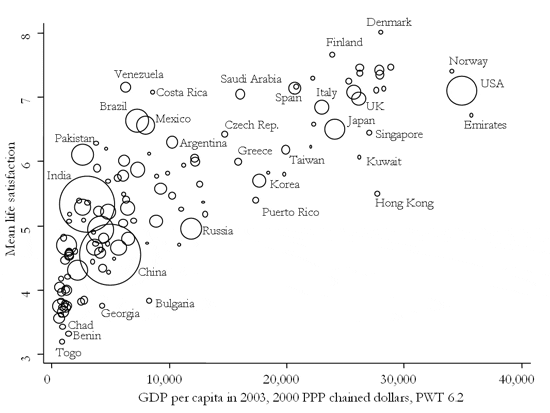
Now at the Gallup website we find Angus Deaton's latest summary of his happiness findings. The important graph is this one:As Deaton explains,
As the graph indicates, life satisfaction is higher in countries with higher GDP per head. The slope is steepest among the poorest countries, where income gains are associated with the largest increases in life satisfaction, but it remains positive and substantial even among the rich countries; it is not true that there is some critical level of GDP per capita above which income has no further effect on life satisfaction. Instead, each doubling of income adds about the same amount to life satisfaction, across poor and rich countries alike.

In fact, a global map of average life satisfaction levels by country based on the Gallup World Poll data looks much the same as an income map of the world: the inhabitants of North America, Western Europe, Japan, Australasia, and Saudi Arabia are rich and well-satisfied with their lives, with average national life satisfaction scores in the range of 7.5- 8.5. The really unsatisfied places on the planet, with life satisfaction scores in the range of 3.1- 4.5, are in sub-Saharan Africa, plus Haiti and Cambodia.
Deaton then goes on to look at why life satisfaction should be so closely related to national incomes. His answer,
A simpler interpretation of the Gallup World Poll findings is that when asked to imagine the best and worst possible lives for themselves, points 10 and 0 on the scale, people use a global standard. Danes understand how bad life is in Togo and other poor places, and the Togolese, through television and newspapers, understand how good life is in Denmark or other high-income countries.
(HT: Will Wilkinson)

Small business and jobs

In a recent message I noted that
Most business in New Zealand are small. According to Roger Kerr in a recent article in the Otago Daily Times there are around 413,000 businesses around the country employing five or fewer employees.
I have now come across a new NBER working paper by David Neumark, Brandon Wall and Junfu Zhang, Do Small Businesses Create More Jobs? New Evidence from the National Establishment Time Series. The abstract of the paper reads:
We use a new database, the National Establishment Time Series (NETS), to revisit the debate about the role of small businesses in job creation. Birch (e.g., 1987) argued that small firms are the most important source of job creation in the U.S. economy, but Davis et al. (1996a) argued that this conclusion was flawed, and based on improved methods and using data for the manufacturing sector they concluded that there was no relationship between establishment size and net job creation. Using the NETS data, we examine evidence for the overall economy, as well as for different sectors. The results indicate that small establishments and small firms create more jobs, on net, although the difference is much smaller than what is suggested by Birch's methods. However, the negative relationship between establishment size and job creation is much less clear for the manufacturing sector, which may explain some of the earlier findings contradicting Birch's conclusions.
So for the US at least, small businesses create more jobs, on net, than larger ones. Reinforcing the importance of the small business sector to the economy.

(HT: Freakonomics)

Incentives matter: smoking ban file

This from Foxnews.com: Minnesota Bars Skirt Smoking Ban by Declaring Patrons as 'Actors',
A new state ban on smoking in restaurants and other nightspots contains an exception for performers in theatrical productions. So some bars are getting around the ban by printing up playbills, encouraging customers to come in costume, and pronouncing them "actors."

The customers are playing right along, merrily puffing away — and sometimes speaking in funny accents and doing a little improvisation, too.
(HT: Market Power)

Buiter on Bhagwati

Willem Buiter offers his view on the Jagdish Bhagwati's article, Obama's free-trade credentials top Clinton's. Buiter's third point is interesting,
Third, Obama is willing to lie about and to deceive the voters about his true views on trade policy and about his future policy intentions, should he be elected president. You can only become the Democratic candidate for the US presidency if you are prepared to act in a dishonest and unprincipled manner. Obama is willing to pay that price. While Obama plays tough cop on NAFTA in Ohio, his chief economic advisor Austan Goolsbee (whom I knew when he was an undergraduate at Yale University and one of the bright young lights guided by Jim Tobin) plays nice cop at the Canadian consulate in Chicago. There’s a useful lesson here for young Austan, one that anyone interested in becoming active in hands-on politics should heed: there is no such things as ‘off the record’.
In so far as it is true that any candidate has to say one thing and do another, you have to ask what are the voters thinking? Why can they not see that a candidate would do this and vote accordingly? If Buiter's point is correct do voters only have themselves to blame?

Friday, 7 March 2008

Underpricing concerts, why?

In an interesting article on the Adam Smith Institute blog, Eamonn Butler talks about The secondary ticket market. Butler writes,
Concerts and sports fixtures underprice their tickets in the belief that this makes them more accessible for the 'real fans' or because promoters earn more from sell-outs.
But why does doing these things make sense? Why underprice for "real fans"? Isn't it likely that the "real fan's" demand will be less elastic than the non-real fans, in which case he should be charged more. Also if a dollar from a non-real fan is the same as a dollar from a "real fan" why underprice? Why not sell the ticket to the non-real fan at a higher price, if he is willing to pay more? [If he is willing to pay more, then who is the real fan?] Sell-outs may increase the profits of a promoter but this does depend on how much you have to drop the price to get a sell-out. For example, if a sell-out is 10 tickets and you can only get the sell-out by charging $1 but can sell 6 tickets at $2, why go for a sell-out? Underpricing doesn't seem to be profit maximising.

This doesn't mean the secondary ticket market isn't a good thing, it is. But I just don't see why promoters price in such a way as to give people the incentive to set up such a market.

A friend of mine suggests the following answer to the problem of underpricing. His argument is that concerts historically were underpriced because they were tie-ins for CD sales. The point was to create buzz around the album, cassette, or CD. You do that by having hard core folks line up for days on end and having the news media report on them. This results in huge amounts of free publicity worth way the more in CD sales than concert revenues foregone. Moreover, the kid who wouldn't pay $100 for a ticket might well pay $50 for a ticket and then buy another $100 worth of tie-in stuff while at the arena: t-shirts and posters and such like, that the people willing to pay more for the ticket would never buy. He also points out that a testable hypothesis for his story is that underpricing of concerts would be largest where CD sales are most important. Compare, say, a jazz or classical music concert to pop music.

Thursday, 6 March 2008

Profit is not a dirty word

"Never speak to me of profit," mid-twentieth century Indian leader Pandit Nehru once said to an industrialist. "It's a dirty word."
(Roger Kerr, "Prejudice against a word", The Otago Daily Times - 16 January 2004.)
Most business in New Zealand are small. According to Roger Kerr in a recent article in the Otago Daily Times there are around 413,000 businesses around the country employing five or fewer employees. Also according to Kerr large businesses, that is those employing 100 or more make up only 0.5% of all businesses, but employ 46% of the total work force. Thus business are important to society as providers of jobs and income. In fact most economic activity takes place within firms, not in markets. Economist John McMillan estimates that less than a third of all transactions in the U.S. economy occur through markets and over 70 percent occur within firms.

Kerr also makes the important point that all these business set out to meet the needs of consumers, that's how they make profit, its how they stay in business. The main function of any firm is to be an efficient producer of goods and services that consumers value. By making what consumers want, at a price consumers are willing to pay, firms make profits. That is, profits are a signal that consumers value the good or service being produced more than the firm values the resources used in its production. They are also a signal to other firms that maybe they should enter the market: in the hope of also making positive profits. In this way profits attract new firms into markets, thereby increasing competition in that market and forcing businesses compete with one another to be more innovative and resourceful and in the process they drive down prices and give better value for the customer's dollar. This competitive process lends to good use of resources, resources are used efficiently to produce the goods and services people want. Such competition would result in profits being driven to zero, in equilibrium, should we ever get there. This in turn tells firms to stop entering the market and to go and look for other, more profitable, ways to apply their resources. It is this constant searching for profit that drives innovation and that has brought lower priced and better quality goods to consumers.

On the other hand losses tell firms the opposite, to stop what they are doing as consumers do not value their goods highly enough to make production worth while. Firms then switch into another line of business or go out of business and their assets are transferred to others who think they can use them in a profitable way. It may seem a harsh way of allocating resources in an economy. But it is the best way we have yet found. Just look at economies, like the old Soviet Union, which tried to allocate resources without the profit motive to appreciate this point.

A subprime primer

Confused about what has been happening in credit markets in the U.S.? No problem, here is a Subprime Primer which explains all the key issues.

Warning: Some of the language may offend.

(HT: Greg Mankiw)

Wednesday, 5 March 2008

Julian Simon videos

Check out this series of videos of the late, great, Julian Simon. Simon foresaw the falling natural resource prices, increased world oil supply, and decline in farmland prices. His view of population economics is unique and persuasive. Discussion covers resources, environment, population growth and his analytical methods.

Marginal Revolution book forum on chapter 9

Fabio Rojas ends the Marginal Revolution book forum on the Logic of Life with a discussion of chapter 9.

Bhagwati on Obama and Clinton

As always Jagdish Bhagwati writes interestingly on trade relayed topics. This time he has an article in the Financial Times on Obama's free-trade credentials top Clinton's. Bhagwati offers five reason for his preferrence of Obama over Clinton,
First, Mrs Clinton, in an infamous interview with the Financial Times, responded to a question on support for the Doha round with the need for a pause, whereas Mr Obama has not done so. Second, whereas Mr Obama’s economist is Austan Goolsbee, a brilliant Massachusetts Institute of Technology PhD at Chicago Business School and a valuable source of free-trade advice over almost a decade, Mrs Clinton’s campaign boasts of no professional economist of high repute. Instead, her trade advisers are reputed to be largely from the pro-union, anti-globalisation Economic Policy Institute and the AFL-CIO union federation.

Third, Mr Obama’s main union support comes from the Service Employees International Union and the Teamsters, neither of which is protectionist: the SEIU’s membership is in the non-traded sector and, except on the issue of Mexican trucks coming into the US, Teamsters do well as trade expands. By contrast, Mrs Clinton’s support comes heavily from the AFL-CIO, which holds strong anti-trade views. This matters because the IOUs you sign during campaigns provide a straitjacket that can restrict your policy options.

Fourth, while Mr Obama’s anti-Nafta rhetoric is disturbingly protectionist, as is Mrs Clinton’s, remember that this is also strategic. If both are anti-Nafta in the campaign now, her opposition is reinforced because she carries the burden of having supported her husband in backing it.

Fifth, Mr Obama has smartly seized John Kerry’s proposal to remove the incentive to invest abroad and has gone further by proposing that those who invest at home will be given a tax incentive. It is dubious that this proposal will survive challenges from existing bilateral and World Trade Organisation agreements, or can achieve much when other countries can do the same. It is exactly the sort of policy that a constituency fearful of losing jobs demands but, by meeting that demand, President Obama would be left free to abandon the anti-trade rhetoric and embrace the multilateral free trade that has served the American and the world interest so well.
At EconLog Bryan Caplan offers an interest take on the Bhagwati view, see Who Will Be Less Bad for Trade?
My assumption is that neither candidate would actively promote free trade, so the greater evil is the candidate who can "get things done." Given Obama's winning personality, and Hillary's divisiveness, I'm fairly confident that Hillary would do less harm. She may want moderately worse policies, but she'd have a lot more trouble getting others to go along with her. (In fact, I suspect that most Republican protectionists would start defending NAFTA just to spite her!) At minimum, Obama would have a one-year honeymoon period to do harm; Hillary would be lucky if her honeymoon lasted a week.
But would it not be better still if whoever does become the next president was just simply in favour of free trade?

(HT: Greg Mankiw)

Allan on Clark

Writing in The Australian, University of Queensland professor of law, James Allan says that Clark needs new zeal and a lot of luck. On the economic front Allan points out
One of the big problems for the Clark Government has to do with comparative economic performance. Soon after coming into office it said one of its main goals was to lift NZ back into the top half of the Organisation for Economic Co-operation and Development league tables in terms of per capita gross domestic product. It hasn't. Indeed, NZ has dropped a place or two down to 20th or 21st. Little mention is made of this pledge by the Government these days.
Roger Kerr made a similar point in a recent Otago Daily Times article,
In response to business criticisms, the government put the emphasis in the 2001 Budget on economic growth: "We need to set ourselves a goal of being back in the top half of the developed world in terms of per capita GDP". Sustained growth of "4% a year or more" was needed to achieve that goal.

Yet the rate of growth is declining steadily and New Zealand has moved down the OECD ladder, not up. Last year journalist Colin James referred to "Clark's now discarded promise to get back into the top half of the OECD income rankings".
On taxes, Allan writes
And taxes are relatively high. The OECD estimates that NZ's general government receipts are running at 45 per cent of GDP. Australia's run at about 35 per cent. NZ is even above the OECD average, one that includes the high-taxing Europeans. So despite a lower top marginal tax rate there, it is a high-tax economy.
When it comes to all important economic growth, Allan notes,
That [tax] affects comparative economic growth rates. During the past decade, as a whole NZ has averaged a 3.3 per cent rate, only a tad behind Australia's 3.4 per cent rate. Not bad at first sight, although during that period Ireland averaged 6 per cent and Singapore 5.8 per cent. The problem is that NZ's economic and productivity growth rates have been declining in that period, with its Treasury now forecasting annual growth of only 2per cent during the next couple of years. That's about half of Australia's expected rate, and at least half what would be needed for a fair number of years to have any hope of getting the Kiwis into the top half of the OECD league tables.
And here is a real issue. Without growth we will not head back up the OECD league table. Without growth the incomes of ordinary New Zealanders will not improve, poverty will not be reduced. There are real costs to policies which do not deliver growth and without changes in policies New Zealand will not see an improvement in its rate of growth. The current government seem more intent on redistributing wealth than creating it. This may in the short term win them votes but the long term affects should not be ignored.

How bad is it when lawyers start making sense?!